
- /
- Article / A Complete Guide to Hot and Cold Chambers: Working, Uses, and Testing Standards
A Complete Guide to Hot and Cold Chambers: Working, Uses, and Testing Standards
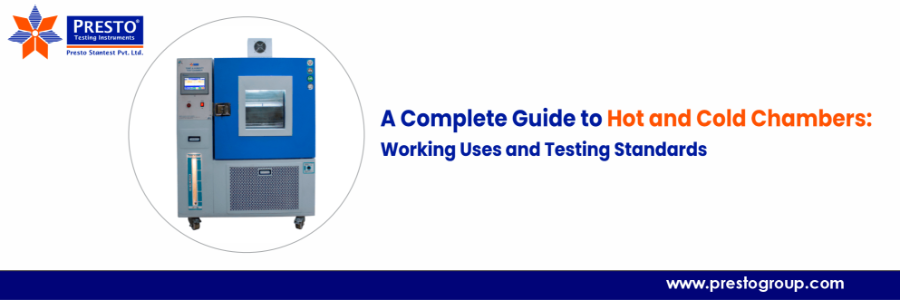
In the field of product development and quality assurance, knowing how materials and components function at various environmental conditions is important. This is where hot and cold chambers come in. Such advanced pieces of equipment are designed so they can provide simulations of a wide range of temperatures to enable producers to conduct real tests of their products in terms of durability, performance, and reliability prior to market release.
What are hot and cold chambers?
Essentially, a hot and cold chamber, or thermal chamber, is an enclosure insulated to retain temperature and regulate it with great precision internally. It is designed to test products under extreme temperatures-both very high and very low-to see how they would react and where their weaknesses may lie. The difference between hot and cold chambers does not lie in their fundamental design but in the range and direction of temperature manipulation they can offer. While many modern chambers can operate both heating and cooling, some older or more specialized units might be solely for one extreme.
These chambers are very important for a number of industries, ranging from electronics and automotive to aerospace and pharmaceutical ones. They enable engineers to accelerate aging processes, simulate real-world use scenarios, and ensure that products will be able to resist the most extreme conditions of their intended environments.
How Do They Work?
The principle of operation of the hot and cold chamber involves a set of heating, cooling, and control systems.
- Heating: Generally, heating is done by electric heaters, which may be located in such a way as to distribute the temperature uniformly inside the test space.
- Cooling: At low temperatures, mechanical refrigeration systems are used, which can include anything from mechanical refrigeration-a common example would be a refrigerator or air conditioner-to cryogenic cooling with liquid nitrogen or carbon dioxide for extremely low temperatures. In this, the cooling system takes away heat from the chamber in order to lower its internal temperature.
- Air Flow: The test environment usually has fans and/or blowers installed to achieve uniform temperatures. Without air flow, temperature gradients will be produced, which are detrimental to testing results.
- Control System: A complex control system, normally microprocessor-based, accurately programs the internal temperature.
Who is using Hot and Cold Chambers and for what purposes?
Many different types of industries are employing hot and cold chambers for highly significant testing.
- Electronics Industry: The industry will test the reliability of components under extreme operating conditions, such as circuit boards, sensors, and displays, to identify device failure in smartphones, laptops, medical equipment, and more.
- Automotive Industry: The integrity of vehicle components, ranging from engine components to interior plastics, its ability to withstand the environmental changes they will experience during their lifecycle. A method of testing this is through thermal shock, which is the process of quickly moving materials in and out of hot and cold environments.
- The performance of materials and systems in the harsh conditions of space or high altitudes needs to be qualified.
- Pharmaceuticals: The testing of drugs and vaccines for stability, in order to maintain their efficacy at different storage temperatures.
- Materials Science: The characterization of thermal expansion, contraction, and overall behavior in new materials.
One common application beyond general temperature testing is hot chamber and cold chambers die casting. While unrelated to environmental testing chambers, the terms themselves denote quite clearly that, even in manufacturing processes, control over temperatures remains important. In die casting, the temperature of the molten metal in contact and the temperature of the die itself make much difference in the quality of the final product. Understanding the nuances of "hot" and "cold" processes here, even if different from environmental chambers, emphasizes how wide-reaching the relevance of thermal control really is.
Testing Standards and Specifications
Various national and international standards outline the use and performance of hot and cold chambers to ensure consistency and comparability of test results. These standards define parameters, including:
- Temperature Stability: The amount the chamber can remain stable at the temperature set point before significant variations in temperature occur.
- Ramp Rates: How fast the chamber changes between different temperatures.
Some of the known standards bodies include:
- ASTM - American Society for Testing and Materials - publishes many standards to environmental testing.
In searching for a hot and cold chamber supplier, it is important that their products meet applicable industry standards and will be able to supply the exact temperature ranges and capabilities required in your testing needs. Reputable suppliers will offer chambers with precision control, solid construction, and extensive calibration services. A quality hot and cold machine investment is an investment in product reliability and, ultimately, customer satisfaction. The hot and cold chambers, respectively, is a necessary tool in modern manufacturing and research. Precision in simulating extreme temperatures lets industries develop products that are stronger, more reliable, and perform better to withstand the diverse environmental rigors they will face.
Achieve top-tier product reliability with our advanced Hot and Cold Chambers. Conduct precise performance testing, meet global standards, and streamline your quality assurance process. Connect with our experts today for tailored solutions and fast assistance. Call +91 9210 903 903 or email info@prestogroup.com to get started!