

- /
- Article / What is a Colorimeter? A Complete Guide to Color Measurement
What is a Colorimeter? A Complete Guide to Color Measurement
Color plays a really important role in many industries, whether it’s healthcare labs, research work, or even food and textile manufacturing. Getting the color intensity and concentration right is actually very important for maintaining quality and consistency. This is where a colorimeter comes into use.
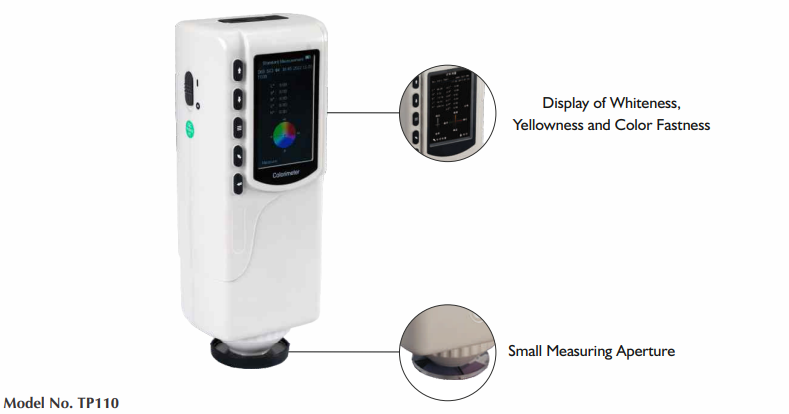
A colorimeter is basically a device used to check how much of a colored substance is present in a solution. It works on a simple idea — light gets absorbed when it passes through a liquid, and based on that, we can estimate the concentration. You’ll usually see it being used in chemistry labs, biochemistry work, pharma testing, and even in environmental checks.
What is a Colorimeter?
A colorimeter is just a simple device used to find out how much colored substance is present in a solution. It doesn’t do anything too complicated — it basically checks how much light gets absorbed when it passes through the liquid. From that, you can figure out the concentration. You’ll usually see it in labs or industries where quick testing is needed.
What is Colorimetry?
Colorimetry is more like a method than a device. It is used to estimate concentration based on the color you see in a solution. The idea behind it comes Beer Lambert’s law. In very simple terms, if the solution is darker or more intense and it means it is absorbing more light, which usually means higher concentration. The distance the light travels also affects it a bit.
Working Principle of Colorimeter
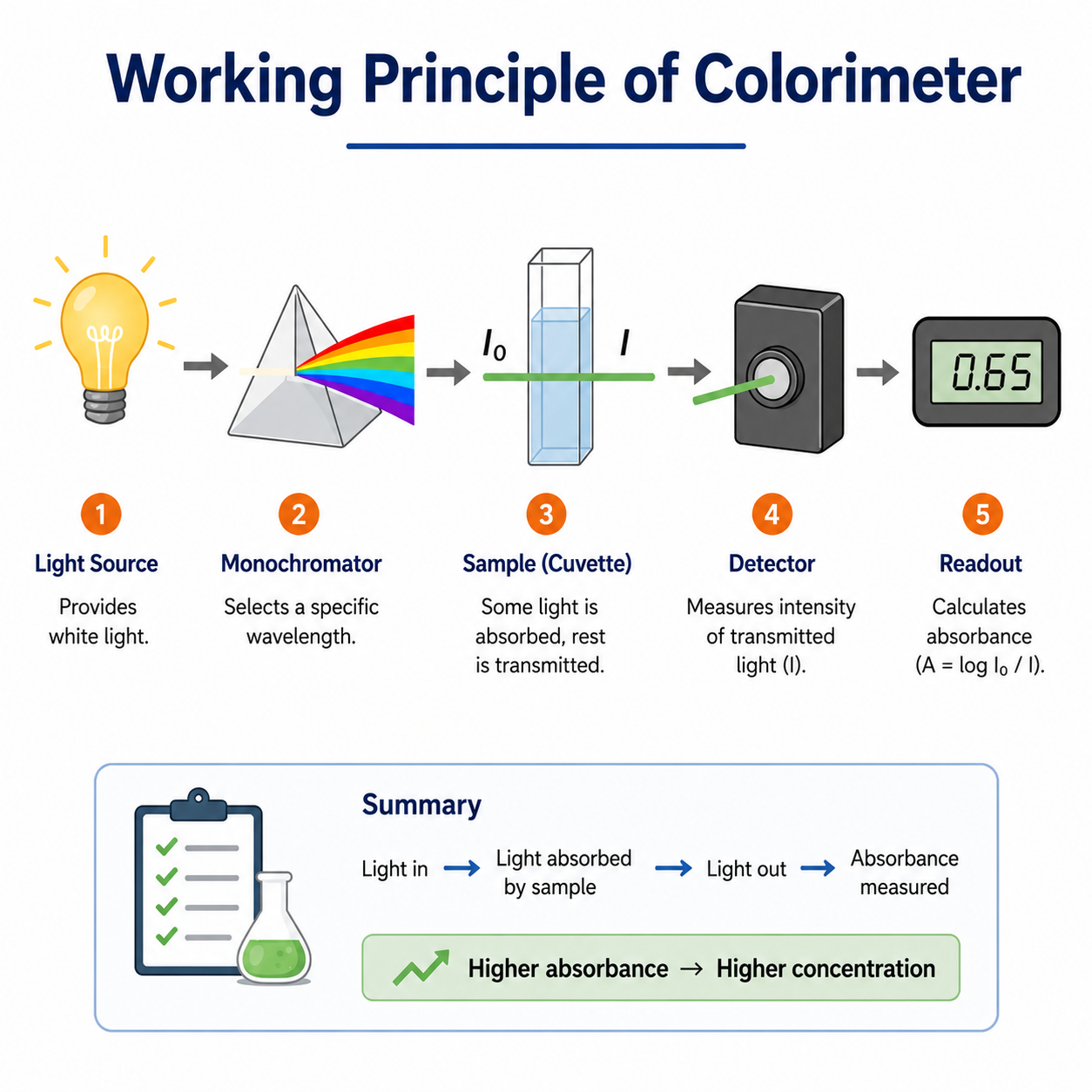
The working principle of a colorimeter is based on Beer Lambert’s law and working is not that hard to understand. A colorimeter sends light of a specific wavelength through the sample. Some part of that light gets absorbed, and the rest passes through. Now, if the solution is more concentrated, it will absorb more light — that’s the basic idea. The device measures this difference and uses it to estimate concentration. Once you get this concept, the rest feels quite simple.
Principle of Colorimeter in Biochemistry
In biochemistry labs, colorimeters are used pretty often. Like when you’re testing proteins or enzymes, usually a reagent is added first, and that causes a color change in the solution. After that, the device just checks how strong or dark that color is. Based on that, you can estimate the concentration. It’s not really a complicated process, but it works well for routine lab work.
Colorimeter Formula
The absorbance (A) of a solution in a colorimeter is determined using the Beer-Lambert Law, which is expressed as:
A = εcl
Where:-
- A = Absorbance
- ε = Molar absorptivity (a constant for each substance)
- c = Concentration of the solution
- l = Path length of the light through the solution
This formula allows researchers and scientists to calculate the concentration of an unknown solution by measuring its absorbance.
How Does a Colorimeter Work?
A colorimeter works by shining a beam of light of a specific wavelength through a sample solution. The process involves the following steps:-
- Light Source: A tungsten lamp or LED emits light.
- Filter Selection: The color filter selects the appropriate wavelength for analysis.
- Cuvette Placement: The sample solution is placed in a transparent cuvette.
- Light Absorption: The light passes through the sample, and some wavelengths are absorbed while others are transmitted.
- Detection: A photocell detects the intensity of transmitted light.
- Data Display: The instrument calculates absorbance and displays the result, which can be used to determine concentration.
Parts of a Colorimeter
A colorimeter consists of the following essential parts:-
- Light Source – Provides the necessary illumination, usually a tungsten lamp or LED.
- Filters – Selects specific wavelengths of light to pass through the solution.
- Sample Holder (Cuvette) – Holds the test solution in a transparent container.
- Detector (Photocell) – Measures the intensity of transmitted light.
- Display and Output – Shows the absorbance or transmittance values.
Colorimeter Diagram
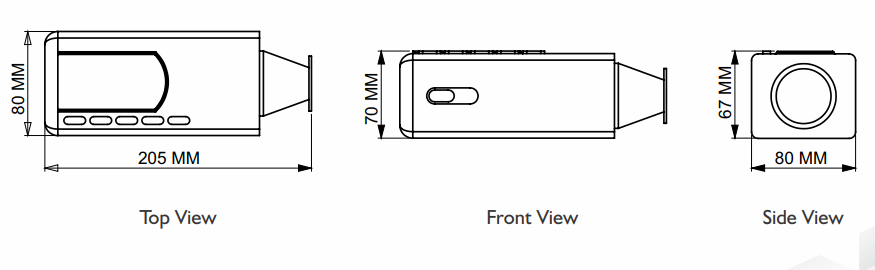
A colorimeter diagram usually shows the basic parts of the device, like the light source, filter, sample holder, and detector. It gives a rough idea of how light actually passes through the solution and how the detector measures the light that comes out to find absorbance. Looking at this kind of diagram makes things easier to understand, especially when you’re trying to see how it works in real use, like in pharma labs, food testing, or environmental checks.
Types of Colorimeters
There are various types of colorimeters, each designed for specific applications:
- Visual Colorimeter – Requires human observation to compare colors against standard solutions.
- Photoelectric Colorimeter – Uses a photocell to measure light intensity and calculate concentration automatically.
- Portable Colorimeter – A compact, handheld device used in field testing.
- Digital Colorimeter – Provides precise and quick digital readouts of concentration values.
Uses of Colorimeter
A colorimeter is an essential device used to measure the concentration of colors in a solution based on light absorption. It has wide applications across various industries:
- Water and Chemical Analysis: Helps in testing water quality by detecting pollutants like chlorine and fluoride.
- Food & Beverage Industry: Ensures color consistency in food products, beverages, and dyes.
- Pharmaceutical & Medical Use: Measures hemoglobin levels in blood and analyzes urine samples for diagnosis.
- Textile & Paint Industry: Maintains color accuracy in fabrics, paints, and printing processes.
- Agriculture & Soil Testing: Analyzes soil nutrients and plant health through chlorophyll measurement.
- Environmental Monitoring: Detects pollution levels in air and water. Cosmetic Industry: Ensures consistency in makeup and skincare products.
Colorimeters play a crucial role in research, quality control, and industrial applications, ensuring precision and standardization.
Spectrophotometer vs Colorimeter
A spectrophotometer and a colorimeter are both instruments for color analysis, but they have distinct differences:-
| Feature | Colorimeter | Spectrophotometer |
| Light Source | Uses filters for specific wavelengths | Uses a diffraction grating to analyze a full spectrum |
| Accuracy | Suitable for routine analysis | Provides high-precision data |
| Range of Wavelengths | Limited to visible light | Measures UV, visible, and IR regions |
| Applications | Basic color measurement | Advanced scientific research and pharmaceutical applications |
Difference Between Colorimeter and Spectrophotometer
The key difference between a colorimeter and a spectrophotometer is that a colorimeter measures absorbance at a single wavelength, while a spectrophotometer provides a full spectrum analysis across multiple wavelengths.
How to Choose the Right Colorimeter
A few things actually matter here:
What are you measuring? Make sure the instrument has a filter (or LED) at the right wavelength for your analyte. If you're doing multiple different tests, you need a model with multiple filter options or a broad enough selection.
Lab use or field use? Benchtop models offer more features, better stability, and usually better data output. Portable models trade some of that for convenience and battery operation. Don't buy a benchtop if you need to test samples on-site.
How much data do you need to record? If you're doing compliance testing or research, look for instruments with data logging, USB output, or software connectivity. If it's just a quick check, a simple display readout may be enough.
Cuvette size compatibility — most instruments use 10 mm path length cuvettes, but confirm this, especially if you're already using a specific cuvette type.
Ease of calibration — some instruments make blank calibration more straightforward than others. If multiple operators will use it, simpler is better.
Calibration of a Colorimeter
Calibration is the step that most errors trace back to, whether directly or indirectly.
The standard procedure: prepare a blank solution — usually distilled water or the solvent used for your samples, without the analyte — place it in the cuvette, and zero the instrument against it. This sets the baseline so that any absorbance you measure in your samples is purely due to the substance of interest, not the solvent itself.
After zeroing, run your calibration standards — solutions of known concentration — and record their absorbance values. Plot these to get your calibration curve. Then measure your unknowns and read their concentrations off the curve.
A few things that affect calibration quality: the purity of the blank solution, the accuracy of your standard concentrations, and whether the cuvette is clean and properly positioned, and whether the instrument has been allowed to warm up and stabilise before use. Rushing through calibration is the single most common source of unreliable results.
Sources of Error in Colorimetry
Sometimes the issue is not with the machine but small mistakes. Like using a cuvette that isn’t clean, or there are bubbles in the solution. Even touching the glass with fingers can affect the reading. Also, choosing the wrong wavelength can mess things up. So yeah, small things matter here more than expected.
FAQs
Q1) What is a colorimeter used for?
Ans: A colorimeter is used to measure the concentration of colored compounds in a solution by determining its absorbance at specific wavelengths.
Q2) What is the principle of colorimeter?
Ans: It works on something called Beer-Lambert’s law. Basically, if the solution is more concentrated, it will absorb more light. The distance the light travels also affects it.
Q3) Why is colorimetry used?
Ans: Colorimetry is used in a lot of areas where you need to measure concentration. Like in lab work, environmental testing, food industry, and even some industrial processes.
Q4) What is Beer's law of colorimetry?
Ans: Beer’s law just explains the relation between absorbance, concentration and path length. In simple words, higher concentration usually means more light is absorbed.
Final Thoughts
A colorimeter is one of those tools that just makes things easier when you need to check color intensity, whether it’s lab work or some industrial use. Once you get a basic idea of how it works and where it’s used, choosing the right one doesn’t feel that confusing. A spectrophotometer is more advanced, but honestly, for most regular testing, a colorimeter is enough and also easier on the budget.
If you’re planning to get one, just go through a few options, compare what they offer, and pick the one that feels right for your use.
Colorimeter Price
The colorimeter price varies based on its type, features, and brand.
For detailed pricing information and to request a quote, please contact Presto Group directly at +91-9210 903 903 or email info@prestogroup.com. Their team will provide you with the most accurate and up-to-date pricing based on your specific requirements.
Accurate Results | Trusted by Industry Leaders | Fast Delivery
Further Reading for You
Colorimeter Explained: How It Works, Types, and Uses in Industries
Colorimeter – Definition, Parts, Working, Uses, and Advantages
How to Use a Portable Spectrocolorimeter for Color Testing
Test The Colors Of Tomatoes With Highly Effective Color-Measuring Instruments
Test The Vibrancy Of Colors With High-Quality Of Color Matching Devices
Ice Cream Colour Measurement: A Complete Guide with Spectrophotometers
Recent Articles
- Climatic Chamber: Working Principle, Uses, Diagram, Price & Top Manufacturers in India
- Izod vs Charpy Impact Test: Difference, Method & Standards
- Colorimeter vs Spectrophotometer: Accuracy, Working Principle, and Industrial Uses
- Quality Assurance and Quality Control: Two Pillars of Product Excellence
- Hardness Test: Types, Testing Methods, Procedures, and ASTM Standards

Need more information
Connect with us for your business enquiries. Generally, we respond within one or two working days.