- /
- Blog / Evaluate Bursting Strength Of Corrugated Boards As Per TAPPI Standards
Evaluate Bursting Strength Of Corrugated Boards As Per TAPPI Standards

Quick Summary
Corrugated boxes are a part of the packaging and shipping business. Their strength determines whether your product gets to where it needs to go without getting broken. This blog talks about what the Bursting Strength Test is, how it is performed following TAPPI standards, which TAPPI methods are used for materials, and why testing the bursting strength of a 5-ply corrugated box (or any other number of plies) is important for companies that make boxes. Written in words that are easy to understand, this guide is for anyone—people who are just starting out in quality control and people who have been working in packaging for a long time—who wants to learn how the strength of corrugated board is checked.
Introduction
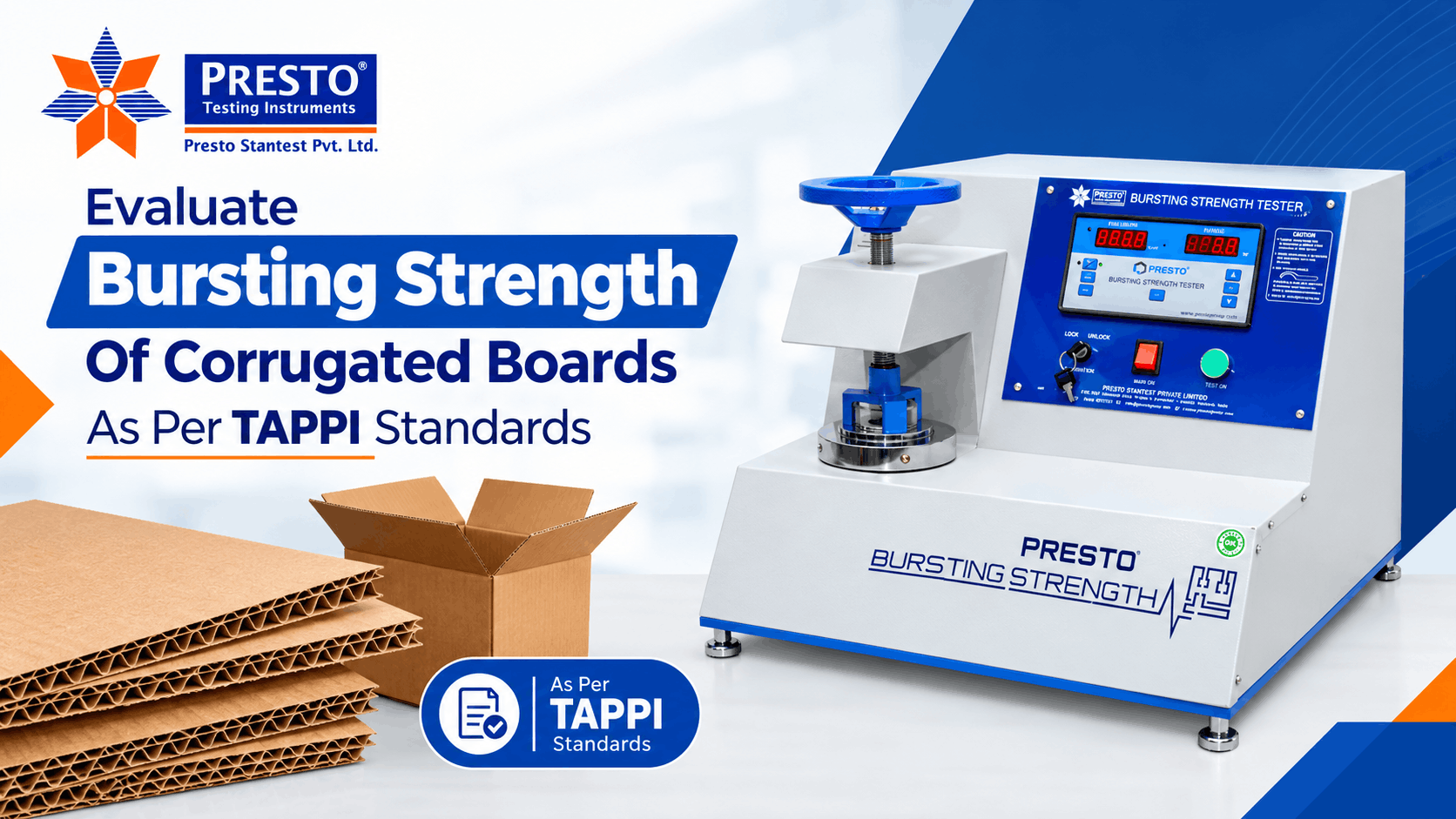
Various national and international standardization authorities like ASTM, ISO, BIS, TAPPI, offers the list of standards that comprises of various test methods and procedures to test the quality of corrugated boxes. The ideal standards to measure the Bursting Strength as per TAPPI standard are TAPPI/ANSI T 810 om-11, TAPPI/ANSI T 810 om-11, TAPPI T 807. Out of these methods, TAPPI/ANSI T 810 om-11 is used to measure the bursting strength of corrugated sheets.
The test method clearly describes the test procedure to measure the bursting strength of the single wall and double wall corrugated boxes having the range from 100 psi to 700 psi or 690 kPa to 4825 kPa. As per the TAPPI standard of measuring bursting strength, the instrument comprises of a disk-shaped molded diaphragm. The double walled and single walled corrugated board can be tested with the device considering that the single board comprises of two faces with one fluted medium in between, and the double wall corrugated board comprises of three faces and two fluted mediums.
How Can Prest Help?
Presto is a well-known company in the area of testing and packaging instruments. The company makes equipment that follows quality standards. For years, Presto has worked with industries such as packaging, paper, corrugated boxes, plastics, and textiles. Presto is famous for combining engineering with simple operation. The company offers a range of products. These include bursting strength testers and compression testers. They also have heat sealers and impact testers. All of these tools help manufacturers check the quality of their materials before making large quantities of products. Presto instruments are made considering TAPPI, ASTM, ISO, and BIS standards. This means companies do not need to worry about missing any rules when they show test reports to customers, auditors, or government agencies. Presto does more than sell machines. The company wants to be a long-term partner in quality. Presto helps with choosing the instruments. They also offer support with calibration and after-sales service. This helps testing labs work for many years.
What Is the Bursting Strength Test?
In terms, a bursting strength test measures how much pressure a corrugated board can take before it bursts open. Think of it like this—if you keep pressing a balloon, at some point it pops. The test works on an idea, except instead of air, hydraulic pressure is applied evenly to a corrugated board sample until it gives way.
Unlike some packaging tests that only look at one direction of force, bursting strength gives a broader picture since the pressure is applied evenly across the entire surface of the sample rather than at a single point. This makes it especially useful for predicting how a box will behave when it's compressed from sides at once, such as when it's stacked deep inside a shipping container or loaded onto a pallet with other boxes pressing against it. Because of this around pressure application, bursting strength is often considered one of the more reliable indicators of a corrugated board's overall toughness alongside other measures like compression strength and puncture resistance.
It's also worth noting that bursting strength isn't about the outer liner of the board—the fluted medium sandwiched between the liners contributes significantly to how much pressure the board can take. This is one reason why boards with flutes and layers, like a 5-ply corrugated box, tend to perform differently compared to simpler single-wall constructions.
TAPPI Standards Used for Bursting Strength
TAPPI, which stands for Technical Association of the Pulp and Paper Industry, provides a group of test methods that change depending on the type of material being tested. TAPPI gives an overview of these methods.
| TAPPI Standard | Material Tested | Purpose |
| TAPPI/ANSI T 810 om-11 | Corrugated boards (single & double wall) | Measures bursting strength of corrugated sheets. |
| TAPPI T 807 | Linear/linerboards | Measures bursting strength of linerboard material. |
| TAPPI T 403 | Paper | Measures bursting strength or bursting factor of paper. |
Looking at the table, the method used changes a lot depending on what you test. Is it a corrugated board, a linerboard, or plain paper? That is why knowing bursting strength according to the TAPPI standard is very important before you choose the test procedure for your product. Knowing bursting strength helps you pick the method used for each material.
Test Method as per TAPPI/ANSI T 810 om-11
The TAPPI/ANSI T 810 om-11 method clearly explains how to measure the bursting strength of both single‑wall corrugated boxes and double‑wall corrugated boxes. The TAPPI/ANSI T 810 om-11 method test covers a pressure range from 100 psi to 700 psi (690 kPa to 4825 kPa). This range works well for kinds of boxes and for boxes that have different thicknesses. For example, a 5‑ply corrugated box normally has a higher bursting strength because it has more layers and is more rigid. That high strength often appears at the end of the pressure range.
According to the TAPPI standard, for measuring bursting strength, the testing instrument uses a disk-shaped diaphragm. This diaphragm is very important because it's the part that pushes directly against the corrugated sample during the test. It’s the component that applies pressure steadily and accurately.
It's worth understanding the basic structure of the boards being tested:
| Board Type | Structure |
| Single-Wall Corrugated Board | Two faces (liners) with one fluted medium in between. |
| Double-Wall Corrugated Board | Three faces (liners) with two fluted mediums in between. |
| 5-Ply Corrugated Box | Multiple liners and flutes layered together for extra strength. |
When a corrugated board has layers or more plies, it usually becomes more resistant to bursting. That is why the bursting strength of a 5‑ply corrugated box is measured in a specific way. The expected pressure ranges for a 5‑ply corrugated box are not the same as those for a standard single‑ or double‑wall corrugated board.
How the Bursting Strength Test Is Performed
To perform the bursting strength as per TAPPI standards, the specimen is clamped between the two plates with circular opening the centers. The lower plate of the instrument is fixed whereas the upper clamp can be adjusted and remain stationery to perform the test until the specimen bursts. The instrument comprises of an expanded diaphragm on the lower clamp through which the hydraulic pressure is provided to the specimen until the specimen burst. The pressure at which the specimen burst is recorded by the instrument.
To evaluate the bursting strength or bursting factor of the paper, TAPPI has provided TAPPI T 403 and for linear boards TAPPI 807.
Here's a simple step-by-step look at how the bursting strength test works, as per TAPPI/ANSI T 810 om-11:
| Step | What Happens |
| 1 | The corrugated board specimen is clamped between two plates, each with a circular opening at the center. |
| 2 | The lower plate of the instrument remains fixed in place. |
| 3 | The upper clamp is adjusted and held stationary during the test. |
| 4 | Hydraulic pressure is applied through an expanded diaphragm on the lower clamp. |
| 5 | Pressure keeps increasing steadily until the specimen bursts. |
| 6 | The instrument records the exact pressure at which the specimen bursts. |
Why Bursting Strength Testing Matters for Manufacturers
- Prevents shipping damage. Boxes that pass the bursting strength test are less likely to break or rip while being shipped.
- Ensures consistency. Testing on a batch basis helps make sure the quality is the same in every group of boxes that are made.
- Builds customer trust. A box that handles handling shows that the brand that ships it is reliable.
- Supports compliance. Following the TAPPI, ASTM, ISO, or BIS standards helps manufacturers stay in line with what the industry expects and what customers want.
- Reduces returns and complaints. Fewer broken packages mean fewer people asking for money back or new products and fewer unhappy customers.
Whether it's a single-wall box or a heavier 5-ply corrugated box, high bursting strength testing makes sure the packaging fits the product inside. It also confirms the package can handle the way it will be moved, stored, and delivered to the customer. Every step of the journey matters, and the packaging must keep up.
There is also a money side that is often forgotten. Making a box too strong by using material or more layers than needed increases the cost of materials. This can be avoided. If the box is not strong enough, it might. Cause products to be returned. Testing the strength of the box regularly helps companies find the right level. They use enough material to keep the product safe without spending extra. This is very important for companies that send boxes. Even a small saving on each box can make a difference when you have thousands of boxes.
Industries that rely heavily on corrugated packaging—such as moving consumer goods, electronics, and pharmaceuticals—often make their own internal rules for bursting strength. These rules usually follow TAPPI standards. They look at how a package moves and how it is handled. How high it is stacked in warehouses. That is why bursting strength testing isn't something you do once and then ignore. It is part of quality control. It changes when materials change, when suppliers change, or when shipping conditions change. You have to keep testing.
Conclusion
The Bursting Strength Test is very important in making sure corrugated boxes actually work the way they are supposed to—keeping the product inside safe all the way from the factory to the delivery point. By following TAPPI standards like T 810 om-11, T 807, and T 403, manufacturers have a standard way to measure how much pressure their boards can take. Whether you are testing a single-wall box or checking the bursting strength of a 5-ply corrugated box, having the right testing instrument is very important. It makes the difference between guessing and knowing for sure that the quality is good. Presto’s testing equipment is made to make this process accurate, easy, and always in line with the standards.
Experience perfection with world-trusted testing equipment. Contact us today!
FAQs
1. What is the Bursting Strength Test used for?
It measures the pressure needed to break paper, paperboard, or corrugated board. This test helps understand how strong the material is.
2. Why is bursting strength important for corrugated packaging?
It helps manufacturers make sure the board can handle being pushed or squeezed without breaking during the time it is being handled, stored, and moved.
3. How is bursting strength measured?
A test specimen is held in place by the tester. Then hydraulic pressure is applied through a diaphragm. This continues until the material breaks. The pressure at the moment of break is written down.
4. Is bursting strength the only test needed for corrugated boxes?
No. Depending on the use case, manufacturers may also use tests such as edge crush, box compression, puncture, and drop testing. These tests help manufacturers evaluate aspects of box performance.
Recent Blogs
- Industrial Leak Testing: Methods, Technologies, Benefits, and Industry Applications
- Autoclave in Laboratories and Industry: Principle, Procedure, Components, and Applications
- Uses of BST in Packaging, Paper, and Corrugated Box Testing
- Leak Testing Procedures for Packaging Materials in Accordance with ASTM D6653
- Bursting Strength Testing: ASTM, ISO, and TAPPI Standards for Packaging Evaluation