

- /
- Blog / How Does the TAPPI T 494 Standard Measure Paper Tensile Strength?
How Does the TAPPI T 494 Standard Measure Paper Tensile Strength?
What is TAPPI T 494?
The TAPPI T 494 is a worldwide test method that measures the tensile properties of paper and paperboard with the use of a constant rate of elongation tensile tester.
The test method targets four different properties: tensile strength, stretch, tensile energy absorption, and tensile stiffness.
The test method is applicable to almost all types of paper and paperboard, excluding combined corrugated board. This method is used in packaging, printing, and specialty papers, especially in those that experience breaks or tears, which have financial consequences.
Why Tensile Strength Matters to Investors
A paper that fails in a press line or packaging line is a problem, resulting in lost production, waste, and customer complaints. Consistent tensile strength information, as determined by TAPPI T 494, helps assure investors that your rolls can stand up to high-speed converting and handling.
For investors, this standard turns mechanical behavior into comparable numbers.
Those numbers support decisions about capacity upgrades, new Paper tensile strength testing equipment, or backing a higher‑margin, higher‑performance grade portfolio.
Equipment Used in TAPPI T 494
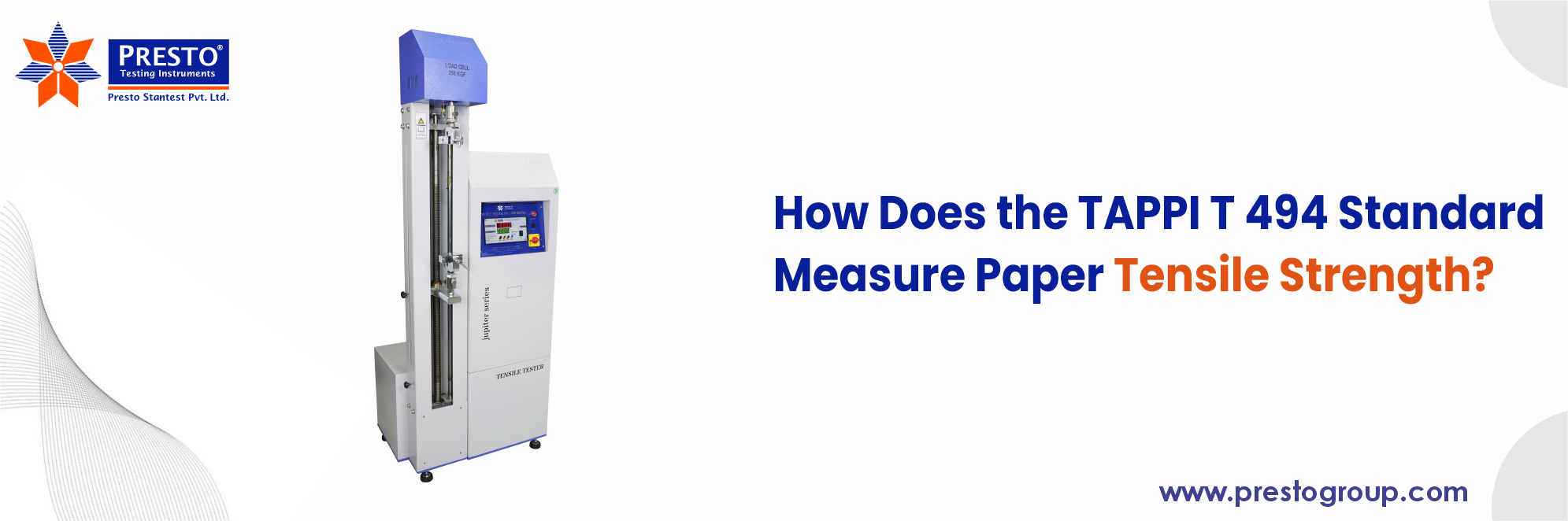
The method requires a constant‑rate‑of‑elongation Paper tensile strength tester that pulls a narrow strip of paper until it breaks.
In modern labs, this is usually a Universal testing machine for paper with digital controls and software.
Typical setup under TAPPI T 494:
- Gauge length: 180 mm between grips
- Strip width: 15 mm or 25 mm, depending on setup
- Speed: set the extension rate so it is constant through the test
- Grips: flat jaws with controlled pressure to avoid slippage or jaw breaks
A modern Digital tensile strength tester collects the full load–elongation curve and calculates tensile strength, stretch, TEA, stiffness, and often breaking length automatically.
Key Tensile Properties in TAPPI T 494
| Property | What it measures | Why investors should care |
| Tensile strength | Maximum force per unit width before rupture | Indicates web break risk and overall sheet strength |
| Stretch | Percent elongation at break | Shows how well paper survives uneven stresses |
| Tensile energy absorption | Energy absorbed before break (TEA) | Critical for sacks, tapes, demanding packaging |
| Tensile stiffness | Ratio of force to strain (slope of elastic region) | Relates to runnability, feel, and deformation |
| Breaking length / index | Strength normalized to grammage | Enables fair comparison across different basis weights |
These parameters together describe how a sheet behaves from first loading to final failure.
For capital allocation, this supports claims about premium performance, downgauging potential, and line stability.
Sample Preparation in TAPPI T 494
Accurate testing starts with proper sample preparation. Paper strips must be cut with consistent dimensions and conditioned under standard temperature and humidity.
Typical Sample Specifications
- Sample width usually 15 mm or 25 mm
- Length long enough to fit between grips
- Edges must be clean and straight.
Environmental conditioning is also important. Paper properties change with moisture levels. Standard testing conditions are typically:
- Temperature around 23°C
- Relative humidity about 50 percent
Once samples are conditioned, they are ready for testing.
Step-by-Step: How T 494 Tests for Tensile Strength
Basic principle: Clamp a strip, pull it at a constant rate, and record the breaking point.
TAPPI T 494 makes it an exact, reproducible procedure.
1. Sampling and conditioning
Paper is sampled, cut into strips of known width, and conditioned at known temperature and humidity before testing.
This minimizes effects due to moisture content, etc., and makes the results depend only on the grade.
2. Mounting the specimen
The operator sets the grip separation (gauge length) to 180 mm and aligns the strip straight in the grips.
Grip pressure is tuned so the strip does not slip or break right at the jaws.
3. Applying the tensile load
The Universal testing machine for paper pulls the strip at a constant rate of elongation until rupture.
The machine records force and extension continuously, generating a load–elongation curve.
4. Calculating tensile strength
The maximum force at break is divided by the specimen width to give tensile strength, typically in kN/m.
Software can also convert this to tensile index or breaking length when grammage is entered.
5. Deriving other properties
From the same curve, the system calculates stretch at break, TEA (area under the curve), and tensile stiffness (slope in the elastic region).
The result is a compact data set that connects micro‑level fiber bonding to macro‑level machine and end‑use behavior.
How to Read the T 494 Results
Higher tensile strength usually means fewer web breaks and better runnability in printing or coating.
However, investors should also watch stretch and TEA, especially for sacks, envelopes, and pressure‑sensitive products.
- High stiffness with low stretch can feel premium, yet may be brittle in demanding logistics.
- Moderate stiffness with good stretch and TEA can support downgauging without loss of performance.
Breaking length and tensile index normalize strength to grammage, which helps compare different products in a portfolio.
This normalization is useful for assessing whether a new lightweight grade truly delivers equal or better functional strength per unit mass.
Choosing the Right Tester: Strategic Questions
When evaluating equipment businesses or capex projects, a few questions usually matter more than brand names.
Key angles to look at:
- Does the Paper tensile strength tester comply with TAPPI T 494 and related ISO or ASTM methods?
- Can the Universal testing machine for paper handle current grades and future higher‑strength or specialty products?
- Does the Digital tensile strength tester capture complete curves and integrate with LIMS or plant MES for traceability?
- How competitive is the Tensile testing machine price relative to accuracy, throughput, and automation level?
- Is the supplier a proven Digital tensile strength tester manufacturer with service coverage in key mills and regions?
Future Trends in Paper Strength Testing
Testing technology continues to evolve with digital systems and automation. Modern testers now include:
- AI-based data interpretation
- Automated sample analysis
- Cloud-based reporting
- Advanced force sensors
These improvements enhance accuracy and simplify laboratory workflows. As packaging standards become stricter, advanced paper tensile strength testing systems will play an even bigger role in quality assurance.
Improve Your Paper Quality Testing Today
Investors who understand this test can better judge which producers and equipment makers convert lab data into a durable competitive advantage.
Now is a good moment to:
- Review how portfolio companies document their tensile testing and standards compliance.
- Ask for recent T 494 reports alongside commercial KPIs for packaging or printing grades.
- Map which assets might benefit most from upgraded Paper tensile strength testing capability
The next funding round, equipment upgrade, or acquisition can then lean on more than a promise. It can lean on tensile curves, breaking lengths, and a clear link from TAPPI T 494 data to market performance.
Contact Presto Group Today!
A business that controls tensile performance under TAPPI T 494 controls risk, brand reputation, and is a key part of its technical story. Get in touch with us to learn more about the latest paper testing devices.
Call us: +91 9210903903
Email: info@prestogroup.com
Visit: www.prestogroup.com
Recent Blogs
- How Does the TAPPI T 494 Standard Measure Paper Tensile Strength?
- Why Is Torque Control Essential in Bottle Cap Testing?
- Precision in the Air: How Humidity Chambers Enable Reliable Lab Testing
- Why ASTM D642 Standard Matters in Box Compression Testing
- Flexible Packaging & Pouch Testing Instruments Seal Strength, Barrier & Durability Testing


Related Blogs

Tensile Testing Tactics: Strengthening Your Product's Durability
The basic principle of having a good tensile strength tester is that one will know how much load his fabric can take before tearing it into pieces.
.png)
The Importance of Tensile Testing in Manufacturing
Manufacturing is a complex and intricate process that requires precision, accuracy, and attention to detail. A tensile strength test is one of the quality tests that will be performed on the material to determine the failure of the product when tensile force is applied to it. By performing tensile tests on the materials, manufacturers can easily discover the yield strength, ductility and other related properties of the materials with ease

Tensile Testing Machine to Measure Strength of Rubber
Tensile Testing is one of the prominent and flexible solutions to determine the quality index of the material. Also, it helps to study the behavior and properties of material against load.

What is Tensile Testing? Its Significance & Applications!
Tension testing or tensile testing is one of the most performed mechanical tests in manufacturing units. It is to analyze the physical properties of the material?s specimen for a better result in the production of the final product.