Why Products Need Protection from Moisture and Heat?
Many products, including those in the pharmaceutical, medical device, and industrial sectors, are very sensitive to moisture, humidity, and germs. Items such as instruments, powders, petroleum‑based products, and other heat‑tolerant tools need a sterilization method that removes germs without adding moisture that could harm the quality of those products. That is exactly where dry heat sterilization becomes very useful.
Dry heat sterilization works by using air to kill tiny living things. Unlike using steam, like some other methods, this approach is good for things that might get ruined or rust if they get wet. Deciding whether to use heat or moist heat allows labs and companies to make sure their products are clean and safe, without ruining what they are making.
What is dry heat sterilization?
Dry heat sterilization is a method that tests and sterilizes products. It places products in a chamber. Exposes them to high temperatures for a set period. The period usually ranges from one and a half to three hours. The exact length depends on the temperature chosen and on the material being treated. Dry heat sterilization is different from moist heat sterilization. Dry heat sterilization uses dry heat. Dry heat sterilization removes microbes, contaminants, and microorganisms from the surface. The inner layers of a product.
How can dry heat sterilization be performed?
Dry heat sterilization can be performed using two different strategies:
Static Air Type
Force Air Type
The static air type is known for sterilization that is performed using ovens that comprise heating coils on the bottom of the device to create hot air inside the chambers with the help of gravity convection. This type of sterilization helps to maintain a consistent temperature throughout the oven.
How do sterilizers work?
Sterilization is done by conducting a test using a testing instrument known as Hot Air Oven. During the test procedure, the product which is placed for sterilization captivates the heat on the outer surface of the material and then allows the heat to enter layer by layer. After the procedure, the complete material reaches a level of required temperature to carry on the sterilization procedure easily.
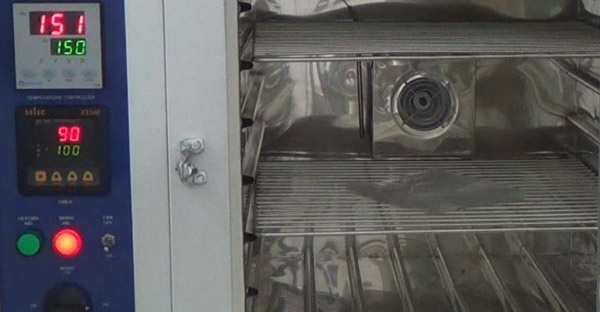
The process of dry heat sterilization burns the organisms layer by layer by oxidization of molecules and eradicates the microbes and microorganism from the material and keeps the material clean and hygienic to use. The dry heat sterilization is performed on the products by creating sufficient amount of dry heat inside the ovens. The dry heat is maintained at least for one hour using Hot Air Ovens to destroy the difficult and harmful chemicals & germs from the product. To perform the dry heat sterilization, actual time and temperature limits need to be set as per the three common time and temperature relationships:
- 150oC for 2 ½ hours and so on as per the requirement
- 160oC for 2 hours,
- 170oC for 1 hour,
Why Choose Presto Stantest for Your Hot Air Oven & Dry Heat Sterilization Needs?
When you choose dry heat sterilizers, the quality of the instrument decides how accurate and consistent your sterilization results will be. Presto Stantest has earned a reputation as a trusted manufacturer and supplier of laboratory testing instruments in India and around the world. Here is what makes the Hot Air Oven range stand out:
| Feature | What It Offers |
| Double-Walled, Corrosion-Resistant Construction | The inner wall is made of stainless steel. The outer part is made of steel that has a powder coating. The color is an autumn gray and blue look. This color does not get damaged by rust for a time. |
| Superior Insulation for Thermal Efficiency | Mineral glass wool insulation is packed between the walls. This helps keep heat loss low. It also keeps the unit at thermal efficiency during long dry heat sterilization cycles. The insulation works well to hold in the heat. This makes the unit run efficiently. It’s an important part of the design. |
| Precision Temperature Control | Microprocessor-based programmable digital temperature controller with a PT-100 sensor; a special T/P action ensures temperature never overshoots the set requirement. |
| Uniform Heat Distribution | The built-in rapid air circulation fan ensures homogeneous heating throughout the chamber, so every item receives consistent exposure to dry heat. |
| User-Friendly Digital Interface | The bright LED display is clear and easy to read. Controls are very easy to use, like a feather touch. The preset timer shows hours, minutes, and seconds. Built-in auto-tuning and calibration help cut down setup time and avoid mistakes. |
| Traceable Calibration & Documentation | Every unit ships with an instruction manual. It also ships with a wiring diagram. Every unit also ships with a calibration certificate to NABL-approved labs. |
| Trusted Across Industries | Widely used across rubber, plastics, pharmaceuticals, textiles, and paper industries for heat deformation, compression set, heat resistance, and dry heat sterilization applications. |
Methods of Performing Dry Heat Sterilization
Dry heat sterilizers usually work in one of two ways, each one for different kinds of sterilization tasks:
1. Static Air Type
In this method, the hot air oven uses heating coils that sit at the bottom of the chamber to generate air. The hot air oven produces heat that rises upward and spreads naturally around the chamber. The hot air oven relies on natural convection; no fan or blower assists in moving the air. This technique keeps the hot air oven temperature uniform throughout the oven. Because the hot air oven distributes heat evenly, the hot air oven performs well for sterilization cycles that require consistent conditions.
2. Forced Air Type
Also known as convection sterilization, mechanical convection sterilization uses a motor‑driven blower or fan that is placed inside the chamber. The blower moves air around the oven, making the temperature more even and steady than in systems that rely on still air. Because the heat is moved mechanically, forced‑air dry heat sterilizers—such as the model supplied by Presto Stantest—usually sterilize faster and more evenly, especially when the load is large or the items are oddly shaped.
.jpg)

Moist heat vs. dry heat
The difference between moist heat and dry heat is simple: moist heat uses steam, while dry heat uses hot air. Moist heat, such as autoclaving, works faster at lower temperatures but may not suit moisture-sensitive items. Dry heat needs higher temperatures and longer exposure, but it keeps the material dry. It is commonly used for powders, oils, petroleum products, and certain metal instruments that may be affected by moisture.
Another way to perform sterilization is the forced-air type. This type of sterilization is also known as mechanical convection sterilization. This type of sterilization comprises a blower, which moves with the help of a motor. The motor and fan of the device help to maintain an even temperature inside the chamber.
For more information on Dry Heat Sterilizers or Hot Air Ovens, click here.
Get a Quote
Looking for a way to protect your products from moisture and heat damage? Presto Stantest offers precision-engineered air ovens and dry heat sterilizers. These units are designed to provide accurate dry heat sterilization. They work well with the most sensitive materials. You can count on them to perform every time.
Call us now: +91 9210 903 903. Email us at info@prestogroup.com.
Reach out to our team today to find the right hot air oven or dry heat sterilizer for your specific application.
Conclusion
Protecting items from moisture and heat damage starts with picking the sterilization method. Dry heat sterilization is a choice because it does not involve moisture. This makes it safe for use on things like tools, powders, and petroleum products. It keeps these items protected without exposing them to water or damp conditions. Using a hot air oven, companies can achieve sterilization by controlling the heat. They follow known time and temperature rules to kill germs properly. Knowing the difference between heat and dry heat helps industries pick the best option for their products. With dry heat sterilizers that are traceable to NABL standards from Presto Stantest, companies can keep their products clean, safe, and protected every time they do a batch.
FAQs
1. How does a hot air oven perform sterilization?
A hot air oven warms the item slowly until it reaches the temperature that is needed. The dry heat then kills germs by causing oxidation.
2. What is the difference between moist heat and dry heat sterilization?
Moist heat uses steam. Usually works faster at lower temperatures. Moist heat uses steam. Usually works faster at lower temperatures. Dry heat uses air and is better suited for materials that can get damaged by moisture. Dry heat uses air and is better suited for materials that can get damaged by moisture.
3. What is the difference between static-air and forced-air dry heat sterilizers?
Static air ovens depend on convection. Forced-air ovens use a blower to move air around. Forced-air systems usually create even temperatures. Static air ovens give quieter performance.
4. Which products benefit most from dry heat sterilizers?
Dry heat sterilizers are very useful for items that are moisture‑sensitive. It works well with metal instruments, sharp tools, powders, and certain petroleum‑based products.