
- /
- Publications / Adhesive Testing on Capsulated Stoppers
Adhesive Testing on Capsulated Stoppers
Solution
- Motorized torque tester for precise measurement.
- Custom-designed chuck grips to securely hold capsuled (bar-top) stoppers.
Benefits
- Quickly identifies stoppers with weak or inconsistent adhesive bonds.
- Provides a firm, uniform grip on slippery or coated surfaces for accurate testing.
To measure adhesive bond strength, the cork shank is secured in one grip while the bar-top cap is held in another. Torque is applied to the stopper until either the cork breaks or the adhesive bond breaks between the cork and the stopper.
Requirement
A capsulated stopper—such as a T-top, bar-top is made up of a natural or synthetic cork that is inserted into a capsule that is made from wood, PVC, porcelain, metal, glass, or other materials. These stoppers are commonly employed for liqueurs, fortified wines, and spirits, which are served across a number of pours. Popular among bartenders and consumers, they are known for being easy to open and reseal and have found increasing application in wineries and distilleries producing port, sherry, whiskey, brandy, tequila, and other spirits.
The assembly of the cork and cap can be done by hand or by machine, depending on the size of the production and the type of material. Adhesives, bonding agents, and cork are all rigorously tested and chosen to meet regulatory standards such as those required by the FDA. The integrated stopper must survive years of being yanked and twisted without the cork pulling apart from the cap—a staggeringly important aspect for the high-end stuff.
Evaluating the mechanical adhesive joint between cork and cap is a must-have test for manufacturers as well as their end users to guarantee product performance. For instance, Diam France required a dependable system to evaluate their range, which combines rapid elastic return with consistent bottle-to-bottle performance. The system had to accommodate bar-top caps in various materials and sizes while providing reliable gripping during testing.
Solution
To measure adhesive bond strength, the cork shank is secured in one grip while the bar-top cap is held in another. Torque is applied to the stopper until either the cork breaks or the adhesive bond breaks between the cork and the stopper. The peak torque value is then taken and compared to predetermined quality control limits for assessment. The motorized torque tester provides a constant rotational speed and torque, thereby avoiding fluctuations induced by manual torque application.
Peak torque is captured at high data-acquisition rates, ensuring sudden adhesive or cork failures are accurately recorded.
Gripping coated cork and hard bar-top caps presents a challenge due to slipperiness and material differences. Presto Stantest's custom-machined chuck that holds both parts (the mandrel and the cap) includes a square-drive mechanism that enables uniform tightening with a torque wrench. This creates standardized holding power and prevents the stopper from slipping or being harmed and, at the same time, gives repeatable outcomes.
Test Equipment
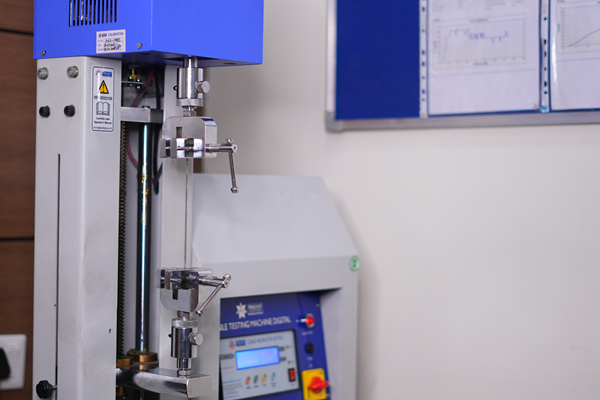
- Motorised Torque Tester
- 6 N·m Torque Transducer
- Torque Indicator
- A dedicated chuck set for encapsulated stoppers of varying sizes and materials.

1.png)
.png)
.png)