
- /
- Publications / Child Safety – Force Required to Access a Lighter
Child Safety – Force Required to Access a Lighter
Child Safety – Force Required to Access a Lighter
Solution
- Software-controlled test stand with intelligent cell
- Custom clamping fixtures and attachments designed for the product.
Benefits
- Accurate verification of safety features against customer specifications
- Simple, repeatable testing procedure
- Flexible programming for R&D and additional test applications
The child-resistant mechanism of a lighter needs to provide a comfortable level of performance while also maintaining high levels of safety performance by minimizing the chance of a child's accidental access to the lighter and without interfering with its normal performance. Presto has developed a software-driven force testing system to precisely test out the actuation force necessary to unlock and unfasten less massive safety guards and locking mechanisms. The intelligent load cells, custom fixtures, and programmable test routines provide detailed force versus displacement behavior measurements with high accuracy. Real-time graphical analysis and repeatable testing procedures assist manufacturers to ensure safety performance, improve the design of their products, and avoid inconsistencies in quality during research, development, and production tests.
Requirement
One of the manufacturers of the lighters was actually in the process of coming up with a child-resistant guard that would be incorporated to discourage accidental cases of access to the same by young children. The issue of concern regarding the critical safety requirement was to identify the maximum force that should be used to disengage the guard and gain access to the lighter without any injury. The targeted actuation force at the lock point was specified at 10 N, a value carefully chosen to balance user convenience with child safety.
For research and development purposes, the testing system needed to provide exceptionally detailed data. This included high-frequency data capture of up to 2000 Hz to accurately capture transient forces and subtle mechanical responses of the child-resistant mechanism. Additionally, real-time graphical output was required so that engineers could immediately visualize the force versus displacement behavior during testing. The system also needed the flexibility to accommodate multiple test program configurations, allowing for the simulation of different usage scenarios, modification of displacement rates, and repeatable execution of standardized test protocols.
Solution
To meet these stringent requirements, Presto Stantest provided an Imperial computer-controlled test system equipped with an intelligent load cell. This combination ensured precise measurement of the actuation force while maintaining repeatability and reliability across multiple test cycles.
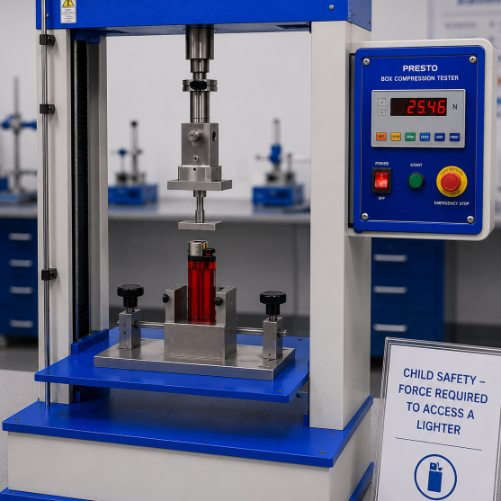
A specially designed holding fixture, supplied by the customer, secured the child-resistant guard horizontally on the anvil plate of the test stand. The fixture ensured proper alignment of the lock with the load cell axis, eliminating any off-axis loading that could affect accuracy. A pin, attached to the load cell via an extension rod, applied a controlled and measured compression force to the lock mechanism.
An experimental test was also done at a step rate of 2.5 mm/min, which resembles a realistic interaction between the users. At the target force of 10 N, the child-resistant guard was set free, and the target force and displacement measurements were successfully recorded using the intelligent load cell during the course of the activity. This enabled the R and D team to check that the guard was always going with the safety requirements and also found out whether there was any deviation in the performance of the guard.
It was also possible to create several test programs with the help of the system and, thus, to simulate more testing conditions. For example, variations in force application angles, repeated actuation cycles, and evaluation of different materials for the guard could be tested easily, providing a complete understanding of the product’s mechanical behavior.
Test equipment
- Computer-Controlled Test Stand
- Intelligent cell for Compression Testing
- Extension rod
- Custom holding fixture (supplied by customer)
- Pin (supplied by customer)
Test standards

1.png)
.png)
.png)