
- /
- Publications / Lap Shear Testing of Plywood
Lap Shear Testing of Plywood
Lap Shear Testing of Plywood
.png)
Lap shear testing of plywood
Solution
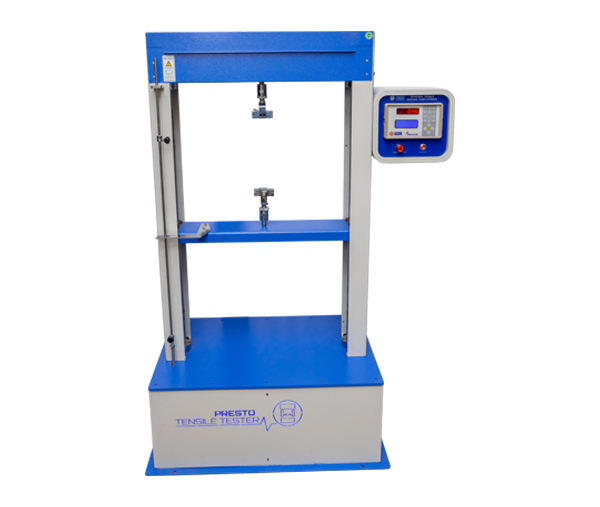
- High-capacity twin-column, software-driven tensile testing system.
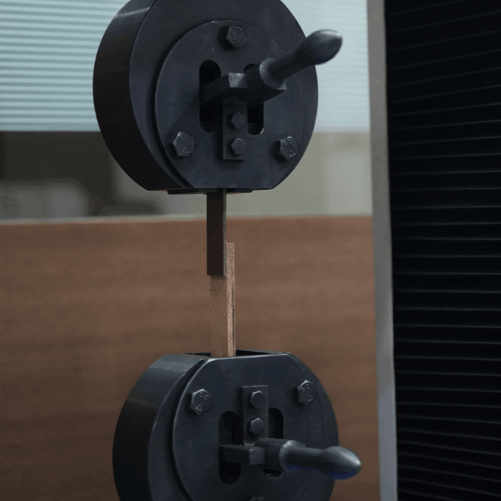
- Pneumatic planar vice grips with serrated jaw profiles for secure clamping.
Benefits
- Automated software control ensures testing in line with standardised methods.
- Quick-change gripping fixtures improve operational efficiency and consistency.
- Automatic computation of key mechanical properties.
- Structured and repeatable reporting aligned to user-defined formats.
The Presto Stantest twin-column tensile testing system has been useful to plywood manufacturers, as they can conduct lap shear testing effectively and precisely to assess the bonding quality of the adhesives between veneer layers of the wood. With the help of pneumatic vise grips fitted with serrated jaws and software-controlled operations, the system ensures stable and safe clamping of the test specimens and applies stable tensile force until it reaches the bond failure point.
During the entire testing process, the automatic testing records the force and displacement data and automatically calculates the shear strength and maximum load values based on the BS EN ISO 314-1 and other testing standards. Quick-change gripping fixtures make for more convenient sample handling and help to maintain consistent testing during a routine quality control process. Graphical output software and custom programming reporting capability enable the manufacturer to compare the performance of adhesives, as well as monitor the quality of production, to ensure structural reliability for plywood used in construction, flooring, transportation panels, and other load-bearing applications.
Requirement
Engineered wood product manufacturers (especially plywood manufacturers) are obliged to prove the integrity of adhesive bonding between layers of veneers. Plywood is made by a combination of several thin layers of wood with the help of particular resins that create a cross-laminated system that is very popular in construction, flooring, transport panels, and external works.
The dependability of such bonded interfaces is of importance due to their use in load bearing environments. The performance of adhesives can be varied directly and have a direct impact on structural strength, durability, and service behavior in the long term. Consequently, to verify the quality of bonding needed, the exact shear tests are required to meet the international performance standards.
Solution
Shear testing is used to determine the bond integrity as per the EN 314-1, which outlines the procedures to be followed in measuring the quality of bonding of plywood and other wood-based panels. The testing system applies a controlled tensile force in a shear configuration to prepared specimens until bond failure occurs.
To ensure accuracy, samples—often conditioned or pre-treated as required by the standard—are firmly gripped using pneumatically operated vise grips. The serrated jaw faces provide consistent clamping pressure, reducing the risk of slippage and ensuring that failure occurs within the bonded interface rather than at the grips.
The twin-column tensile frame delivers stable load application at a constant rate, governed by advanced control software. The data on the force and displacement are recorded continuously during the test. The system automatically computes parameters like maximum load (N) and shear strength (N/mm²) and gives the results in a straightforward graphical form, and it is also capable of exporting the results in the form of customized reports and further analysis.
Test Equipment
- Software-controlled twin-column tensile testing machine
- High-precision cell suitable for elevated force ranges
- Pneumatic vice grips with serrated jaws
Test Standards
- BS EN 310 Wood-based panels – Measurements of bending strength and modulus of elasticity
- BS EN ISO 314-1 Plywood – Bonding quality – Test methods
Test standards

1.png)
.png)
.png)