
- /
- Research Paper / Statistical Correlation between ASTM B117 Salt Spray Test Results and Field Corrosion Behavior
Statistical Correlation between ASTM B117 Salt Spray Test Results and Field Corrosion Behavior
10-11-2025
Abstract
Corrosion testing depicts the results obtained after prolonged periods of environmental exposures in terms of temperature, moisture, air pressure, sun rays effects on metal substrates.
The ASTM B117 Neutral salt spray testing being a researched standards gives an accelerated corrosive environmental to simulate the effects of marine, coastal and on site conditions which the sample undergoes in real life and with judgments in terms of no. of hours, user get the idea of how much is the corrosive sustenance capabilities of sample on site. 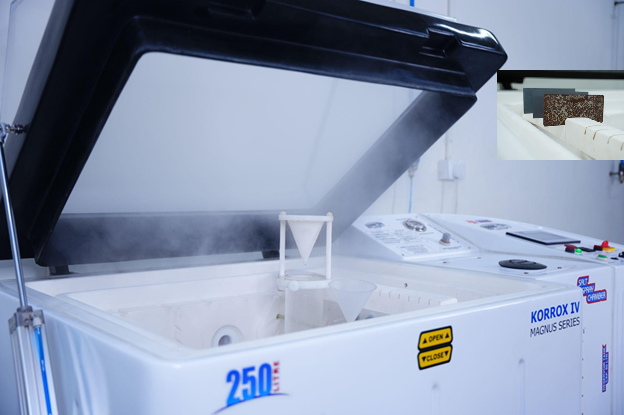
However, the main purpose of study is to establish the real correlation between the laboratory performance of corrosion with ASTM method and how much it matches the field performance. As many studies by Heresite Protective coatings specify that correlation coefficient between laboratory method through Neutral Salt spray testing and on site performance is 0.11. But this contains lesser quantitative and qualitative analysis in terms of data and parameters. Hence, the study will comprehensively look into actual industrial samples being tested and how much does it correlates with the real exposure and at last with Pearson's correlation coefficient with sufficient data we can mention the correlation coefficient between ASTM B117 testing and field performance of product and can say on its reliability as a quality testing method.
Research Methodologies:
1. Conducted Survey- For Data extraction and analysis on sample. Data is the foundation of whole research.
For ASTM B117 - The data has been collected from the commercial laboratories performing the test. This will give solid evidence after testing at 200, 400, 500 hours in salt spray chamber what is the behaviour of specimens.
For Field Behaviour - The data collected is of actual product used as samples of ASTM B117 testing. Data has been taken in terms of where it is used, warranty claims of products, what kind of climatic conditions are in that region, when does the first sign of corrosion happen.
2. Pearson Correlation coefficient - Formula used for establishing quantitative correlation between the empirical testing (laboratory) and on site performance. The purpose of using this coefficient is to get a quantitative relation between the results.
n (Σxy) - (Σx)(Σy)
Pearson’s Correlation coefficient {r} = ⎻⎻⎻⎻⎻⎻⎻⎻⎻⎻⎻⎻⎻⎻⎻⎻⎻⎻
√[nΣx2 - (Σx)2][nΣy2 - (Σy)2]
x = Results for corrosion in ASTM B117 in hours
y = first sign of corrosion in on site environment
xy = mean of respective datasets
3. Comparative analysis between the laboratory and on site conditions in tabulated form
A comparative tabulation was prepared to present the deviations and consistencies between laboratory and field conditions. Parameters such as exposure duration, temperature, humidity, and corrosion manifestation patterns were compared to understand how well the laboratory simulation reflects on-site environmental behavior.
| Parameter | Laboratory (ASTM B117) | On-site Performance |
| Temperature | 35 ± 2°C (constant) | Location specific |
| Humidity | ~95% RH | Location specific |
| Corrosion Onset | In hours | In years |
Specifications of specimen under test
The specifications of the sample under test will help to do better qualitative and quantitative analysis. Hence, we contacted various industrial technicians performing the ASTM B117 testing for corrosion behaviour and then will compare it with the testing time it takes to corrode under field with mentioning the field behaviour. The Correlation coefficient of 1 is perfect in terms of relation between the laboratory empirical observations and on site perforation of the sample. The correlation coefficient 0.1,0.2 etc. shows less reproducibility. The samples used are part of some or the other product like compressor assembly, galvanised Anchor bolt, a mild steel bracket and a sample with Matt black Non heat resistant Paint.
Compressor assembly- Truck refrigeration unit
The product is used in the truck refrigeration unit in which perishable goods are placed. It needs sustenance to corrosion due to transit application in outdoor environments. Hence the on site performance study is being done on the compressor assembly used in the truck refrigeration unit. The compressor is used to maintain the temperature inside the cargo component. The refrigeration unit is used to preserve the perishable goods. For the testing purpose we used a compressor assembly on which high grade Molybdenum disulphide coating.
Molybdenum disulphide is used to prevent friction, it has high load capacity. Because of the layering provision the coating film slides pass each other due to which friction does not occur. Hence by preventing any sort of adhesive wear it prevents the life of the compressor's internal moving part.
During on site application, the compressor assembly undergoes of corrosive elements such as:
● Atmospheric moisture and humidity, especially in coastal and monsoon-prone regions.
● Salt and chemical residues resulting from road spray and the use of de-icing materials.
● Fluctuations in temperature ranging from -20°C to +45°C, causing condensation and the formation of small cracks in protective coatings.
● Physical abrasion and vibrations that hasten coating deterioration and leave the underlying metal vulnerable to corrosion.
| Material | Compressor Assembly Size:- 200x150x150 mm |
| Coating type | Molybdenum disulphide (MoS2) |
| Time of Testing | 240 hours |
Study of Hot Dip Galvanised Anchor
The product is used in the Masonry (construction site) concrete industry. The sample is exposed in varied conditions. Right now study has been for observing the on site performance of coastal areas. The criticality of this product is such that it is used to connect the foundations with sill plates and used to connect the electrical components in complex conditions. And the foundation will be the concrete structures. Hence failure in these components leads to failure from foundations and its critical to have high durability in these.
Considering the hot dip galvanisation, this kind of coating helps in substrate with protection of zinc from moisture and oxygen. The durability of hot dip galvanisation is an added advantage.
| Material | Anchor Bolt M30 X 1850 |
| Coating type | Hot dip Galvanisation (HDG) |
| Time of Testing | Up to 200 hours |
Study of MS bracket
The product tested is used as a supporting element in the telecommunication industry as support structure for antennas and base stations. The Mild Steel Bracket which has been used for ASTM B117 testing is used to install cellular antennas. These are used to prevent samples from high stresses like environmental stress and storms. Mild steel brackets are used as supporting structures.
Powder coating provides a non porous structuring to the products as without a coating sample undergoes wear and tear including rusting easily. Powder coating has an added advantage due to its characteristic of prevention from scratching and chipping in comparison to other forms of coating
| Material | MS Bracket |
| Coating type | Powder coating |
| Time of Testing | 250 hours |
Study of Matt black Paint
This matt black paint tested is used to paint the automotive assemblies/components like scooter front and back panels, safety gears. It requires long sustenance to corrosive conditions as generally these samples are in outdoor/harsh conditions. The advantages and criticality of matt black paints lies in the nature of its look. Due to its matte aesthetics it prevents glare to the eyes which inherently glossy surfaces possess. In the helmet segment this can be a cause of accident if glare is too high. The matte surface hides the small scratches and scuff as well.
| Material | KONG CCLH Matt Black Paint |
| Coating type | Paint |
| Time of Testing | 432 hours |
ASTM B117 conditions
The ASTM B117 standard is used to check the corrosive properties of samples in a standardized and accelerated manner. The Standard is claimed to have a low correlation coefficient with the on site performance of the product. Hence, we have collected the commercial laboratory data on these conditions. The test is suitable to judge the comparative results of corrosive behaviour between the sample. Hence it has been widely used.
Below is the comprehensive table of conditions of ASTM B117 on which sample has been exposed to. IF discussed in detail the purpose of using the Nacl solution is to give the accelerated condition to the testing to fasten the process and the effect produced in years could be judged in months. Similarly rather than the ambient Relative humidity the testing has been done at 95% +/- 5% which itself depicts its accelerated behaviour.
| Test Temperature | 35 deg. Cel. +/- 2 deg. Celsius |
| Relative humidity | 95 % +/- 5% |
| Air pressure | 0.7 to 1.2 kg/sq. cm. |
| Solution used | Nacl (Lab grade) 5 +/- 1% + DM water in 95 parts |
| DM water specs | Type IV as per ASTM D1193 |
| pH of solution | 6.5 to 7.2 |
| Air saturator temperature | 47 deg. Celc. +/- 2 deg. Cel. |
| Specimen Orientation | 15 deg. to 30 deg. from vertical |
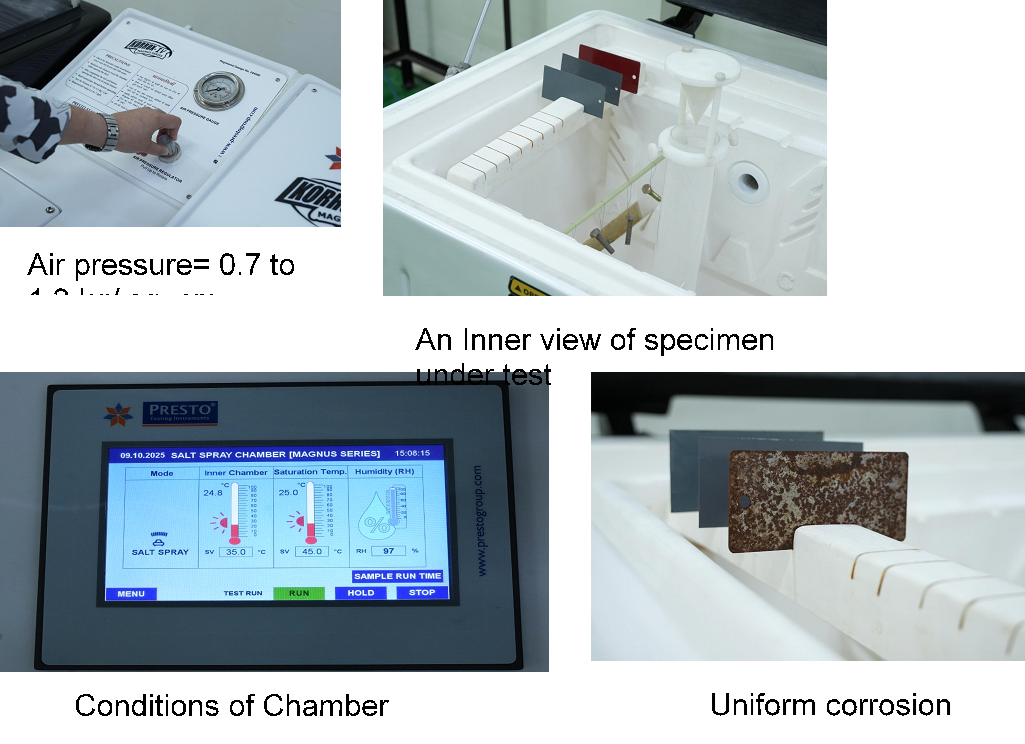
Observations after testing as per ASTM B117
After testing different components in the chamber the comprehensive dataset in tabulated format has been presented to show. The main things to be considered has been when actually rust occurs, then what type of corrosion it is after testing (white rust, pitting etc.). FOr reference, images are also provided.
Compressor assembly - Truck refrigeration unit
| Time taken to show corrosion/rust | 24 Hrs (Minor white rust), 216 Hrs. (Major white rust observed & Major red rust observed) |
| Type of Corrosion/ Rust | White rust then red rust |
| Image | 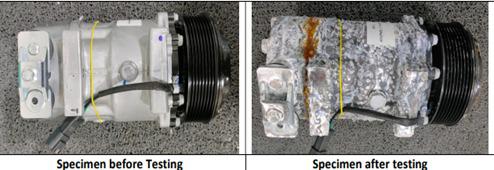 |
HDG Anchor Bolt
| Time taken to show corrosion/rust | 92 hours (minor white rust), 200 hours (major white rust) |
| Type of Corrosion/ Rust | White rust |
| Image | 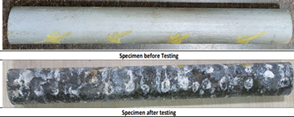 |
MS bracket:
| Time taken to show corrosion/rust | 72 hours (minor red rust) / 144 hours (major red rust) |
| Type of Corrosion/ Rust | Red rust |
| Image | 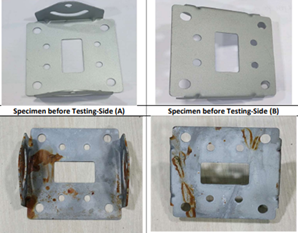 |
Matt Black Non Heat resistant Paint
| Time of Testing | 432 hours |
| Time taken to show corrosion/rust | Passed 432 hours testing |
| Type of Corrosion/ Rust | Flaking |
| Image | Not shown |
On site performance of product
The specimen under test after complying to standard norms is sent to the field. After the analysis we can check the on site performance of the sample in terms of how much time had it taken to corrode. This will give us the insight on adding the variable to the Pearson correlation coefficient.
The purpose of this stage is to judge the onsite behaviour of the sample and then to compare the results in terms of how much time does it actually take to corrode. It will help in checking correlation coefficient of ASTM B117 results and field behaviour results.
Study of Compressor assembly
The location chosen is a coastal region which itself possesses aggressive conditions in terms of high chloride concentration and due to closure to sea it has high temperature fluctuating tendencies. The Compressor assembly here is used in truck refrigeration unit and after analysis it was found that the first sign of corrosion occurred in 5 years.
| Place | Chennai |
| Temperature of Environment under exposure | 25°C - 35°C |
| Relative humidity of Env. | 65-85% |
| Pollutants and AQI of area | 90-120 |
| First sign of corrosion/Time of Depreciation | 5 years |
| Time of complete damage | 7 years |
| Type of corrosion | Uniform, pitting |
Study for Anchor Bolt HDG
The place chosen is Mumbai location and high humidity with poor air quality. Here, the Anchor bolt is used for construction purposes. And the bolt here has shown degradation after 20 years.
The Hot dip galvanisation is used to provide the sacrificial layer of zinc coating.
| Place | Mumbai, India |
| Temperature of Environment under exposure | 25° C - 33 ° C |
| Relative humidity of Env. | 80-90% |
| Pollutants and AQI of area | 70-140 (Moderate to poor) |
| First sign of corrosion/Time of Depreciation | 20 |
| Type of corrosion | Uniform Corrosion |
Study for Mild Steel Bracket
The area is dominated by high PM 2.5 and PM 10 levels with a non coastal yet pollution intensive environment. The sample is used in supporting structures to the antenna. The company making this product supports the automotive and telecommunication industry.
| Place | New Delhi, India |
| Temperature of Environment under exposure | 26° - 31° C |
| Relative humidity of Env. | 45-55% (higher in monsoon) |
| Pollutants and AQI of area | 175-225 (PM 2.5 and PM 10 dominated) |
| First sign of corrosion/Time of Depreciation | 2 years |
Study for Matt black Non HR Paint
The paint is used in Helmet. The location has fluctuating humidity with moderate level of pollution. Due to the low glare and safety concerns this is used
| Place | Pune, India (Urban Area) |
| Temperature of Environment under exposure | 30 ° C |
| Relative humidity of Env. | 40 -65% |
| Pollutants and AQI of area | 67-90 (Moderate) |
| First sign of corrosion/Time of Depreciation | 5 years |
Using Pearson’s Correlation coefficient
Variables used for judging the correlation coefficient between ASTM and field performance will be hours (x) and years (y). The number of samples used for study can be ‘n’. Then we can add the variable in the formula and judge the correlation coefficient.
Pearson’s Correlation coefficient {r} = n (Σxy) - (Σx)(Σy)
⎻⎻⎻⎻⎻⎻⎻⎻⎻⎻⎻⎻⎻⎻⎻⎻⎻⎻⎻⎻⎻⎻⎻⎻
√[nΣx2 - (Σx)2][nΣy2 - (Σy)2]
Observations
| Samples | ASTM B117 (hours) | On site Performance first sign corrosion (years) |
| Compressor assembly | 216 | 5 |
| Anchor Bolt | 200 | 20 |
| MS bracket | 144 | 2 |
| Matt black Paint | 500 hours |
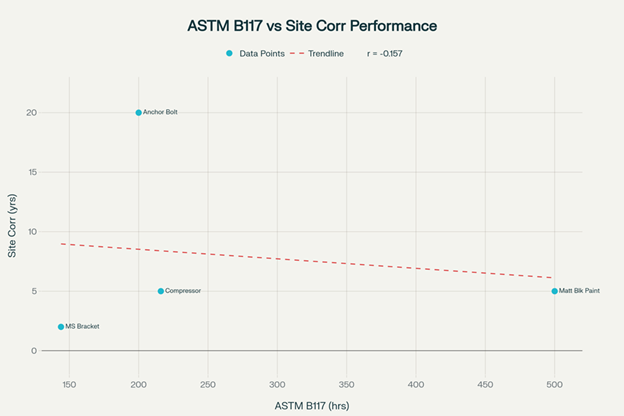
The correlation coefficient is -0.16. The weak/negative correlation coefficient is shown due to huge variation in matt black paint ASTM B117 performance and its on site performance.
Case 1: Including Matt Black Non-HR Paint
Adding the Matt Black Non-Heat Resistant Paint sample, the correlation coefficient dropped to -0.16, indicating a weak negative correlation between laboratory test results and field performance.
This steep reduction indicates that painted surfaces respond differently to corrosion stress compared to metallic components.
Interpretation
● The Matt Black Paint showed 500 hours of achievement in the ASTM B117 test, indicating strong salt spray resistance; however, its actual field lifespan was only 5 years—similar to that of the compressor assembly, which achieved 216 hours corresponding to a 5-year service life.
● This variation greatly affected the correlation pattern, suggesting that the ASTM B117 test by itself is insufficient for accurately predicting the long-term durability of painted or coated materials, particularly when subjected to UV exposure, temperature variations, and changes in humidity.
● The variation emphasizes that paint deterioration processes—like UV-induced chalking, micro cracking, and coating delamination—play a more significant role in real-world conditions than the basic chloride corrosion represented in the ASTM B117 test.
Observations (excluding Matt black paint)
| Samples | ASTM B117 (hours) | On site Performance first sign corrosion (years) |
| Compressor assembly | 216 | 5 |
| Anchor Bolt | 200 | 20 |
| MS bracket | 144 | 2 |
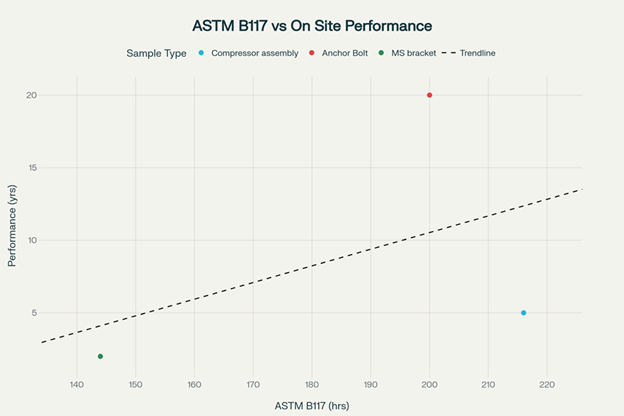
The correlation coefficient is 0.66. It shows that for non heat resistant paint the ASTM B117 test has shown weak correlation coefficient while it holds good for coatings.
Case 2: Without Matt Black Paint
When only the metallic samples (Compressor Assembly, Anchor Bolt, and MS Bracket) were considered, the correlation coefficient was +0.66.
This suggests a fairly strong positive relationship between ASTM B117 salt spray test outcomes and actual field corrosion performance.
In other words, parts that performed better in laboratory salt spray tests generally exhibited longer durability when exposed to real outdoor environments.
This confirms that the ASTM B117 test is reasonably effective in forecasting real-world corrosion behavior for metal components when coating types and environmental conditions are comparable.
Conclusion
● Without paint samples: ASTM B117 provides a reasonably reliable correlation (r = +0.66) for metallic assemblies.
● With paint samples: Correlation drops drastically (r = –0.16) due to differing degradation mechanisms.
● Therefore, for coated or painted components, multi-environmental testing such as cyclic corrosion testing (ASTM G85, ISO 11997-1) or UV–Condensation Weathering (ASTM G154) should supplement ASTM B117 for more accurate life prediction.
Further scope of study
Can study the correlation coefficient as per ASTM B368 (CASS test).
More parameters should be included for testing UV exposure, sulphide testing.
Correlation coefficient of ASTM G85 and on site performance is better as it simulates more exposures due to cyclic test features.
Can take more data on paint testing and then see correlation coefficient. As of now a diverse data set has been combined to check the result.
It is advised to conduct further studies where at the same location 4 to 5 samples should be tested.
References
1. https://www.aqi.in/in/climate-change/india/maharashtra/mumbai
2 .https://www.teknobond.com/heat-resistant-paint-hr-250-paint-black-manufacturer-pune.html
3. https://transocean-coatings.com/about-us/protective-coatings/iso-12944/
4. https://www.aqi.in/in/dashboard/india/maharashtra/mumbai
5. https://cor-pro.com/corrosion-protection-services/coatings/molybdenum-disulfide/
6. https://galvanizeit.org/knowledgebase/article/corrosion-rate-of-galvanized-steel
7. https://pubs.rsc.org/en/content/articlelanding/2023/ta/d2ta07821j
8.https://www.sciencedirect.com/science/article/pii/S1878535218302272
9. https://laxmienterprisevadodarasteelhub.com/preventing-corrosion-in-ms-steel/
10. https://www.teknobond.com/heat-resistant-paint-hr-250-paint-black-manufacturer-pune.html
11. https://www.aqi.in/in/dashboard/india/maharashtra/mumbai
12. https://www.ijirset.com/upload/2014/iciet/mech/63_ICIET_M53.pdf
13. http://ferrite.in/how-to-prevent-rust-from-iron/
14. https://irimee.indianrailways.gov.in/instt/uploads/files/1434526473518-corrosion%20prevention%20practices.pdf
15. https://pmc.ncbi.nlm.nih.gov/articles/PMC11722518/
16. https://www.galserv.com.au/wp-content/uploads/2023/04/Guide-to-the-Durability-of-Hot-Dip-Galvanized-Steel-v3.1.pdf
17. https://www.google.com/search?q=Molybdenum+disulfide+(MoS%E2%82%82)+coating%3A&rlz=1C1RXQR_enIN1160IN1160&oq=Molybdenum+disulfide+(MoS%E2%82%82)+coating%3A&gs_lcrp=EgZjaHJvbWUyBggAEEUYOTIICAEQABgWGB4yDQgCEAAYhgMYgAQYigUyDQgDEAAYhgMYgAQYigUyDQgEEAAYhgMYgAQYigUyDQgFEAAYhgMYgAQYigUyCggGEAAYgAQYogQyCggHEAAYogQYiQUyCggIEAAYgAQYogQyCggJEAAYgAQYogTSAQc1NTRqMGo3qAIAsAIA&sourceid=chrome&ie=UTF-8
18. https://icc-es.org/testing/astm-b117/
19. https://www.fabmann.com/news/is-salt-spray-test-credible-53749325.html
20. https://galvanizeit.org/knowledgebase/article/salt-sprayfog-accelerated-corrosion-testing-of-hdg-steel
21. https://www.q-lab.com/sites/default/files/Technical_Articles/Combined-Corrosion-and-Weathering-Validating-a-Concept-With-Over-a-Decade-of-Research.pdf
22. https://industrial.sherwin-williams.com/na/us/en/protective-marine/media-center/articles/the-limitations-of-astm-b117-salt-spray--fog--testing.html
23. https://www.heresite.com/astm-b-117-salt-spray-test-does-not-correlate-to-real-world-environments/
24. https://www.dau.edu/artifact/modification-astm-standard-b117-salt-spray-corrosion-test-improved-correlation-field
Recent Research Paper
No records found