

- /
- Article / How Spectrophotometry Works: Principles, Uses, and Applications
How Spectrophotometry Works: Principles, Uses, and Applications
This tool is the cornerstone of innumerable analytical conclusions, offering quantitative evidence—quite frequently in mere seconds—that assures regulatory support and safety in products. It is not only theoretical to learn about the Spectrophotometry working principle and applications; it's an indispensable ability that forms the basis of Expertise, Authoritativeness, and Trustworthiness of the global laboratory community.
Let's shed some light on the technology that has been setting the agenda for chemical and biological analysis for decades.
Spectrophotometry is defined, fundamentally, in analytical chemistry as finding the amount of light, or amount of light absorbed by a chemical compound, or that has passed through the visible spectrum. If a given wavelength of light is used to shine through the sample, and you measure the amount of the light that comes out of the sample, you can gauge the identity and amount of compounds that are in the sample.
The Governing Principle: Beer-Lambert Law
The whole discipline is based on the Principles of spectrophotometry, which are mostly ruled by the Beer-Lambert Law. In summary, the law states that the amount of light absorbed by the sample solution is proportional to the concentration of the solute and the path the light travels through the solution.
This can be described mathematically with A = ε c l where A is absorbance, c is concentration, and l is path length. This simple and linear relationship provides an accurate, easy measurement of quantitative values, and is the basis for all working principles and use of Spectrophotometry.
Spectrophotometry working principle and uses
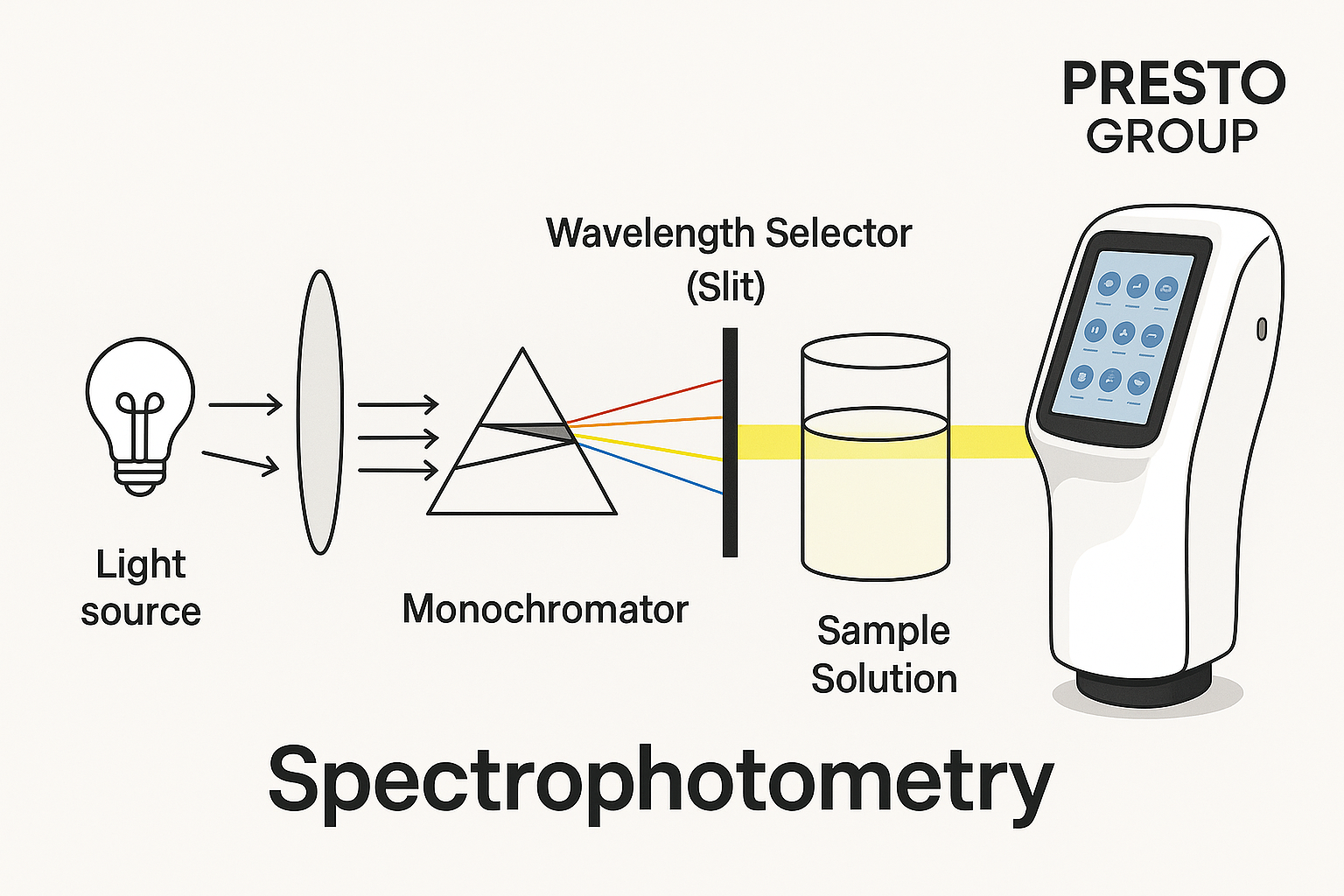
A spectrophotometer operates by accurately regulating light transmitted through a sample and then measuring the outcome. It has five primary components:
- Light Source: Provides energy (for example, deuterium lamp for UV, tungsten lamp for visible light).
- Monochromator: A device that filters all but a desired, narrow bandwidth of light (one color or wavelength).
- Sample Compartment: Reserves the cuvette holding the sample.
- Detector: Records how much light passes through the sample.
- Display/Readout: Expresses the findings as absorbance or transmittance.
Double Beam Spectrophotometer vs Single Beam
When selecting the Best spectrophotometer for laboratory testing, design makes all the difference. The principal operational difference is between the Double beam spectrophotometer vs single beam:
| Feature | Single Beam Spectrophotometer | Double Beam Spectrophotometer |
| Light Path | Light passes through the reference (blank) and sample in sequence. | Light is divided, passing through the reference and sample at the same time. |
| Stability | Less stable; re-zeroing (blanking) is done constantly. | Highly stable; adjusts for changes in the light source automatically. |
| Speed | Slower for high-throughput analysis. | Faster and more appropriate for scanning over a range of wavelengths. |
For accurate, high-throughput applications such as UV Vis spectrophotometry for drug analysis, the speed and stability of a double beam instrument make it the choice, albeit a more costly, one.
Who Uses Spectrophotometry? Applications Vary
The technology is incredibly versatile and thus a mainstay in many scientific disciplines.
1. Life Sciences
The Applications of spectrophotometry in biology are basic. Spectrophotometry in biochemistry (DNA, protein analysis) is applied every day to:
Measure DNA/RNA: There is maximum absorbance in nucleic acids at 260 nm. The purity and concentration of a sample can be found by measuring the absorbance at this wavelength in an instant.
Protein Concentration: Proteins usually are quantified at 280 nm or with colorimetric assays such as Bradford or BCA, where intensity of colour is proportional to protein concentration.
2. Industry and Quality Control
In the drug industry, UV Vis spectrophotometry in pharmaceutical analysis is essential for determining active ingredients, dissolution studies, and product stability.
Difference between a spectrophotometer and a colorimeter
The root of significant confusion is the difference between colorimeter and spectrophotometer. A colorimeter utilizes filters to measure broad, fixed wavelengths of light (usually three corresponding to blue, green, and red), and is inherently less accurate. A spectrophotometer utilizes a monochromator to select any specific wavelength in between the UV and the Visible (Vis) range and therefore is much more versatile for accurate Spectrophotometry in analytical chemistry.
By carrying out regular UV Vis spectrophotometry for pharmaceutical analysis on solute tablet samples, you can instantly confirm the active ingredient's concentration by quantifying its characteristic absorbance peak. Through this fast, accurate method, you can ship batches in a shorter time using Expertise and purity information that proved strict regulatory adherence and established market Trustworthiness. This is evidence that spending money on the Best spectrophotometer for laboratory analysis is an act of quality itself.
Conclusion: From confirming the accurate dosing of a life-saving medication to measuring the building blocks of life, spectrophotometry is a non-destructive, robust, and basic analytical technique. By understanding the Principles of spectrophotometry, laboratories everywhere have the best safety and quality standards.
Do you want to improve your analytical power or choose the Best spectrophotometer for laboratory analysis to satisfy new regulatory requirements? Talk to a certified lab equipment expert now to maintain your methodology and equipment at the highest level of accuracy and efficiency.
Get the Best Spectrophotometer at the Most Competitive Price!
Are you looking for a reliable spectrophotometer to achieve accurate color measurement and consistency in your products? Presto Group, the world’s leading spectrophotometer manufacturer and supplier, offers high-performance instruments trusted by industries worldwide.
If you want to know the latest spectrophotometer price or need expert assistance in choosing the right model for your needs, our team is here to help you every step of the way.
Call Now: +91 9210 903 903
Email: info@prestogroup.com
Presto Group — the world’s best manufacturer and supplier of spectrophotometers and color measurement instruments.