

- /
- Article / How to Operate a Salt Spray Chamber as per ISO and ASTM Standards
How to Operate a Salt Spray Chamber as per ISO and ASTM Standards
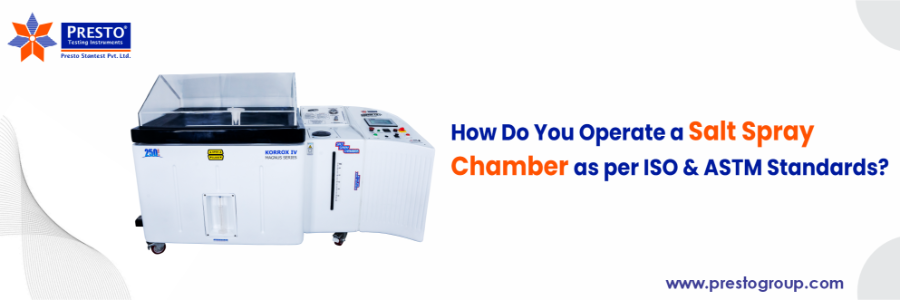
A modern investor wants test data that is fast, repeatable, and globally accepted.
That is exactly what Salt spray testing delivers when it follows international standards like ISO salt spray test and ASTM B117 salt spray test.
These methods expose metals and coatings to a controlled salt fog so that corrosion behaviour appears much faster than in real field conditions.
A corrosion testing chamber creates an aggressive marine-type atmosphere and keeps it stable for hundreds of hours.
When the chamber is operated correctly, the results give early warning about coating failure, product life, and warranty risk.
This is highly relevant for investors who track quality costs, recalls, and reputation.
Key Standards Investors Should Know
Both ISO and ASTM provide detailed guidance on how a Salt spray testing environment must be created and controlled.
The most used standards for neutral salt spray are:
- ISO salt spray test – mainly ISO 9227 Neutral Salt Spray (NSS) for metals and coated metals.
- ASTM B117 salt spray test – long-established US practice for neutral salt fog corrosion tests.
For neutral salt spray, ISO 9227 NSS and ASTM B117 use almost the same solution, temperature, and collection rate conditions, which makes results broadly comparable across markets.
Core Test Parameters as per ISO 9227 and ASTM B117
The table below shows the typical neutral salt spray settings that a quality lab will maintain. These parameters are critical for any Salt spray test for coatings, as even small drifts can alter test severity and affect failure time.
| Parameter | ISO 9227 NSS (ISO salt spray test) | ASTM B117 salt spray test | Notes |
| Salt solution | 5 percent NaCl in purified water | 5 percent NaCl in purified water | Same basic solution for both methods. |
| pH of solution | 6.5 to 7.2 | 6.5 to 7.2 | Neutral salt spray range. |
| Chamber temperature | 35 °C ± 2 °C | 35 °C ± 2 °C | Standard temperature for NSS. |
| Spray collection rate | 1 to 2 mL per hour on 80 cm² | 1 to 2 mL per hour on 80 cm² | Measured using collection funnels. |
| Specimen angle | 15° to 25° from vertical | 15° to 25° from vertical | Plates face upward toward the fog. |
| Test duration | Often 24 to 1000+ hours, as per product spec | Often 24 to 1000+ hours, as per product spec | Duration is defined in the coating or product standard. |
Any high-quality salt spray testing equipment should allow the operator to set and monitor all these parameters, with alarms, data logging, and easy access to collection points. Investors generally prefer suppliers that design chambers within the ISO 9227 and ASTM B117 ranges, as this reduces compliance risk across multiple export markets.
Pre-test Preparation
Before loading samples, the operator prepares both the work area and the parts. The clean preparation protects salt spray testing from false failures.
Key preparation steps include:
- Place the corrosion testing chamber in a cool room away from direct sunlight and strong drafts.
- Check leaks, blocked nozzles, or damaged seals that may disturb the fog pattern.
- Prepare a fresh 5% NaCl solution of high-purity salt in demineralized/Type IV water.
- Adjust pH 6.5-7.2 for neutral salt spray with appropriate acid or alkali.
- Oil and dirt may be removed by cleaning specimens with a mild solvent or detergent and drying completely.
- Whenever the test method requires scribing, the operator makes a controlled cut through the coating down to the base metal before placing the panel in the chamber.
This enables evaluation of film corrosion and creepage, which are often more critical than surface uniformity in high-value coatings.
Loading the Chamber Correctly
Correct loading allows fair comparison of different materials under salt Spray for coatings. Uneven loading patterns can cause shadow areas, dripping, or uneven exposure.
Best practice steps are:
- Mount flat panels so the test face faces upwards 15 to 25 degrees from the vertical for ISO 92 27 and 15 to 30 degrees for ASTM B117.
- Check that no specimen comes into contact with another or the chamber wall and condensate does not drip from one specimen onto the other.
- Use nonreactive racks/hangers that do not change the chemistry nor form galvanic couples.
- Place all labels and identification outside the direct spray area to prevent peeling off during the long test.
If this setup is followed, performance differences are mainly related to coating or material quality and not rack or fixture geometry. This is important if investors benchmark multiple suppliers within a single program.
Step-by-step Operation Sequence
When specimens are in place, the operator runs a consistent sequence for each neutral ISO salt spray test or ASTM B117 salt spray test.
Typical steps are:
- Fill the humidifier and pressure systems with clean water as directed in the chamber manual.
- The chamber temperature should be 35 °C, with a tolerance of ±2 °C, and should be allowed to stabilize before starting the test.
- Set the spray nozzle air pressure to about 0.7 to 1.4 bar (depending on the chamber design).
- Start atomizing salt solution with compressed air through the nozzle to form a fine fog.
- Verify that the fallout collection rate is within 1 to 2 mL per hour at each collection funnel.
- Check that the supply tank and humidifier have a stable pH and solution level.
- Start timing exposure based on product or coating specification, which may be 24 - 1000 hours.
Once the test is running, door locks must be closed - except for brief checks - to prevent temperature and fog fluctuations. Temperature, humidity, and fallout rate are logged automatically for engineers and investors.
Monitoring During Long Exposures
A neutral Salt spray testing run is continuous. There are normally no dry cycles or breaks. So monitoring is about confirming that all key variables remain within ISO and ASTM limits.
Typical checks include
- Recording chamber temperature and saturator temperature at fixed intervals.
- Measuring pH and salt concentration of the collected solution, not just the tank solution.
- Verifying air pressure and nozzle condition so that fog density stays uniform.
- Inspecting the fallout collection rate daily by removing funnels and reading the volume.
If any parameter drifts outside the specified band, the test may need to be paused or declared invalid, depending on the test plan.
While this may seem like an extra cost, it actually protects the lab's credibility and any published warranty claim.
Post-test Handling and Evaluation
At the end of the programmed duration, the chamber is stopped and specimens are removed carefully.
Many standards call for a defined cleaning and drying routine before rating the panels.
Evaluation may include:
- Visual inspection for blistering, red rust, white corrosion products, and under-film creepage from the scribe.
- Rating of corrosion area according to coating-specific standards or rating scales.
- Photographic documentation for investor or customer reports.
Weight-loss measurement for bare-metal coupons, if required.
Because the salt-spray test for coatings is accelerated and severe, it does not, on its own, predict exact field life.
Instead, it serves as a screening tool that supports material selection, supplier approval, and warranty design.
Why Operation Discipline Matters for Investors
For an investor, a corrosion testing chamber is not just a lab asset.
It is a decision engine that influences which suppliers are approved, which coatings are promoted, and how long warranties can be safely offered.
Tightly controlled salt spray testing equipment reduces the chance of false negatives, where a good coating fails early because of poor test control, and false positives, where a bad coating appears to pass.
Both cases have a clear financial impact through rework, claims, and brand damage.
When a lab follows ISO salt spray test and ASTM B117 salt spray test procedures closely, investors get comparable data across plants and countries.
Selecting Reliable Corrosion Test Chamber Suppliers
Well-designed chambers make it easier for technicians to meet ISO and ASTM requirements on a daily basis.
This is why buyers look closely at Corrosion test chamber suppliers when planning a new lab or upgrade.
Features that support compliant operation include:
- Stable temperature control around 35 °C with fast recovery after door openings.
- Accurate air pressure regulation and high-quality atomizing nozzles.
- Easy access to fallout collection points with clear graduated receivers.
- Corrosion-resistant construction that avoids contamination of the fog.
- Intuitive controls, alarms, and data logging for all critical parameters.
When Corrosion test chamber suppliers can show traceability of calibration to ISO 9227 and ASTM B117, investors can have more confidence that results from different labs will agree.
This supports smoother audits from automotive, aerospace, and other demanding OEM customers.
Bottom Line
Investors who back-test infrastructure early often see quieter warranty lines and stronger brand trust later.
Before the next product launch or capacity expansion, it is wise to review whether current Salt spray testing equipment truly supports ISO salt spray test and ASTM B117 salt spray test requirements.
If there are gaps in control, reporting, or uptime, this may be the right moment to engage with leading Corrosion test chamber suppliers and upgrade to a more advanced Corrosion testing chamber.
Contact Presto Group Today!
Careful operation of a salt spray chamber is a technical topic, but the payoff is very clear in cash terms when failures are caught in the lab instead of in the market. Call our experts now to learn more about salt spray testing
Call us: +91 9210903903
Email: [email protected]
Visit: www.prestogroup.com
Recent Articles
- Climatic Chamber: Working Principle, Uses, Diagram, Price & Top Manufacturers in India
- Izod vs Charpy Impact Test: Difference, Method & Standards
- Colorimeter vs Spectrophotometer: Accuracy, Working Principle, and Industrial Uses
- Quality Assurance and Quality Control: Two Pillars of Product Excellence
- Hardness Test: Types, Testing Methods, Procedures, and ASTM Standards
Need more information
Connect with us for your business enquiries. Generally, we respond within one or two working days.