
- /
- Article / How UTM Machines Perform Tensile, Compression, and Flexural Tests Accurately
How UTM Machines Perform Tensile, Compression, and Flexural Tests Accurately
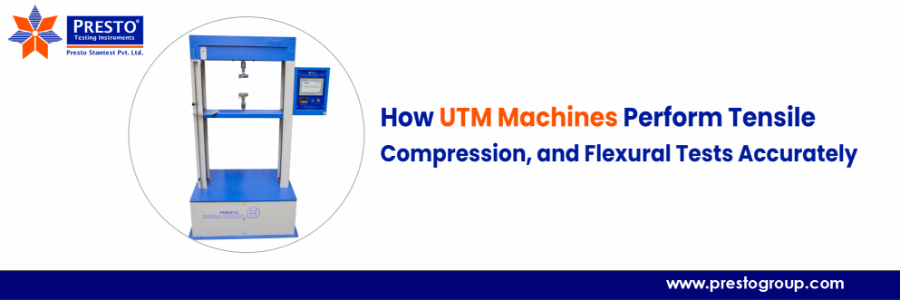
In the case of material science or engineering, a great understanding of the behaviour of materials under various forces is observed.
What is a UTM Machine?
A UTM is the general term for an electromechanical or hydraulic system used to test the mechanical properties of materials. The "universal" designation comes from its ability to perform many standard mechanical tests-most notably tensile, compression and flexural (bending) tests-on virtually any material, from metals and polymers to ceramics and composites.
The basic design of a general UTM machine diagram consists of:
- Load Frame: The rigid structure that houses the testing mechanism.
- Crosshead: The moving part that applies force on the test specimen.
- Load Cell: A transducer that precisely measures the force being applied.
- Extensometer: Instrument that measures a specimen’s change in length, or strain.
- Drive System: The hydraulic or electromechanical drive system for the crosshead operation.
- Control/Data Acquisition System: A computer interface that manages the test and acquires raw data, usually in the form of a stress-strain curve.
Accurate and reliable performance of an UTM machine test is very important; hence, regular calibration of UTM machine is mandatory. The process ensures that the load cell and extensometer are reporting forces and displacements within acceptable tolerances, usually according to international guidelines.
UTM Machines Execute Precise Tests?
The precision of the UTM machine is due to its closed-loop control system and high accuracy sensors. Specific fixtures of the UTM machine testing procedure are required for different tests.
1. Tensile Testing
The tensile test measures the resistance of a material to pulling forces. A specimen is gripped from both ends and is stretched by the moving crosshead until failure.
Procedure: The test specimen is mounted in special grips. A continuously increasing pulling force (tension) is applied by the UTM machine. The force is measured by a load cell, and the resulting elongation by an extensometer.
Results: The test is used to determine yield strength, ultimate tensile strength, and elongation at break-these important values used to evaluate structural materials.
2. Compression Testing
The compression test examines a material's resistance to being crushed, and is pertinent to anything that is going to bear a load, such as concrete and columns.
Testing procedure: The specimen is placed between two parallel pieces of metal called platens. The crosshead is then moved downward to compress the specimen.
Results: Compression will provide a compressive strength of the specimen and is required for brittle materials that do not perform well in tension.
3. Flexural (Bending) Testing
The flexural test (3-point or 4-point bending test) is used to evaluate the resistance of material from deforming while undergoing a bending load; this is critical for plastics, wood, and beams.
Testing Procedure: The specimen is supported by two supports, and the cross head applies a load at the centre - 3-point; or at two points - 4-point.
Results: The flexural test will provide a flexural strength and flexural modulus, which shows stiffness and fracture resistance.
All these tests have to be performed according to machine standards laid down by established UTM, such as ISO or ASTM International. The standards define the exact specimen geometry, testing speed, and reporting requirements that assure comparability of test results internationally.
Who uses the UTM machine, and why?
Span nearly every engineering and manufacturing sector uses the UTM machine.
UTM machine Uses:
Aerospace: alloy and composite testing for use in aircraft parts.
Automotive: Testing materials for strength and stiffness in parts like the chassis and engine components as well as materials used in safety systems.
Plastics/Packaging: Testing to identify durability and puncture resistant of materials like polymer films and containers.
The principal purpose of the UTM machine is to provide precise, reproducible data that confirms material quality and guides engineering design decisions with a view to ensuring public safety and longevity in service. The regular calibration of the UTM machine is a pre-condition, the indispensable step that forms the basis for reliance on all the test results obtained.
Frequently Asked Questions (FAQs)
Q. What is the full form of UTM machine?
A. The full name of UTM is Universal Testing Machine. It gets the name "Universal" because it can be set up for a wide variety of standard mechanical tests, including tension, compression, and flexure.
Q. Which test is done on UTM machine?
A. A wide range of tests are conducted on a UTM machine, mainly: Tensile testing (pulling), Compression testing (crushing), and Flexural or Bending testing (bending). It can also carry out shear, peel, and fatigue tests with the relevant accessories.
Q. How much does an Instron UTM machine cost?
A. The price for a UTM system manufactured by a well-known, world-wide manufacturer of UTM systems can vary considerably from one manufacturer to another depending on a number of variables such as load capacity, machine frame configuration (i.e. single column, dual column), and optional features and accessories (grip, extensometer, software, etc.). If you were to look at the price for a UTM with a high load capacity and high level of complexity, the price could range from $50,000 to greater than $250,000 USD. However, I have seen evidence of smaller, desk top style systems costing in the $15,000 USD range.
Q. What is a UTM for?
A. A UTM machine determines material mechanical properties through the application of controlled forces and measuring the resultant deformations. This data is essential for material specification, design validation, quality control, and adherence to industry UTM machine standards.
Get accurate and consistent material testing with advanced UTM machines designed for tensile, compression, and flexural applications. Improve product reliability, meet global standards, and make confident engineering decisions with expert support from Presto. For guidance or enquiries, call +91 9210 903 903 or email info@prestogroup.com.