
- /
- Blog / How to Choose the Best Top Load Tester for Plastic Containers in 2026
How to Choose the Best Top Load Tester for Plastic Containers in 2026
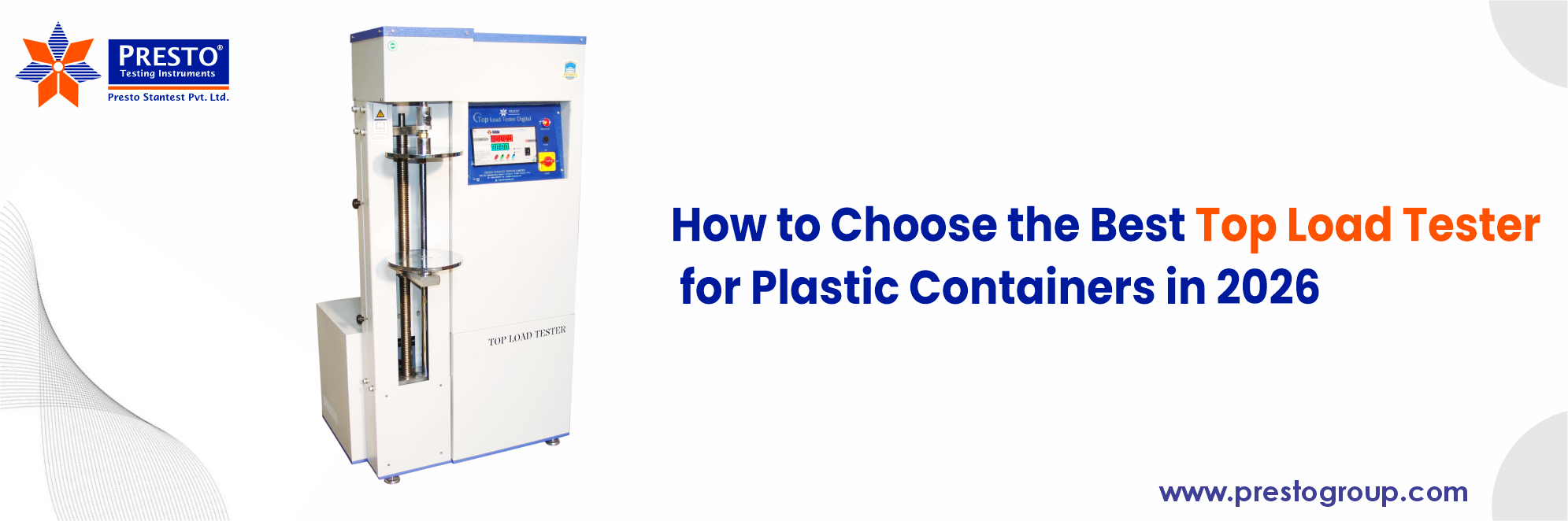
Packaging failures cost manufacturers time, money, and reputation. A reliable top load testing machine helps prevent that. It measures how much compressive force a plastic container can handle before it deforms or collapses. This single test can make or break a product's quality approval.
If you are investing in a top load tester for plastic containers in 2026, here is what you need to know before buying.
What Is Top Load Testing?
Top load testing for packaging applies a controlled axial (vertical) force to a container until it reaches the point of buckling or failure. It simulates real-world conditions such as stacking, storage, and transit pressure.
It is usually performed on blow-moulded/injection-moulded and reformed plastic bottles, HDPE jars and LDPE containers. This gives is a peak load value in kgf that tells engineers the maximum compressive strength of the container.
The Significance of Peak Load Testing in 2026
Top load testing is a standard quality metric for plastic bottles, jars and rigid containers because it measures the vertical force a container can take before deforming or failing. This test simulates real filling, capping, stacking, storage and transport conditions where containers are compressed by other packs and pallets.
For investors, the right top load testing machine directly affects product safety, brand reputation and claims risk in high volume packaging lines. It also funds light-weighting projects in which producers use fewer plastics but still maintain performance.
Key Selection Criteria For Investors
Before finalizing any top load testing machine, review these specifications carefully.
1. Container Type And Application
The first filter is the packaging portfolio the lab will test.
- Narrow‑neck PET bottles for beverages
- Wide‑mouth jars for food or nutraceuticals
- DPE or multilayer containers for chemicals and home care products
- Cartons, trays, or boxes for secondary packaging
Each format has different height and load requirements, so inTop load testing for packagingvestors must ensure the Top load testing machine offers suitable load range and frame height for current and future SKUs.
2. Load Range And Accuracy
Modern testers for plastic containers typically cover ranges from a few hundred newtons up to several kilonewtons, with fine resolution so small differences in design can be detected. A precise Digital top load tester should offer at least ±2 percent accuracy with small least count steps for reliable QC decisions.
This level of accuracy is important when plants implement light‑weighting, where safe margins reduce as wall thickness drops and process capability becomes more sensitive.
3. Digital Vs Manual Operation
A digital top load tester provides a digital display, automatic peak load hold, auto tare, and programmable test parameters, which improves repeatability and reduces operator influence. Manual units are cheaper but depend more on operator skill and usually provide limited data output.
For serious investors, digital systems are preferred because they support data logging, trend analysis, and easier integration into quality systems and audits. This makes a Top load tester for lab use more suitable for central labs and R&D centers that support multiple plants.
4. Compliance With Test Standards
Top load testing for packaging is governed by several international standards, including ASTM D642, ASTM D4577, ASTM D2659, and ASTM D4169 for compression and shipping performance. A compliant Top load testing machine allows labs to align with customer specifications and regulatory expectations across markets.
Investors should confirm that test speeds, control modes, and reporting formats can meet current and likely future standard requirements. This reduces the chance of re‑investment when buyers or export markets tighten specifications.
5. Speed, Control, And Testing Modes
Advanced systems allow control by load rate, displacement rate, or time, so engineers can simulate different real‑world stacking or capping scenarios. PLC‑controlled testers with ball screw drives and adjustable speeds deliver consistent motion and repeatable loading profiles.
Multiple modes, such as compression to fixed displacement, compression to failure, or stepped loading, give more insight into container behavior under different supply chain conditions.
6. Data, Connectivity, And Software
In 2026, investors should expect connectivity as standard rather than an add‑on. Many Digital top load tester models provide USB or RS‑232 outputs, optional software, and integration with printers for automatic reporting.
Centralized data storage supports:
- Statistical process control
- Correlation with filling or blow‑molding parameters
- Quick response when complaints or failures appear in the field
This turns top load testing into a continuous improvement tool instead of a basic pass or fail station.
Typical Features In Modern Top Load Testers
| Parameter | Basic top load unit | Advanced Top load testing machine |
| Load range | Limited, often sized for one container family | Multiple ranges or higher capacity for varied packaging |
| Display | Simple digital or analog readout | Microprocessor based Digital top load tester with peak hold and auto tare |
| Control | Manual start and stop, fixed speed | PLC control, adjustable speed and displacement, multiple test modes |
| Data output | Minimal or none | PC software, RS‑232 / USB, reporting and trend charts |
| Safety | Basic limit switch | Overload protection, automatic return, buckling stop features |
This comparison helps investors align capital spend with the level of automation and reporting actually needed in the lab.
Choosing The Right Configuration For Lab Use
A laboratory top load tester is typically positioned in a central QC laboratory or close to the production lines for convenient checks. Near-line positions require faster test cycles, robust safeguarding, and simplicity of operation, whereas central laboratory positions prioritize flexibility, higher test capacity, and more detailed information.
If plants run multiple container families, adjustable compression plates, quick‑change fixtures, and generous test space will reduce downtime between setups. For single product lines, a dedicated, lower range system may be enough as long as it still meets customer test standards.
Sourcing From The Right Manufacturers And Suppliers
The choice of top load tester manufacturers has a big influence on life‑cycle cost, uptime, and calibration quality. Established suppliers in packaging testing usually offer in‑house calibration, local service engineers, and spare parts support.
Investors should review:
- Years of experience in packaging test instruments
- Range of Top load testing for packaging solutions across sectors
- Availability of validation documents, IQ/OQ support, and training
- References from similar plants and container formats
Robust after‑sales support reduces the risk of long stoppages when components fail or standards change.
Quick Checklist Before Investing
Before signing off on a top load tester for plastic containers, an investor can walk through this simple checklist.
- Confirm container types, heights, and future formats
- Match load range and accuracy to light‑weighting targets
- Decide whether a Digital top load tester is mandatory for data and audit needs
- Check compliance with relevant ASTM and ISO standards
- Validate connectivity, software, and data export options
- Evaluate service, calibration, and support from the top load tester manufacturer
- Compare offers from multiple Top load tester suppliers to benchmark value
Using this checklist keeps the discussion grounded in risk, capability, and long term cost rather than only purchase price.
Business Case And ROI For Investors
Effective top load testing for packaging reduces transport damage, leakage, and returned goods, which directly protects margin and brand value. Data from a Top load testing machine also supports optimization of resin usage and container geometry, which can deliver ongoing material savings at scale.
When equipment is specified correctly and supported by reliable top load tester suppliers, payback typically comes from a mix of reduced failures, fewer complaints, and improved packaging efficiency rather than from test cost alone. That combination makes a well chosen Top load tester for lab use a strategic asset in any plastic packaging portfolio.
Ready to Test Smarter?
Investors looking to improve the performance of their packages can begin by identifying their container composition, volumes, and target markets, and then short-listing two or three best load testing machines that are qualified and satisfy their needs. They may then proceed to request demo tests on their own packages, such as bottles or jars, and analyze reports from various options by different Top load tester manufacturer brands. They may also consider the cost of ownership.
After identifying the best digital top load tester, investors may then consult with all key personnel on the potential savings from light-weighting, reduced rejection rates, and fewer claims, and then proceed to implement the technology in a phased manner with the support of qualified Top load tester suppliers.
Contact Presto Group Today!
Eliminate product deformation and leaks with our latest range of digital top load testers. Connect with our team to find out the best devices to fit your needs.
Call us: +91 9210903903
Email: info@prestogroup.com
Visit: www.prestogroup.com
Recent Blogs
- How to Choose the Best Top Load Tester for Plastic Containers in 2026
- Why Angular Drop Capability Matters in Drop Testing Machines
- How Box Compression Testing Helps E-Commerce Packaging Prevent Transit Damage
- How Durable Is Your Plastic? Insights from the ISO 180 Izod Test
- How Does the TAPPI T 494 Standard Measure Paper Tensile Strength?