

- /
- Blog / Why Is Torque Control Essential in Bottle Cap Testing?
Why Is Torque Control Essential in Bottle Cap Testing?
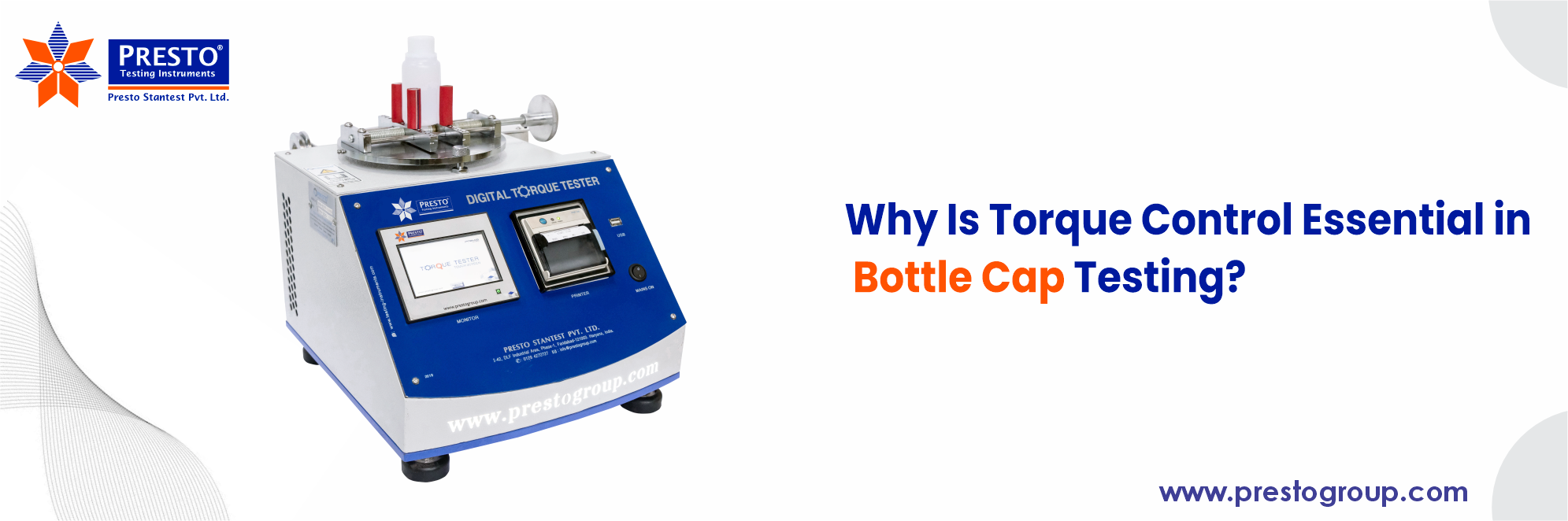
In the packaging industry, bottle tops are not just used for sealing a package. It is used for protecting the product, ensuring the freshness of the product, and safe delivery to the customer. The cap that is loose will result in leakage, whereas the cap that is too tight will be frustrating or will break the package.
The above scenario explains the importance of torque control.
The manufacturers rely on bottle-cap torque testing to ensure that caps are fitted with the correct force. The testing process measures the amount of rotational force required to close or open a bottle cap. It allows the maintenance of the integrity of products in the beverage industry, pharmaceutical industry, cosmetic industry, and chemical industry.
Torque testing is not just a technical process to investors and corporate leaders, but it is also quality assurance, compliance with the laws and regulations, and brand trustworthiness.
Understanding Bottle Cap Torque
Torque refers to the twisting force that is used to secure or loosen a cap. Essentially, it dictates the rigidity of the seal of the cap. In case companies are undertaking bottle-cap torque measurement, they measure the force that is necessary to either open the bottle-cap or to close it. This process allows establishing whether the cap falls into the established range of specifications; the violation of the standard range may cause instant problems.
Common issues include:
- Product leakage during transportation
- Broken seals or damaged threads
- Customer complaints about tight caps
- Reduced product shelf life
Because of these risks, Torque testing for bottle caps is now a standard quality practice in packaging manufacturing.
Why Torque Control Matters in Packaging
Torque control has a direct contribution to product safety, package reliability, and customer satisfaction. Without the correct torque control, the manufacturers face operational risks and loss of brand image.
The following are the primary causes as to why torque control is a necessity.
Eliminates Leakage and Product Loss
One of the most frequent reasons for packaging failure is loose caps. Caps can also be loosened during transportation due to the change of vibration and pressure. The correct bottle-cap torque test is done to make sure that the seal does not leak during storage and shipping.
Protects Product Quality
The customers need to find a cap that is easy to open and does not require much effort. The caps that are too tight can be very frustrating and can even cause harm. The proper determination of torque for a bottle cap can help manufacturers maintain a balance between safety and comfort.
Enhances Customer Fulfilment
The customers want a bottle with a cap that is easy to open, which does not demand much effort. The caps should not be too tight, as this can cause frustration and injury. The correct bottle cap torque can help the manufacturer maintain the perfect balance between safety and comfort.
Guarantees Regulatory Compliance
The packaging standards that have to be adhered to are high in many industries. Competent agencies often require that cap-sealing performance be verified. Caps testing using torque-measuring devices helps companies to comply with the requirements.
Reduces Production Defects
A small variation may arise in capping in automated filling lines. These variations are identified at early stages with the help of torque testing. Manufacturers are able to make changes in the settings of the machines prior to the defective product getting into the market.
Key Industries That Depend on Torque Testing
Several industries rely heavily on controlled torque during packaging.
| Industry | Importance of Torque Control |
| Beverage | Prevents leakage and preserves carbonation |
| Pharmaceutical | Maintains sterile packaging and patient safety |
| Cosmetics | Protects product consistency and shelf life |
| Food & Condiments | Ensures freshness and tamper protection |
| Chemicals | Prevents hazardous leaks during transport |
In all these sectors, consistent Bottle cap torque testing helps maintain product integrity.
How Bottle Cap Torque Testing Works
The testing process measures the force required to remove or apply a cap. This is typically done using a Digital torque testing machine. The machine holds the bottle securely while measuring rotational force as the cap moves.
There are two main measurements involved.
Application Torque
This measures the torque used when applying the cap during the capping process. It helps determine whether the cap is tightened properly.
Removal Torque
This measures the torque required to open the cap. Removal torque directly affects user experience and product safety.
Both values are important for quality assurance.
Key Parameters Measured in Torque Testing
Torque testing machines evaluate several important metrics.
| Parameter | Purpose |
| Application Torque | Measures the tightening force |
| Removal Torque | Measures the opening force |
| Peak Torque | Maximum torque during rotation |
| Breakaway Torque | Force required to break the initial seal |
| Strip Torque | Maximum torque before cap thread failure |
These values help packaging engineers maintain optimal sealing performance.
Types of Torque Testing Equipment
Manufacturers use different torque testers depending on production needs.
Manual Torque Testers
Manual testers are simple tools used for small-scale testing. They require operators to manually rotate the cap while recording torque values.
Advantages include:
- Lower cost
- Portable operation
- Suitable for small production lines
However, manual testers have limitations in accuracy and data recording.
Digital Torque Testing Machines
A Digital torque testing machine provides precise and automated measurements. These machines use sensors and software to measure torque accurately.
Key advantages include:
- High measurement accuracy
- Digital data recording
- Consistent testing results
- Integration with quality control systems
For large production environments, digital torque testers are the preferred option.
Benefits of Using Digital Torque Testing Machines
Modern packaging lines depend on accurate torque measurement. Digital systems improve both efficiency and quality control.
Some major benefits include:
- Real-time torque monitoring
- Reduced human error
- Data storage for quality audits
- Improved production consistency
- Faster testing cycles
Because of these benefits, many companies choose to buy Torque tester systems to upgrade their packaging quality processes.
Features to Look for in Torque Testing Equipment
Selecting the right equipment is essential for accurate testing. When evaluating Torque testing equipment for caps, manufacturers usually consider the following features.
Key features include:
- High precision torque sensors
- Adjustable bottle fixtures
- Digital display and data logging
- Multiple measurement units
- USB or software integration
- Overload protection
Reliable Torque tester manufacturer companies often provide calibration services and technical support as well.
Common Torque Testing Standards
Torque control often follows industry guidelines and testing protocols. These standards help ensure consistency across manufacturers.
| Standard Area | Purpose |
| Packaging standards | Define torque ranges for closures |
| Pharmaceutical guidelines | Ensure tamper-proof packaging |
| Food safety regulations | Prevent contamination |
| Transport testing | Simulate shipping conditions |
Compliance with these standards strengthens product credibility and brand trust.
The Role of Automation in Torque Testing
Packaging facilities are becoming more automated. This shift has increased the importance of automated torque testing systems. Automated Digital torque testing machines can integrate with production lines. They allow real-time torque monitoring during filling and capping operations. Automated torque testers help in reducing manual errors during holding and applying torque.
Automation provides several advantages:
- Continuous quality verification
- Immediate detection of torque deviations
- Reduced inspection time
- Improved production efficiency
As packaging lines scale up, automation becomes essential for maintaining consistent torque levels.
Risks of Ignoring Torque Control
Those companies that neglect the torque testing usually have serious operational issues. These issues may influence the safety of the products as well as the brand image.
Common risks include:
- The shipping with leaking bottles.
- Damaged caps or threads
- Product contamination
- Increased product returns
- Negative customer reviews
Severe results of packaging failures may even result in regulatory fines. Frequent torque measurement of bottle caps will prevent such expensive results.
Future Trends in Bottle Cap Torque Testing
The technology of packaging keeps changing, and torque testing is getting sophisticated. The future of this industry is being determined by a number of trends.
Smart Testing Systems
The testers are now modern and have digital connectivity. Information is able to be amassed, assessed, and exchanged among quality teams.
IoT Integration
Some Digital torque testing machines connect to manufacturing networks. This allows real-time monitoring across multiple production lines.
AI‑Based Quality Monitoring
The torque data can be processed by artificial intelligence, and this will assist in the early identification of possible failures.
Sustainability Focus
As sustainable packaging grows, new materials are being introduced. These materials are sensitive to the presence of torque that ensures the integrity of the seal.
The innovations will go on to advance the reliability of packaging and safety.
Wrapping Up
One of the major aspects of the quality of packaging in the modern world is torque control. This helps in maintaining the integrity of the products by ensuring that there is compliance with regulations as well as customer satisfaction. Through the testing of the bottle cap torque, the manufacturers are able to identify the problems that exist in the sealing.
Contact Presto Group Today!
Reliable bottle cap torque testing is critical for ensuring end users have a seamless experience. Facilities in need of advanced and compliant torque testing devices must get in touch with us. We provide compliance, automation, and precision with worldwide testing standards.
Call us: +91 9210903903
Email: info@prestogroup.com
Visit: www.prestogroup.com
Recent Blogs
- Why Is Torque Control Essential in Bottle Cap Testing?
- Precision in the Air: How Humidity Chambers Enable Reliable Lab Testing
- Why ASTM D642 Standard Matters in Box Compression Testing
- Flexible Packaging & Pouch Testing Instruments Seal Strength, Barrier & Durability Testing
- Testing Instruments & Lab Equipment Complete Guide to Industrial and Packaging Testing Machines