

- /
- Article / Boxes & Cartons Testing Instruments Quality Control Tests for Corrugated and Paperboard Packaging
Boxes & Cartons Testing Instruments Quality Control Tests for Corrugated and Paperboard Packaging
Corrugated boxes and paperboard cartons make up modern packaging. These help protect goods in warehouses, in shipping, or on retail shelves. With such packages failing, brands risk product damage, returns, and huge logistic costs.
To prevent this, manufacturers test the strength, the toughness, and the uniformity of every batch. These tests ensure that each box or carton performs as required in actual service.
Role of Boxes & Cartons Testing Instruments
Boxes and cartons testing instruments are laboratory devices measuring strength, stiffness, compression, impact resistance, and environmental performance of packaging materials. These instruments help packaging teams change design specifications to measurable quality standards.
With the help of such devices, manufacturers can:
- Verify corrugated board & paperboard conforms to internal and industry standards.
- Identify box behavior during stacking, handling, and transport.
- Reducing customer complaints, transit damage & material waste.
Core Quality Control Tests for Corrugated Boxes
1. Bursting Strength Test
The bursting Strength Test is sometimes called the Mullen Test, because it measures the pressure required to tear the face of a corrugated board/paperboard. The maximum pressure is recorded as a rubber diaphragm presses against the sample until it bursts.
This test demonstrates how well the box can withstand rough handling, internal pressure, and external impacts. Using hydraulic pressure and a diaphragm, a digital bursting strength tester gives bursting values for paper, cardboard, and cartons.
2. Edge Crush Test (ECT)
This edge Crush Test evaluates the corrugated board's edgewise compressive strength. A thin strip of board is pressed vertically between two plates until it collapses, and the result is edge crush strength, or ECT value.
This value depends directly on the stacking strength of an empty box in a warehouse/truck. The higher ECT enables the box to withstand heavier loads without edge crush during stacking.
3. Flat crush, Ring crush & Corrugated Crush Tests
A Crush tester can perform several related Tests on paper and board samples.
- Flat Crush Test (FCT) is a resistance Test of flutes to crushing under pressure applied at right angles to the surface.
- The Ring Crush Test (RCT) measures the compressive strength of paper and paperboard rolled into a ring.
- Corrugated Crush Test (CCT) checks corrugated board compression strength under various loading conditions.
These tests measure flute integrity, paper strength, and the contribution of each ply to total box performance.
4. Box Compression Test
The box Compression Test determines how much load a complete box can bear without collapsing. A box compression tester exerts a vertical force on the top of the box until it fails and records the peak load.
This test simulates stacking in warehouses and trucks where several boxes are left over for long periods. It assists packaging engineers in selecting flute profiles, board grade & safety factors for distribution chains.
5. Drop Test
This test checks whether a corrugated box can protect its contents from impacts during manual handling. Once filled to a specified weight, the box is dropped from defined heights on faces, edges, and corners and checked for damage.
Results show if the box structure, closures & cushioning inside are sufficient for normal handling/courier operation. For e-commerce packaging and shipments that transit through multiple hubs, this is critical.
6. Puncture Resistance Test
The puncture resistance test measures the energy required to pierce corrugated board with a pendulum or other similar device. It includes some impact and some penetration and signifies contact with edged or protruded objects during handling and transit.
Higher puncture resistance values signify better protection from nails, pallet corners, and accidental tool or equipment hits. This is important for heavy-duty cartons used for industrial and export packaging.
Tests for Paper and Paperboard Used in Cartons
1. Tensile Strength Test
Tensile testing measures how far paper or paperboard can be pulled apart in the machine or cross directions. Established standards like TAPPI T494 for paper and paperboard direct test conditions and specimen preparation.
Results help manufacturers check that base paper can handle processing, folding, filling, and sealing operations in converting lines. A simple tensile test could serve as a quality control tool for batch and supplier comparison.
2. Grammage, Thickness & Stiffness
Not always difficult tests, but very important for board selection. Instruments measure sheet weight per unit area and thickness to confirm consistency with specifications.
Stiffness testers measure bending resistance and affect the performance of cartons on carton formers, filling lines, and retail shelves. Correct stiffness helps shelf appearance and stackability - especially for folding cartons!
3. Moisture Content & Environmental Conditioning
Paper & paperboard are sensitive to humidity and temperature; moisture Content testing & Conditioning are part of quality assurance. Standard conditioning procedures assure that tensile and related tests are realistic.
Following moisture and conditioning samples before testing helps manufacturers predict how cartons perform in tropical, cold, or variable climates. This applies mainly to export packing & long logistics chains.
Key Test Instruments For Boxes And Cartons
1. Bursting Strength Tester
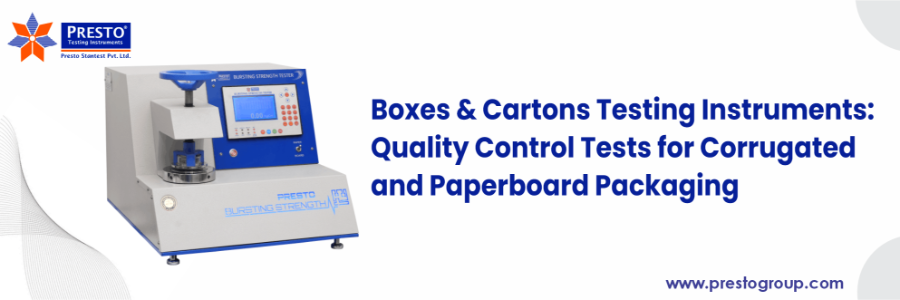
A bursting Strength Tester measures the resistance of paper, cardboard, and corrugated board to rupture under pressure. The modern digital models use hydraulic pressure and a rubber diaphragm. It gives direct readouts of bursting strength and bursting factor.
They are used mainly in quality labs for box grade classification and checking of incoming material against purchase specifications. They support packaging performance standards ASTM and ISO 9001: 2008.
2. Special Edge Crush Testers
Crush testers measure ECT, RCT, FCT, and CCT on small samples. They place controlled compressive loads at specified speeds and record the maximum forces before failure.
One versatile crush tester allows a packaging lab to test paper, single-wall, double-wall, and triple-wall corrugated boards. This flexibility enables optimal flute combinations and paper grades for different loads and supply chains.
3. Box Compression Tester
Box compression testers apply vertical loads to filled/empty boxes. They have rigid load frames, moving platens, load cells & digital controllers to record exact failure loads over a period of time.
Combined with other test setups, these instruments simulate warehouse stacking, long-term storage, and transport vibration. They also validate designs for cost reduction, as lighter boards still meet safety margins.
4. Drop Tester
Drop testers offer controlled, repeatable conditions for dropping cartons on predetermined orientations. They incorporate platforms and means for releasing cartons from fixed heights, without the added rotation or movement.
Using a drop tester instead of manual dropping ensures consistent results and allows packaging teams to compare different designs or cushioning systems objectively. This creates reliable e-commerce/courier-ready packaging.
5. Additional Lab Instruments
Some packaging labs use a combination of other Instruments to build a full test profile. These can include:
- Sealed pack and lined carton vacuum leak testers.
- Core compression testers for film/foil cores.
- In environmental chambers, cartons and materials are exposed to controlled humidity/temperature cycles in accordance with the humidity and temperature cycles.
Using these instruments together enables a better picture of packaging performance under real-world stress.
Benefits of Systematic Testing for Packaging
Consistent usage of testing instruments brings several business and technical benefits. By catching weak batches early, manufacturers can reduce material variation, convert better & reduce waste.
Brand owners report fewer transit damages, fewer claims, and improved customer satisfaction when boxes don't crush, burst, and deform in the supply stream. Over time, accurate testing data also supports lightweighting efforts where board grades are optimized while maintaining safety.
How to Use a Practical Testing Program
A practical program starts by specifying performance requirements for packaging applications, such as stacking height, transport mode & product fragility. From there, packaging engineers select appropriate tests like bursting, ECT, compression, drop, and puncture resistance based on those conditions.
Then the team selects appropriate instruments from reputable manufacturers that are easy for operators to use. Clear test methods, training, and routine calibration retain accuracy and repeatability over time.
Wrapping Up
For manufacturers whose products rely on corrugated and paperboard packaging, quality can not be compromised. Investing in the right boxes and cartons for testing instruments allows them to validate each design, each batch of material, and each box sent to customers.
For packaging, quality control is more than passing a test. It is about protecting products, enhancing brands, and controlling costs in the supply chain. Using bursting strength testers, edge crush testers, box compression testers, drop testers, and other related equipment, any plant can establish a data-driven quality system for corrugated/paperboard packaging.
Contact Presto Group Today!
Packaging plays a vital role in keeping products safe before they reach the customer. We provide an extensive range of Carton and Box Testing instruments to help gauge structural strength and handling endurance in real-world circumstances.
Call us: +91 9210903903
Email: [email protected]
Visit: www.prestogroup.com
Recent Articles
- Climatic Chamber: Working Principle, Uses, Diagram, Price & Top Manufacturers in India
- Izod vs Charpy Impact Test: Difference, Method & Standards
- Colorimeter vs Spectrophotometer: Accuracy, Working Principle, and Industrial Uses
- Quality Assurance and Quality Control: Two Pillars of Product Excellence
- Hardness Test: Types, Testing Methods, Procedures, and ASTM Standards
Need more information
Connect with us for your business enquiries. Generally, we respond within one or two working days.