

- /
- Article / Core Functions of Universal Testing Machines for Tensile and Compression Analysis
Core Functions of Universal Testing Machines for Tensile and Compression Analysis
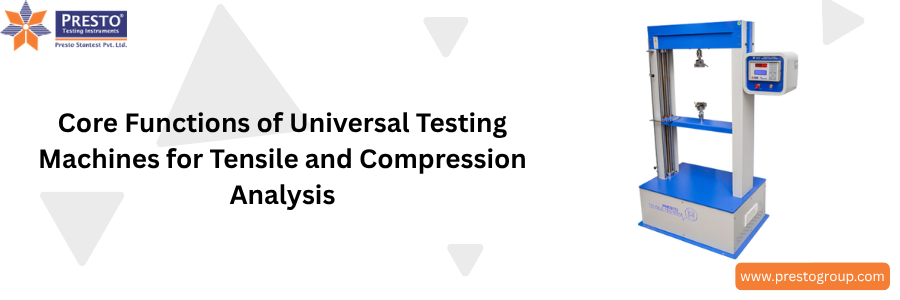
In manufacturing and product development, testing materials properly is not just a quality step anymore — it’s something every serious industry depends on. Whether it is packaging, automotive parts, plastic products, metals, or construction materials, companies need to know how strong their materials actually are before they go into the market.
That is where a Universal Testing Machine, commonly called a UTM, becomes important. A tensile and compression testing machine helps manufacturers understand how a material behaves under different kinds of force. It tells whether a product can handle pulling pressure, compression load, stretching, bending, or deformation during actual use.
Today, industries are using advanced testing systems to improve quality consistency and reduce product failure. In this blog, we’ll understand the important universal testing machine functions, its working principle, applications, and how tensile and compression testing are performed in real industrial environments.
Introduction to Universal Testing Machines
A Universal Testing Machine is a laboratory testing equipment used for checking the mechanical strength of materials. The machine is called “universal” because it can perform multiple tests using different fixtures and attachments.
Mainly, it is used for:-
- Tensile testing
- Compression testing
- Bend testing
- Shear testing
- Peel and adhesion testing
The machine applies controlled force on a sample and records how the material reacts under stress. This helps manufacturers evaluate strength, durability, elasticity and overall performance.
Most industries prefer a UTM machine for tensile strength testing because it gives highly accurate and repeatable results.
Inside the Working of a Universal Testing Machine
To understand the universal testing machine working, it’s important to know how the machine applies force on the sample.
A standard UTM mainly consists of:-
| Component | Function |
| Load Frame | Supports the testing structure |
| Crosshead | Moves to apply force |
| Load Cell | Measures the force applied |
| Grips & Fixtures | Holds the specimen properly |
| Controller & Software | Operates and records test data |
During the test, the sample is fixed between the grips or compression plates. Then the crosshead moves at a controlled speed and applies force gradually. The machine continuously records load and deformation values till the sample breaks or compresses fully.
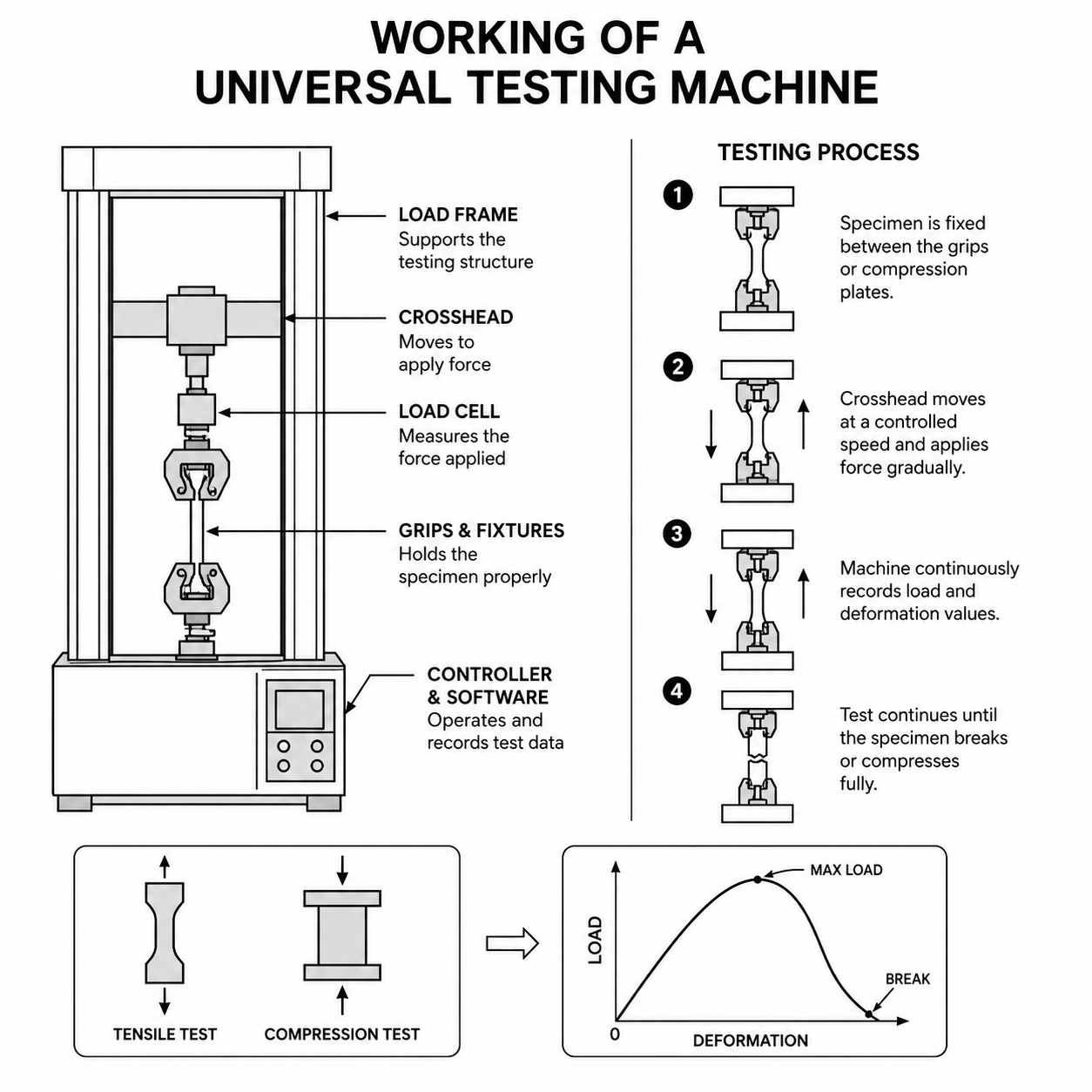
This is the basic process behind both UTM tensile testing and compression testing using UTM.
Important Universal Testing Machine Functions
One of the biggest reasons industries use UTMs is because one machine can perform multiple material tests. Let’s understand some major universal testing machine functions in a practical way.
1. Tensile Strength Testing
Tensile testing is probably the most common use of a UTM. In this test, the machine pulls the material from both ends until it breaks.
This test helps measure:-
- Tensile strength
- Breaking point
- Elongation
- Yield strength
- Material flexibility
Industries perform UTM tensile testing on materials like:-
- Plastic films
- Metals
- Rubber
- Wires and cables
- Packaging materials
- Composite products
The data helps manufacturers know whether the material can survive actual working conditions or not.
2. Compression Testing
Compression testing checks how much compressive load a material can handle before deforming or failing.
A compression strength testing machine is commonly used in industries where products experience stacking pressure or crushing force during handling and transportation.
Some common products tested are:-
- Corrugated boxes
- Foam materials
- Concrete blocks
- Plastic containers
- Springs
- Packaging products
In compression testing using UTM, the sample is placed between two compression plates and force is applied downward slowly. The machine records the compression strength and deformation behavior.
This test becomes very important in packaging industries because weak packaging can lead to product damage during shipping.
3. Flexural and Bend Testing
Many materials face bending stress during actual use. A UTM can also perform flexural testing to check how much bending load a material can tolerate.
This is commonly done for:-
- Plastic sheets
- Construction materials
- Composite panels
- Engineering products
The test helps in understanding stiffness and bending strength.
4. Peel and Adhesion Testing
Packaging and adhesive industries often use UTM for peel strength testing.
This helps manufacturers check:-
- Seal strength
- Adhesive bonding quality
- Lamination strength
- Tape adhesion performance
It ensures packaging seals remain durable during transportation and storage.
Tensile Strength Testing Procedure
The tensile strength testing procedure may look technical, but the process is actually very systematic.
Here’s how it generally works:-
Sample Preparation: The specimen is prepared according to testing standards like ASTM or ISO.
- Mounting the Sample: The material is fixed carefully between the grips of the UTM.
- Setting Parameters: Testing speed, load range, and test conditions are selected in the software.
- Applying Tensile Force: The machine starts pulling the sample gradually.
- Data Collection: The software records stress and strain values continuously.
- Final Result: Once the sample breaks, the machine generates the final tensile strength report.
Modern testing systems from Presto Group make this process much easier with digital controls and automated result generation.
Why Compression Testing is Important
Compression testing is often ignored compared to tensile testing, but in many industries it is equally important.
For example, in the packaging sector, boxes are stacked during storage and transportation. If the packaging cannot handle compression load, products inside may get damaged.
That’s why companies use a compression strength testing machine to verify packaging durability before shipment.
Similarly, construction materials like concrete blocks also require compression analysis to ensure structural safety.
Using proper compression testing using UTM helps industries reduce product failures and improve customer satisfaction.
Universal Testing Machine Applications in Different Industries
The demand for UTMs is growing because almost every manufacturing sector requires material testing at some stage.
Some major universal testing machine applications include:-
- Automotive Industry: Testing seat belts, metal parts, springs, wires, and plastic components.
- Packaging Industry: Checking box compression strength, film strength, and seal quality.
- Plastic Industry: Evaluating tensile and flexural properties of polymers.
- Construction Industry: Testing concrete, steel bars, and structural materials.
- Aerospace Sector: Testing lightweight but high-strength materials.
- Medical Industry: Used for syringes, medical packaging, implants, and biomedical products.
Companies like Presto Group provide advanced testing solutions for many of these industrial applications.
Benefits of Using a Universal Testing Machine
There are several reasons why industries invest in high-quality UTM systems.
Accurate Results:- Modern machines provide very precise force measurement.
Multiple Testing in One Machine:- A single UTM can perform tensile, compression, bend, peel and shear testing.
Better Quality Control:- Testing helps manufacturers identify weak materials before production.
Compliance with Standards:- UTMs support ASTM, ISO, and other international testing standards.
Reduced Product Failure:- Proper testing reduces complaints and product damage in the market.
How to Choose the Right UTM
Choosing the correct testing machine depends on the type of material and testing requirement.
Before selecting a machine, companies usually consider:
- Maximum load capacity
- Material type
- Required testing standards
- Software features
- Automation level
- Fixture compatibility
A reliable testing partner is also important because proper calibration and support directly affect testing accuracy.
Future of Material Testing
Material testing technology is changing rapidly. Modern UTMs now come with smart software, automation, and cloud-based reporting systems.
Some latest trends include:-
- AI-based data analysis
- IoT-enabled monitoring
- Automated specimen alignment
- Real-time reporting
- Advanced digital interfaces
These technologies are helping industries improve efficiency and reduce manual errors in testing laboratories.
The Growing Importance of Tensile and Compression Testing
Nowadays, industries cannot depend only on visual inspection or assumptions when it comes to product quality. Materials need to be tested properly before they are used in real applications. That’s why Universal Testing Machines are becoming a very important part of quality control labs.
Whether it is checking the strength of metal, testing packaging boxes under load, or understanding how plastic materials behave under pressure, a UTM helps companies get clear and reliable data. It gives manufacturers confidence that their products can handle real working conditions without failing easily.
Another reason industries prefer these machines is because one system can perform different types of tests. This saves both time and effort in the testing process.
As product quality standards are increasing every year, companies are now focusing more on accurate and consistent testing. Reliable testing equipment from Presto Group is helping industries improve testing accuracy and maintain better product quality without making the process too complicated.
FAQs
Q1) Why companies do testing with a Universal Testing Machine?
Ans: Before using any material in production, companies usually want to check whether it can handle real working conditions or not. A Universal Testing Machine helps them test the material strength, pressure handling, stretching capacity, and overall performance before the final product is made.
Q2) What materials are mostly checked in a UTM?
Ans: UTM machines are used for testing many kinds of materials. Industries commonly test plastic items, rubber products, metal samples, packaging boxes, films, wires, foam sheets, and sometimes construction materials too.
Q3) What happens in tensile and compression testing?
Ans: In tensile testing, the material is pulled slowly from both sides to see at what point it starts breaking. In compression testing, the sample is compressed or pressed to understand how much pressure it can take before getting damaged.
Q4) Why is tensile testing useful for manufacturers?
Ans: Tensile testing helps manufacturers know if the material is strong enough for actual usage. It becomes easier to avoid low-quality products and maintain better product consistency before supplying items to customers.
Contact Presto Group for Advanced Testing Solutions
If you are looking for a reliable UTM machine for tensile strength testing or advanced compression testing solutions, connect with the experts at Presto Group.

Phone:- +91 9210 903 903
Email:- [email protected]
Get accurate testing results, expert support, and high-quality testing equipment designed to improve your product performance and quality standards.
Recent Articles
- Climatic Chamber: Working Principle, Uses, Diagram, Price & Top Manufacturers in India
- Izod vs Charpy Impact Test: Difference, Method & Standards
- Colorimeter vs Spectrophotometer: Accuracy, Working Principle, and Industrial Uses
- Quality Assurance and Quality Control: Two Pillars of Product Excellence
- Hardness Test: Types, Testing Methods, Procedures, and ASTM Standards
Need more information
Connect with us for your business enquiries. Generally, we respond within one or two working days.