
- /
- Article / Industrial Corrosion Testing Standards: ASTM B117 & ISO 9227 Overview
Industrial Corrosion Testing Standards: ASTM B117 & ISO 9227 Overview
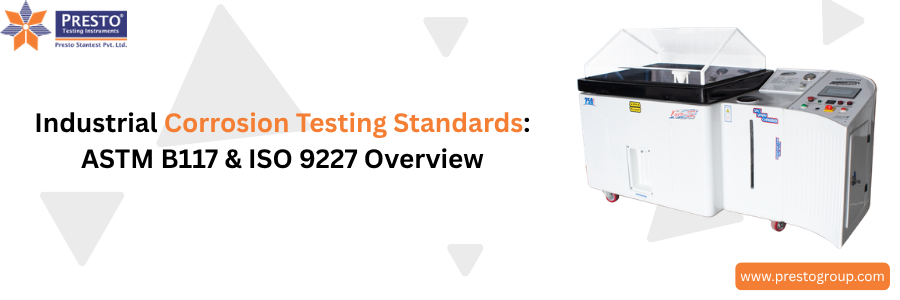
Corrosion silently costs global industries billions of dollars annually. It degrades metals quickly. It compromises protective coatings completely. Replacing rusted infrastructure destroys corporate budgets and ruins massive commercial projects. Manufacturers rely heavily on internationally recognized rules to combat this financial drain. They use these specific engineering documents to evaluate how materials perform under extremely harsh environments. Two specific frameworks form the absolute backbone of modern diagnostic protocols worldwide.
What Is Accelerated Environmental Diagnostics?
Evaluating metal decay requires highly controlled laboratory techniques constantly. Engineers cannot wait several years for real world degradation to naturally occur outside. Manufacturers instead utilize accelerated environmental exposure to simulate decades of harsh damage rapidly. This specialized evaluation assesses the true endurance of metals and surface treatments efficiently.
The Science Behind the Evaluation
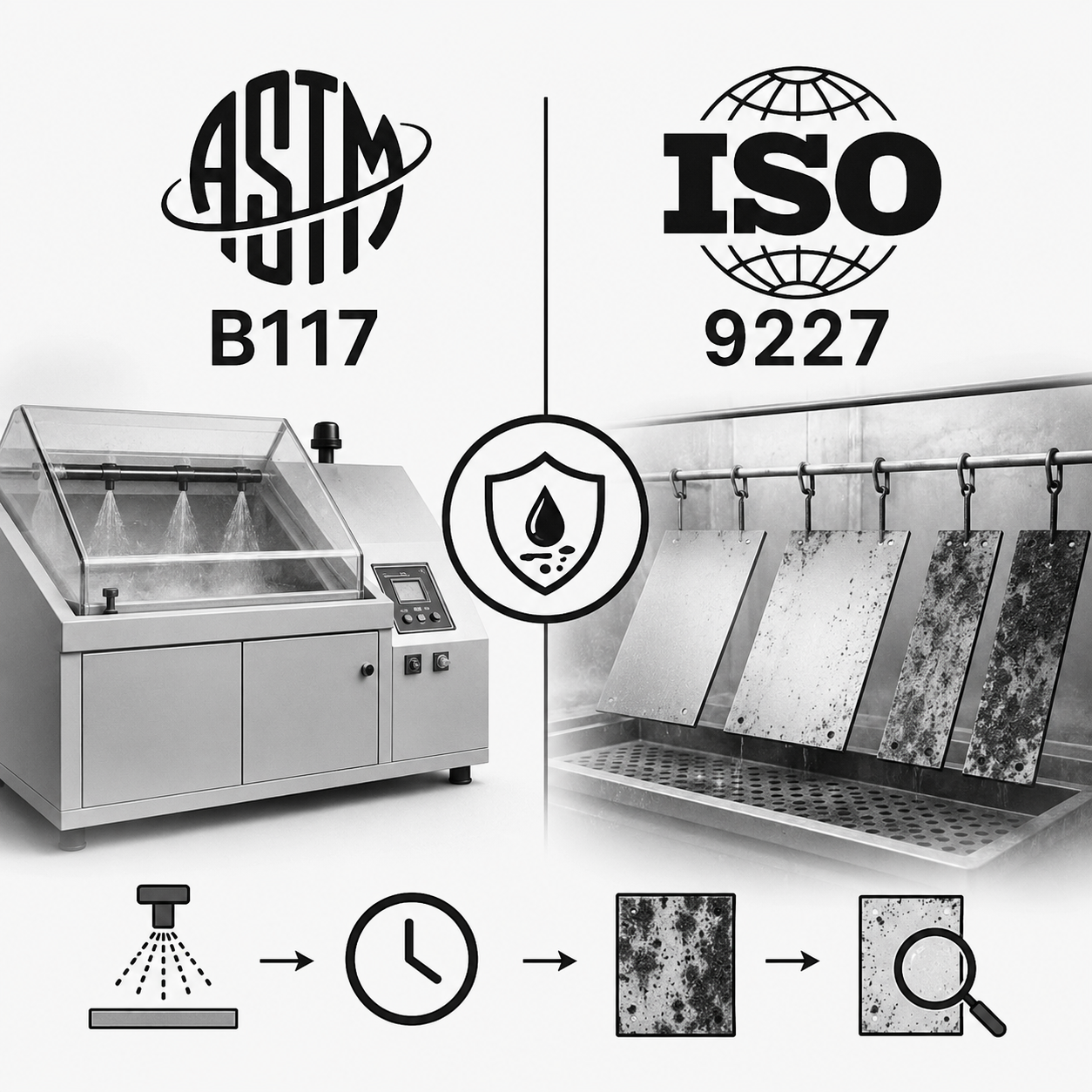
The process involves exposing raw materials to intensified saline conditions indoors. Technicians place the parts inside a highly specialized corrosion testing chamber safely. This massive machine creates a remarkably hostile environment. It simulates extreme coastal weather flawlessly. The sealed cabinet maintains a perfect temperature while spraying a continuous acidic mist.
Industrial Applications
This diagnostic process remains absolutely essential across multiple global sectors today. Reliable physical data helps engineers make incredibly critical manufacturing decisions daily. They must select the proper protective coatings before a product ever reaches the market.
- Automotive builders test steel chassis components and heavy brake systems.
- Aerospace engineers evaluate thick aluminum alloys and specialized paint.
- Marine manufacturers check heavy offshore equipment for total seaworthiness.
ASTM B117: The Global Gold Standard
American engineering societies published one of the most widely adopted testing methods globally. This foundational document boasts a massive century of proven industrial application everywhere. It serves as the primary operational procedure for countless global manufacturing sectors today. Following this exact recipe ensures completely uniform quality control data across different continents.
Defining the ASTM Framework
The ASTM B117 standard stands firmly as the absolute benchmark for atmospheric testing. It provides meticulous guidance on apparatus setup and internal air pressure regulation. The document strictly dictates saline water concentration control and proper specimen handling techniques.
Key Operational Parameters
Running this specific evaluation requires absolute precision from the laboratory staff. The system operates under extremely carefully controlled physical parameters. Every single variable is strictly monitored to guarantee perfect scientific repeatability.
- Chamber temperature: 35°C (constant)
- Salt solution: 5% sodium chloride (NaCl) with a pH of 6.5 to 7.2
- Fog collection rate: 1–2 mL/hr collected in a 10 cm diameter funnel
- Minimum test duration: 16 continuous, uninterrupted hours
- Exposure: Continuous atomized salt fog applied to test specimens
ISO 9227: The International Benchmark
The International Organization for Standardization published their own rigorous equivalent document recently. It builds heavily upon the same basic criteria found in the American framework. However, this global version offers several additional testing variants for highly specialized applications. This expanded scope makes it incredibly comprehensive for diverse international regulatory environments.
Understanding the International Rules
The ISO 9227 standard dictates exactly how global laboratories must conduct accelerated weathering evaluations. A notable procedural difference involves the minimum required testing duration. This international framework requires a minimum of twenty four continuous hours of uninterrupted exposure. This slight increase reflects its highly stringent application globally.
Exploring the Three Variations
This massive international framework actually outlines three distinct testing methodologies clearly. These varying salt spray test standards give engineers highly flexible diagnostic tools. Choosing the right variant is crucial for different industrial materials.
- Neutral Salt Spray (NSS): The most common variant, using a 5% NaCl solution at 35°C — directly comparable to ASTM B117
- Acetic Acid Salt Spray (AASS): Uses an acidified salt solution for more aggressive testing of decorative coatings
- Copper-Accelerated Acetic Acid Salt Spray (CASS): The most aggressive variant, used to test anodic coatings and electroplated surfaces
Executing the Physical Laboratory Evaluation
Running a proper laboratory evaluation demands intense daily supervision from trained professionals. Technicians must prepare every single sample perfectly before the mechanical fogging begins. The actual physical orientation of the metal drastically alters the final scientific results. Strict adherence to the official rulebook guarantees accurate and highly repeatable diagnostic information.
The Standardized Workflow
Regardless of the chosen framework, the general salt spray test procedure follows a completely consistent workflow. Workers must clean the metal specimens thoroughly using approved industrial solvents first. Removing all microscopic oils prevents the saline mist from bouncing off improperly. They then configure the machine to match the exact temperature requirements. Finally, they position the pristine specimens at the correct angle inside the cabinet.
Continuous Monitoring Requirements
The system must generate a continuous and completely uniform mist constantly. Operators perform salt spray chamber testing by periodically checking the internal collection funnels. They meticulously document the exact amount of falling salty liquid hourly. At defined intervals, technicians inspect the specimens for early signs of coating breakdown or blistering. This constant vigilance prevents sudden mechanical failures from ruining the lengthy scientific experiment.
ASTM B117 vs. ISO 9227: Key Differences
While both standards share the same fundamental test conditions, there are technical distinctions worth noting:
| Parameter | ASTM B117 | ISO 9227 |
| Origin | USA (ASTM International) | Global (ISO) |
| Test Type | Neutral Salt Spray only | NSS, AASS, CASS variants |
| Minimum Duration | 16 hours | 24 hours |
| Chamber Temp | 35°C | 35°C |
| NaCl Concentration | 5% | 5% |
| pH Range | 6.5–7.2 | 6.5–7.2 |
| Primary Use | General metals & coatings | Coatings & industrial application |
Why Accurate Equipment Matters Immensely
A diagnostic evaluation is only as reliable as the equipment used to conduct it. The hardware must maintain incredibly stable and highly repeatable conditions throughout the entire cycle. Any sudden deviation in machine performance produces completely inaccurate scientific data instantly. Equipment quality remains a critical factor in strict legal compliance and final product validation.
Maintaining Stable Environments
High quality machines ensure perfectly uniform fog distribution across the entire testing zone. They manage internal condensate brilliantly to prevent liquid pooling on the hanging samples. The sealed construction prevents any unwanted external air from corrupting the internal atmospheric balance.
The Ultimate Goal of Diagnostics
Routine corrosion resistance testing detects hidden microscopic pores and tiny surface defects effortlessly. It provides both qualitative and highly quantitative data regarding organic and anodic oxide coatings. Finding these weak spots early prevents catastrophic structural failures during unexpected severe weather events. Engineers analyze the rusted pieces to understand the exact chemical decay patterns perfectly.
Secure Quality and Compliance with Modern Testing Instruments
Securing the future of your manufactured products demands absolute scientific precision daily. You cannot guess how a new metal alloy will survive in the harsh real world. Implementing rigorous quality control measures prevents catastrophic product failures entirely. Utilizing the correct engineering guidelines guarantees total global compliance and ultimate consumer safety.
Are you ready to eliminate dangerous structural decay from your production line completely? Do not leave your vital corporate reputation to random chance. Contact a certified laboratory equipment supplier today to find the perfect diagnostic instruments for your facility. Invest in proven testing hardware right now to secure your entire supply chain permanently.
Ready to Ensure Compliance with ASTM B117 & ISO 9227 Standards?
Protect your products from corrosion failure with high-precision Salt Spray Chambers and advanced corrosion testing solutions from Presto Group. Our experts help manufacturers achieve reliable quality control, global compliance, and long-term product durability.
Call us: +91 9210903903
Email: [email protected]
 Boost product reliability with trusted industrial testing equipment today.
Recent Articles
- Climatic Chamber: Working Principle, Uses, Diagram, Price & Top Manufacturers in India
- Izod vs Charpy Impact Test: Difference, Method & Standards
- Colorimeter vs Spectrophotometer: Accuracy, Working Principle, and Industrial Uses
- Quality Assurance and Quality Control: Two Pillars of Product Excellence
- Hardness Test: Types, Testing Methods, Procedures, and ASTM Standards
Need more information
Connect with us for your business enquiries. Generally, we respond within one or two working days.