

- /
- Article / Easily perform T-peel test on Adhesive with Presto peel tester
Easily perform T-peel test on Adhesive with Presto peel tester
Gaurav Malhotra
11-8-2023
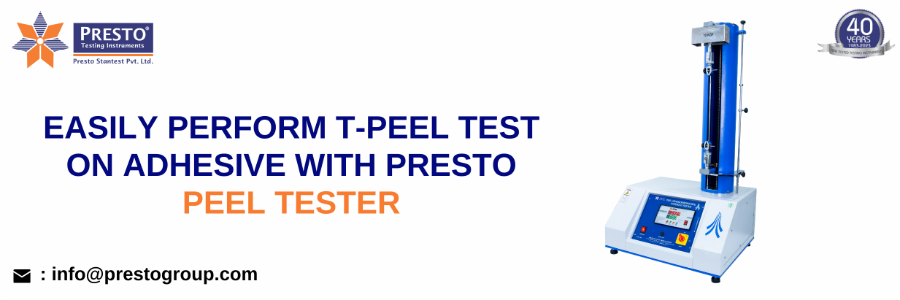
The T-peel test or T-peel adhesion test is a widely used quality test that can be used to evaluate the bond strength between two adhered surfaces. By quantifying the peel ability of different packaging materials, one can easily ensure that quality materials will be delivered to the customers. Thus, we at Presto have designed a high-quality lab testing instrument known as a peel/seal/bond adhesion tester that is used to quantify the permanence of adhesion or peel ability of self-adhesive pressure-sensitive materials. This quality testing equipment has been designed to test the material under specified test conditions from the plate at a specified angle and speed.
Introduction to T-peel test
All about Presto peel adhesion tester
Features of Presto peel strength tester
- Microprocessor-based display for accurate test results
- Display for Peel Adhesive strength of test specimen
- Highly accurate test results under force.
- Strong gripping clamps to perform the Peel test at 180
- Bright LED display
- Inbuilt calibration facility
- Feather touch controls
Technical specifications of Presto peel strength tester
- Load Cell Capacity: 20Kgf
- Display: LED (Digital) 7 segment
- Accuracy: ± 1% at full load (with master load)
- Least Count/Resolution: 0.020 Kgf
- Power: 220V, Single phase, 50 Hz
- Test Speed: 300 mm/min± 5%
- Memory: After perform the test max. value save in memory
- Grip Separation: Min. 25 mm & Max. 300 mm
- Safety Switch: Yes
- Material: Mild Steel
How to conduct a peel strength test on the materials?
- When initiating the test using this laboratory equipment, begin by preparing the specimen. Once the specimen is ready for the peel test, proceed to operate the machine.
- To operate the equipment, connect it to a 5-amp, 220-volt AC power source and turn the machine ON.
- Following this, insert the upper part of the specimen between the fixed upper grips and securely tighten the grip.
- Subsequently, raise the lower movable grip to accommodate the specimen comfortably within the grips, ensuring a minimum distance of 25 mm with the lower limit switch ring.
- Next, position the lower end of the specimen between the lower grips and firmly secure the grip, ensuring the specimen is centred within the grips.
- With the specimen accurately positioned for the peel test, you are ready to initiate the testing process.
Recent Articles
- Climatic Chamber: Working Principle, Uses, Diagram, Price & Top Manufacturers in India
- Izod vs Charpy Impact Test: Difference, Method & Standards
- Colorimeter vs Spectrophotometer: Accuracy, Working Principle, and Industrial Uses
- Quality Assurance and Quality Control: Two Pillars of Product Excellence
- Hardness Test: Types, Testing Methods, Procedures, and ASTM Standards

Need more information
Connect with us for your business enquiries. Generally, we respond within one or two working days.