

- /
- Article / How you can check the compression strength of corrugated boxes?
How you can check the compression strength of corrugated boxes?
11-5-2022
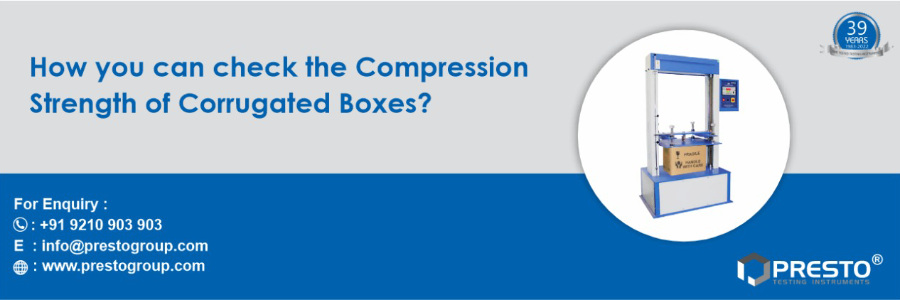
Corrugated boxes are widely used in the packaging industry due to their durability and affordability. However, over time, even the well-made corrugated box will start to show signs of wear and tear. This is why it is so important to regularly test the box compression strength of these boxes. By doing so, manufacturers can ensure that their boxes will be able to withstand the rigors of transportation and storage. Thus, Presto has come up with one of the widely trusted testing instruments for testing the box compression strength of corrugated boxes. This instrument is known as a box compression tester.
This lab testing instrument plays a vital role in the paper and packaging industry as it will accurately display the value of box compression strength for corrugated boxes. Once you test your box for its compression strength then you will be able to maintain the integrity of the boxes while shipping and storage. Here in this article, we are going to provide you the information about how you can accurately check the compression strength of corrugated boxes with ease. So, let us get started!
What if your box will get compressed during shipping?
Product damage is an unfortunate but unavoidable part of the packaging business. During the shipping process, the box will get transported from one place to another. They may also get stacked over each other which may result in the box damage. When they are compressed during shipping then the product inside it will get damaged.
In order to prevent your product from getting damaged during shipping, it is important to choose the right type of packaging. Corrugated boxes that are designed for shipping need to be strong enough to withstand compression forces when they get stacked over each other. If the boxes are too weak, they will collapse and the product inside will be damaged.
Thus, with the Presto box compression testing instrument you will be able to measure the box stacking capability and durability so that the right products will be delivered to the customers. There are many benefits you will get with the Presto box compression tester.
In addition, by regularly testing the box compression strength of their products, manufacturers can also identify any potential areas of improvement. By taking these measures, manufacturers can help to ensure that their products will remain safe and functional for years to come.
Below we have listed the features and technical specifications of this lab testing equipment.
Features of Presto box compression tester
A box compression tester, also called a box crush tester, is used to measure the box compression strength of a corrugated box. This value is important because it gives an indication of how the box will perform when it is subject to forces that compress, squish, or flatten it. The box compression strength is determined by measuring the amount of force required to cause a certain amount of deformation in the box. Presto box compression tester is an ideal testing instrument that works effectively to determine the maximum load range a box or a carton can tolerate till it is deformed.
Here are the features of this lab testing equipment:
- Microprocessor-based display for accurate test results
- Highly accurate test results under uniform compression Force
- TARE and Peak Hold Facility Available
- Over-travel protection
- Strong base plate with rugged structure
- Bright LED display
- Feather touch controls
- Available in various platform sizes and Load Cell Capacity.
- Optional Printer Facility
Technical Specifications of Presto box compression tester
- Type: Compression
- Capacity: 500 Kgf
- Display: LED (Digital)
- Accuracy: ± 2% full scale (with master load).
- Least Count: 200 gm
- Power: 220V, Single phase, 50 Hz
- Test Platform Size : 450 * 450 mm
- Test Speed: 12.5 ± 2.5 mm/min
- Motor: 1 HP Three Phase, 1350 rpm
- Standard: ASTM D642, ASTM D4169, TAPPI T804, ISO 12048, and JIS Z0212.
With these features and technical specifications, it will be easy for you to test the box compression strength of boxes and cartons with ease. You can also read about the top 4 tips to choose a box compression tester with ease.
Now let us focus on how you can easily check the strength of corrugated boxes using a box compression tester.
Steps to check compression strength of corrugated boxes using Presto box compression tester
- Whenever you are going to check the compression strength of boxes then you need to prepare the specimen first.
- After that, you can start the machine by plugging the machine into a 15 amp, 220 Volts AC.
- Once you start the machine then you can place the specimen accurately on the platform in the center and parallel to the compression plate.
- Bring the compression plate near the specimen by moving the rotary switch in a downward direction. Users can make use of the fast runner option to take the compression plate just above the test specimen with an increased speed of 50 mm/min.
- Apply a preload of 1 or 2 kgf on the specimen to remove any air gap between the compression plate and the specimen.
- Once all the above steps are formed, then you can easily commence the test.
In this way, you can easily check the compression strength of corrugated boxes with ease. If you want to know about box compression tester price or want to take a FREE sample testing session then give us a call at +91 9210903903 or email us at info@prestogroup.com. Our team of technical experts will consult you regarding all your queries.
Recent Articles
- Climatic Chamber: Working Principle, Uses, Diagram, Price & Top Manufacturers in India
- Izod vs Charpy Impact Test: Difference, Method & Standards
- Colorimeter vs Spectrophotometer: Accuracy, Working Principle, and Industrial Uses
- Quality Assurance and Quality Control: Two Pillars of Product Excellence
- Hardness Test: Types, Testing Methods, Procedures, and ASTM Standards
Need more information
Connect with us for your business enquiries. Generally, we respond within one or two working days.