

- /
- Blog / How Durable Is Your Plastic? Insights from the ISO 180 Izod Test
How Durable Is Your Plastic? Insights from the ISO 180 Izod Test
For an investor, plastic is not just a material. It is a risk factor, a cost driver, and a reputation issue rolled into one. When a part snaps under sudden impact, the real loss shows up in recalls, claims, and brand damage.
That is where the ISO 180 Izod impact test becomes a practical decision tool, not just a lab routine.
Quick Answer for Investors
- How likely is a plastic to fail under real-world knocks and drops?
- Whether a supplier’s “high impact” claim is backed by a global standard.
- How a material or product line will behave under safety and warranty pressure over time
Definition of ISO 180 and the Izod Test
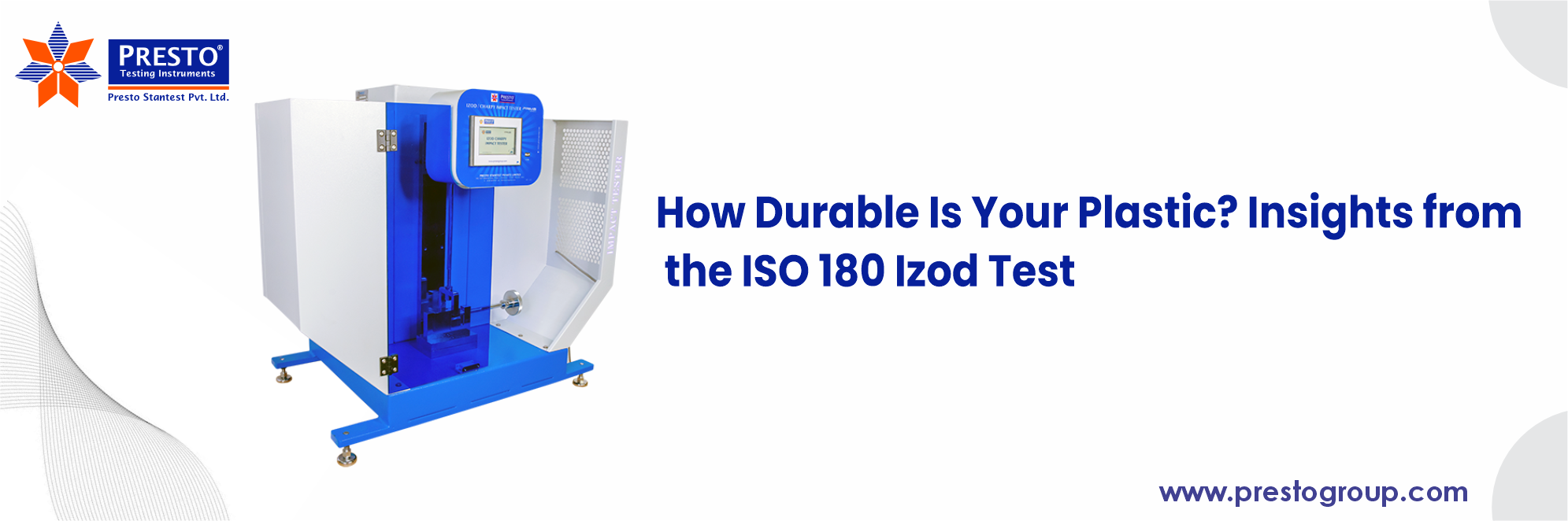
ISO 180 is the global standard for measuring the Izod impact strength of plastics using a pendulum-type impact test. The test sample is clamped like a mini cantilever beam with a notch that concentrates the stress at the point where the sample will break.
In this arrangement, a pendulum swings down and strikes the notched sample, shattering it, and then the machine determines how much energy the sample had absorbed during the fracture. This impact strength is always measured in terms of energy per unit area at the notch, such as kJ per square meter.
For an investor, this is a remarkably concise and comparable method of viewing how various plastics will perform at high strain rates, which is precisely how most failures happen in the real world.
Standardized Izod Testing Methodology
A clear view of the Izod testing method helps investors judge both material data and lab capability.
Typical ISO 180 Plastic impact strength testing flow:
- A standard ISO 180 specimen is prepared with defined dimensions and a precise notch.
- The specimen is clamped vertically in the Izod impact testing machine, cantilever style, with the notch facing the pendulum.
- A pendulum of known potential energy is released from a fixed height and strikes the specimen.
- The machine reads how far the pendulum swings after impact and calculates the absorbed energy.
- Impact strength is computed as energy absorbed divided by the cross-section at the notch.
Because the notch and geometry are tightly controlled, investors can compare results across batches, suppliers, sites, or even competing materials in a portfolio.
Interpretation of Izod Impact Strength Values
Exact acceptance criteria differ by industry. Still, investors can use simple patterns from the Izod impact test for plastics to read risk levels.
Indicative view of Izod impact performance
| Impact behavior (qualitative) | Typical real world signal for investors |
| Very low impact strength | High brittleness risk, cracking at minor drops or assembly shocks, more warranty exposure. |
| Moderate impact strength | Acceptable for controlled environments, but margin is thin under abuse or cold conditions. |
| High impact strength | Better toughness, more robust to mishandling, transit shocks, and crash-like loading. |
An investor does not need the exact joule value in every case. They need to know if the combination of application, climate, and Izod performance gives a safe enough operating window at a profit-making cost.
Strategic Importance of Izod Data for Investment Decisions
In many plastic-intensive sectors, impact failures are among the most visible failures to end users. That makes Plastic impact strength testing directly linked to brand value and regulatory exposure.
Key reasons investors care:
- Impact strength strongly affects crash, drop, and misuse performance in automotive, consumer goods, infrastructure, and packaging.
- ISO 180 gives a consistent global frame, which supports cross-border manufacturing and sourcing decisions.
- Strong, repeatable impact data underpins better E E A T style trust signals in technical documentation, safety files, and even public reports.
Comparative Assessment of ISO 180 and Other Impact Standards
Investors often see both ISO 180 and ASTM D256 in data sheets and equipment brochures. Both describe an Izod style pendulum test for plastics, but the details are not interchangeable.
ISO 180 specifies the method for determining the Izod impact strength of plastics under defined conditions, with several specimen types and notch configurations. ASTM D256 also measures Izod notched impact resistance of plastics, but uses different specimen dimensions, conditioning rules, and reporting formats.
| Feature | ISO 180 | ASTM D256 |
| Primary focus | Izod impacts the strength of plastics only. | Izod notched impact resistance of plastics. |
| Specimen dimensions | Typical 80 × 10 × 4 mm Type 1A-based specimen. | Typical 64 × 12.7 × 3.2 mm specimen. |
| Result expression | Cross-section related impact strength (kJ/m²). | Thickness-related impact resistance (J/m or ft lb/in). |
| Test scope | Notched and unnotched Izod on plastics. | Mainly notched Izod, plus related variants. |
| Interchangeability | Not directly interchangeable with ASTM D256 results. | Not directly interchangeable with ISO 180 results. |
For investors, the key takeaway is clarity. A portfolio company should state clearly which standard it is using, avoid mixing values from different standards in one trend line, and explain how design and safety margins are set on top of those numbers.
Equipment Considerations for Izod Impact Testing
Behind every reliable data sheet is a capable Izod impact testing machine and a lab that knows how to run it. For investors looking at testing companies or equipment makers, the hardware story matters as much as the plastic story.
Modern machines in any serious Izod impact testing machine supplier portfolio often include:
- Multiple pendulum ranges for different energy levels.
- Digital acquisition and automatic calculation of impact strength.
- Fixtures for both notched and unnotched ISO 180 setups.
- Temperature conditioning options for cold or hot testing.
Economic Drivers of Izod Impact Tester Pricing
From an investment angle, understanding Izod impact tester price drivers helps in judging capital intensity and margin potential for equipment makers.
Typical price factors include:
- Energy range and number of pendulums or hammer heads supplied.
- Level of automation, digital controls, and software integration.
- Ability to support both ISO 180 and ASTM D256 in one frame.
- Build quality, calibration options, and service ecosystem.
Lower-end machines may be fine for simple internal checks. High-end systems position a company as a serious Izod impact testing machine supplier for accredited labs and OEMs, which usually supports better margins but also higher R and D and support costs.
Turning Izod data into better investment decisions
For an investor, the next step is to map test data to cash flow, not just to lab charts.
Suggested actions:
- Ask portfolio companies how often they perform the Izod impact test for plastics on production batches and how they trend the results over time.
- Review whether they use ISO 180 or only ASTM data in design reviews, regulatory files, and marketing claims.
- Check if their lab partners use a modern, calibrated Izod impact testing machine and follow the full Izod testing method as defined in ISO 180.
- When looking to Buy Izod impact tester, evaluate leading brands, typical Izod impact tester price, lifecycle support, and customer base in plastics and composites before committing capital.
Done well, Plastic impact strength testing, using robust ISO 180 data, becomes more than a compliance box. It becomes a clear, test-based story about durability, safety, and capital efficiency that both human readers and advanced search systems understand and reward.
Contact Presto Group Today!
Evaluate plastic products with greater confidence! Explore our range of dependable and compliant plastic testing devices today.
Call us: +91 9210903903
Email: info@prestogroup.com
Visit: www.prestogroup.com
Recent Blogs
- How Durable Is Your Plastic? Insights from the ISO 180 Izod Test
- How Does the TAPPI T 494 Standard Measure Paper Tensile Strength?
- Why Is Torque Control Essential in Bottle Cap Testing?
- Precision in the Air: How Humidity Chambers Enable Reliable Lab Testing
- Why ASTM D642 Standard Matters in Box Compression Testing

Related Blogs

Why Material Toughness Matters: The Role of Izod Charpy Testers
Discover why testing material toughness is crucial in quality control and safety. Learn how Izod Charpy testers accurately measure impact resistance and ensure product reliability.

5 Key Reasons Why the Izod Charpy Impact Tester is Essential for Industrialists
Discover the importance of the Izod Charpy Impact Tester in measuring material impact resistance, ensuring product durability, and quality in various industries.
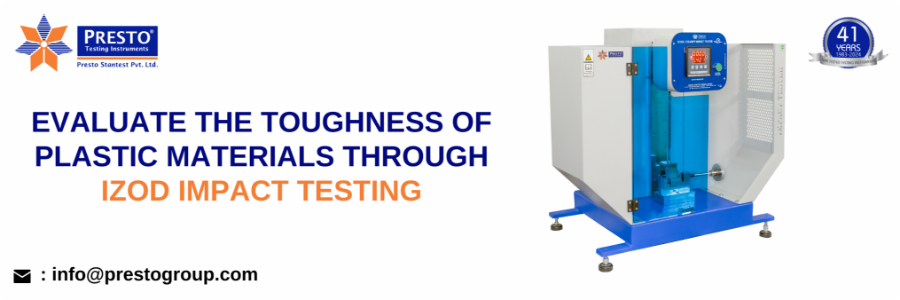
Evaluate the Toughness of Plastic Materials through Izod Impact Testing
In this blog, we will discuss brief information about Presto izod impact tester and the importance of testing the impact resistance of plastics. So, let us get started!
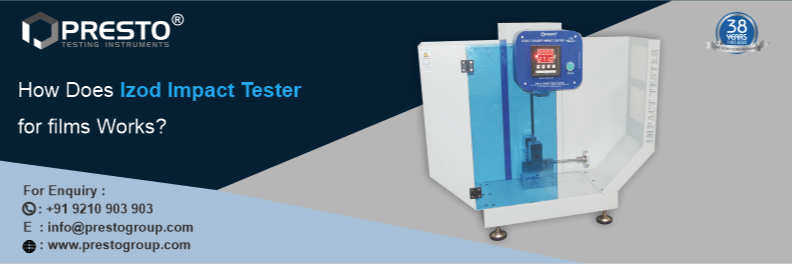
How Does Izod Impact Tester for Films Works?
The impact strength of plastics is considered to be the essential property that will help you to assess the energy required to deform or fracture the materials. This impact strength is also known as impact energy that will allow the manufacturers to classify the materials for specific purposes. For instance, polymers and plastics play an important role in exhibiting higher impact strength than other hard materials.