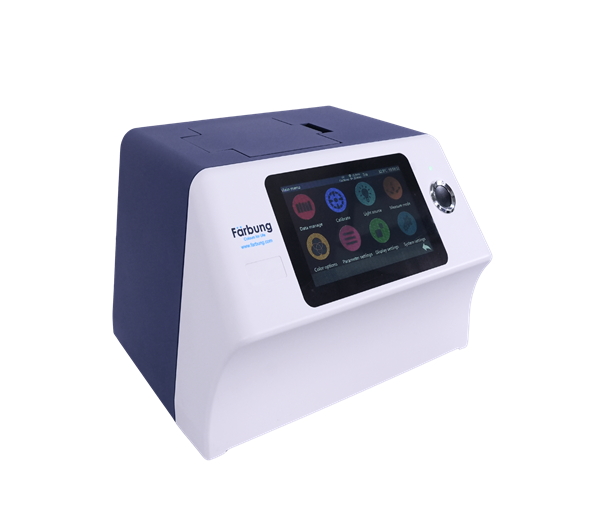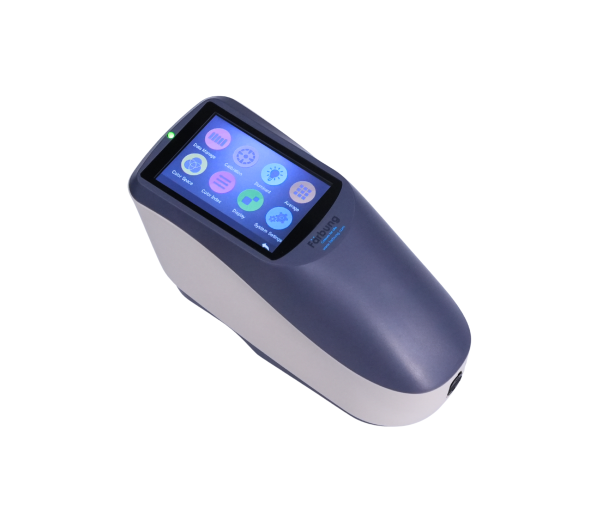
Spectrophotometer FB 9500 Desktop
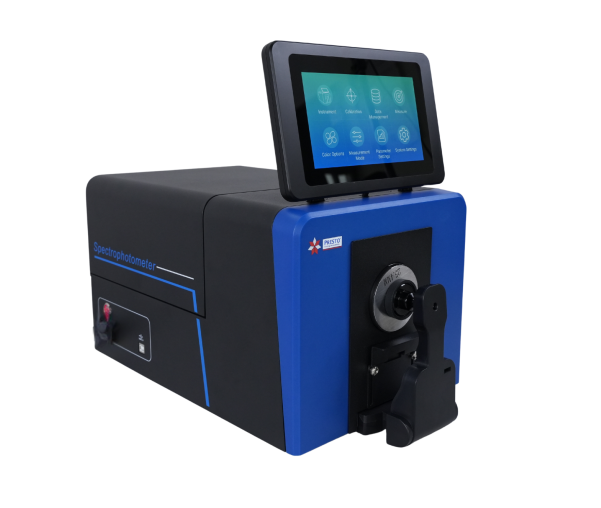
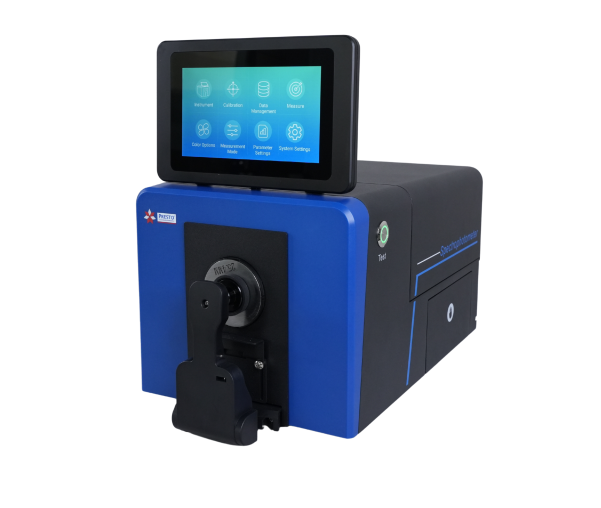
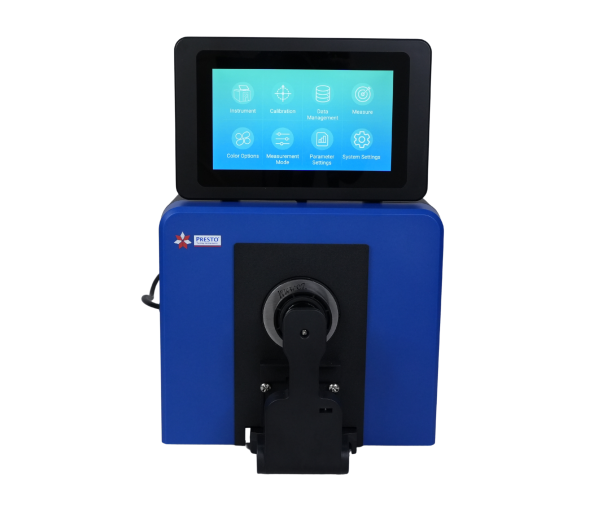
The FB9500 Desktop Spectrophotometer is a high-precision color measurement instrument featuring a dual-array CMOS image sensor, D/8 optical geometry, simultaneous SCI/SCE testing, and a 7-inch rotatable touchscreen for fast, accurate, and repeatable color analysis.

The Presto Stantest FB9500 Desktop Spectrophotometer is a tool that provides stable color measurements. It uses a CMOS image sensor that is very sensitive and covers a wide range of wavelengths. The user controls it with a 7 inch touchscreen. The spectrophotometer can keep reflectance measurements within an error of Delta Eab Less Then Equal to 0.015. When you run tests at stations, the differences stay small within Delta Eab 0.15. The device also automatically adjusts for temperature and humidity, so results stay consistent over test sessions. The D/8 optical design lets you read both SCI and SCE at the same time. You can place samples in different ways, and the device comes with a large library of illuminants. This makes the spectrophotometer useful for color tasks in plastics, electronics, paint, ink, textiles, garment dyeing, printing, and general printing
- Model: FB 9500 (LED light source + xenon lamp)
- Optical Geometry: Reflection D/8 (diffuse illumination, 8° receiving direction), SCI/SCE measurement with/without UV; Transmission D/0 (diffuse illumination, 0° receiving direction), SCI/SCE measurement with/without UV, plus haze per ASTM D1003
- Compliant Standards: CIE No. 15, GB/T 3978, GB 2893, GB/T 18833, ISO 7724/1, ASTM E1164, DIN 5033 Teil 7, JIS Z8722 condition C
- Integrating Sphere Size: Φ154mm
- Light Source: Combined LED, roughly 360–780 nm, including UV, with 400 nm and 420 nm cut-off variants
- Spectrophotometric Mode: Concave grating
- Sensor Type: 256-pixel dual-array CMOS image sensor
- Wavelength Range: 360–780 nm
- Wavelength Interval: 10 nm
- Semiband Width: 5 nm
- Reflectance Measurement Range: 0–200%
- Reflectivity Resolution: 0.01
- Supported Color Spaces: CIE LAB, XYZ, Yxy, LCh, CIE LUV, Munsell, s-RGB, HunterLab, βxy, DIN Lab99
- Color Difference Formulas: ΔEab, ΔEuv, ΔE94, ΔEcmc(2:1), ΔEcmc(1:1), ΔE00, DIN ΔE99, ΔE (Hunter), ΔE*CH, 555-tone classification
- Observer Angle: 2°/10°
- Illuminant Options: 41 total types, including D65, A, C, D55, D75, F1–F12, CWF, DLF, TL83, TPL5, U30, B, U35, NBF, ID50, ID65, LED-B1 through LED-B5, LED-BH1, LED-RGB1, LED-V1, LED-V2, LED-C2, LED-C3, LED-C5, and customizable light sources
- Data Displayed: Spectral map/data, sample chromaticity value, chromaticity difference value/map, color simulation, qualified/unqualified verdicts, color deviation, color evaluation, haze, and liquid chromaticity
- Measurement Speed: Approximately 2.0 seconds per reading; about 4 seconds when testing SCI/SCE together
- Repeatability: Reflectance chromaticity (Φ25.4 mm/SCI): ΔE*ab within 0.015, based on the average standard deviation of 30 whiteboard readings taken at 5-second intervals after preheating and calibration; spectral reflectance/transmittance repeatability: ≤ 0.1%
- Inter-instrument Error: Φ25.4 mm/SCI, ΔE*ab within 0.15, based on average readings across the BCRA series II 12-color plates
- Dimensions: 440 mm length x 248 mm width x 283 mm height
- Weight: Approximately 13.5 kg
- Power Supply: DC 24V, 3A power adapter
- Rated Lifespan: Over 3 million measurements across 5 years
- Connectivity: USB, Bluetooth®
- Storage Capacity: 32GB of built-in storage, supporting over 100,000 stored data entries (SCI/SCE counted together as a single entry)
- Language Support: Simplified Chinese, Traditional Chinese, English; customizable to German, French, Spanish, Russian, Japanese, Thai, Korean, Polish, and Portuguese
- Operating Temperature: 0–40°C (32–104°F)
- Storage Temperature: -20–50°C (-4–122°F)
- Included Accessories: Power adapter, instruction manual, quality management software on USB flash drive, data cable, standard calibration board, black calibration box, transmission black baffle, sample holder, 25.4/15/8/4 mm calibers, transmission testing fixture component, colorimetric cell
- Optional Accessories: Inverted stand, culture dish, microporous (4 mm) transmission testing fixture assembly, film fixture
1. D/8 structure with simultaneous SCI/SCE measurement
2. 7-inch independent, rotatable touchscreen
3. Dual-array CMOS image sensor
4. 41 total observation light sources
5. Automatic caliber recognition (25.4/15/8/4 mm)
6. Side, upward, and downward measurement positions
7. Automatic temperature and humidity compensation
8. Built-in camera for real-time positioning
9. Combined full-spectrum LED and UV light source.
10. SQCX color management software
A: The instrument is rated for more than 3 million measurements over a 5-year span.
Q: How many light source options are available?
A: There are 41 illuminant types in total, spanning D65, A, C, D50, D55, D75, the full F-series, CWF, DLF, TL83/TL84, TPL5, U30/U35, NBF, ID50/ID65, and a range of LED sources, with some accessed via the connected upper computer.
Q: Can it handle transmission or liquid samples?
A: Yes—the open transmission chamber accommodates samples up to 54 mm thick with no restriction on height.
Q: How fast is a single measurement?
A: A single reading takes about 2.0 seconds; capturing SCI and SCE together takes roughly 4 seconds.
Q: Is it possible to capture SCI and SCE readings together?
A: Yes — the D/8 SCI/SCE synthesis technology allows both readings to be taken simultaneously in a single measurement.
Q: What kind of optical geometry does the FB9500 rely on?
A: It uses D/8 geometry (diffuse illumination with an 8° receiving direction) for reflectance testing and D/0 geometry for transmission testing, with SCI/SCE modes available for both, with or without UV.
How it Works

Spectrophotometer FB 9500 Desktop For More details & Information
Please fill this form

Trusted Partners
Trusting by the best, serving the best
.jpg)