
- /
- Publications / Crush Strength Testing of Catalyst Pellets
Crush Strength Testing of Catalyst Pellets
Crush Strength Testing of Catalyst Pellets
Solution
- Software-controlled compression test system.
- Self-leveling steel compression plates.
- Sample container and plunger fixtures for bulk testing.
Benefits
- Capability to test all pellet geometries on a single platform.
- Software-controlled routines for repeatable testing across multiple material standards.
- High-capacity connector grips are crimped.
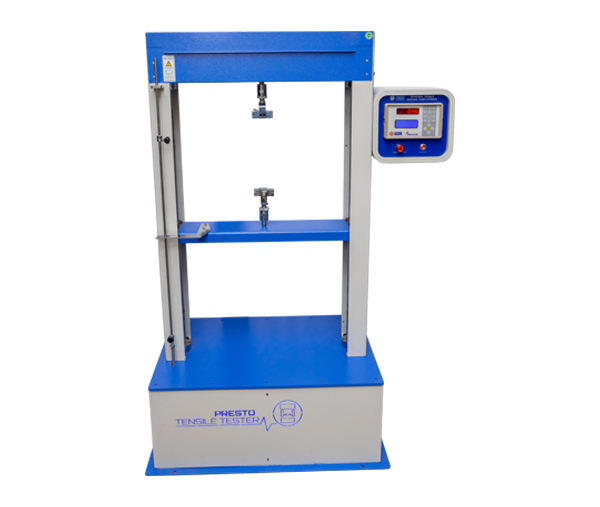
As a result of the introduction of the Presto Stantest compression testing system, manufacturers are now able to accurately crush-strength test their own catalyst pellets and catalyst carriers and, more importantly, to understand catalyst materials' fracture behaviors. The system, equipped with software-controlled routines, self-leveling compression plates, and special fixtures, can be used for testing all types of ground tablets, rings, extrudates, granules, pellets, and spheres on the same system. Repeatable tests can be performed based on ASTM D4179, ASTM D6175, and ASTM D7084 and provided with clear graphical results and pass/fail testing with fast analysis. The machine is capable of recording accurate force data in single-pellet and bulk-crush testing modes, which is essential for industries to monitor the mechanical strength of the catalyst and stability of the process. This has led to more consistent testing, lowered the risks of material failure, and, of course, contributed to the improvement of the quality control of the process of producing catalysts and industrial chemicals.
Requirement
The industrial chemical reactions would not be possible without catalysts, which lower the activation energy levels and make the reaction faster at lower temperatures. Their productivity is not only a factor of their chemical activity but also of their mechanical integrity. Pellets may fracture due to weak or brittle material and may result in blockages, a drop in pressure, and uneven heat transfer that may influence the overall process reliability. Mechanical strength of catalysts is thus a critical assessment that can be used to guarantee homogeneous efficiency.
The catalyst particles are available in different shapes or forms, such as pellets, granules, tablets, spheres, rings, and extrudates, and they are usually delicate and easily deform without any breakage. Testing these requires carefully designed methods, leading to several standardized approaches for different geometries and particle types.
Solution
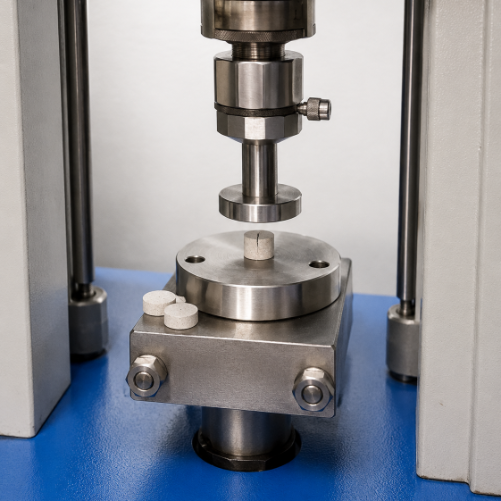
For single-pellet testing, ASTM D4179 measures compressive ‘side crush strength’ (SCS) of regular-shaped pellets like spheres, short cylinders, or tablets. Tests may be radial or axial, with radial crush providing a more representative measure of in-reactor behavior. Force is applied uniformly until the pellet fractures, recording the maximum crush strength.
ASTM D6175 focuses on radial crush strength for extruded catalyst particles of 1.6–3.2 mm diameter and length-to-diameter ratios ≥ 1:1. The compressive force is applied until failure, with the force per millimeter deformation documented, typically covering 0–65 N/mm.
For irregular or bulk catalyst materials, ASTM D7084 defines the bulk crush strength (BCS) test. Particles are placed in a cylindrical container and compressed with a piston at a controlled rate. Pressure is maintained briefly, and the amount of fines (particles passing through a half-size sieve) is measured. Typical BCS values range from 0.1 to 0.35 MPa for small granules to 1 to 3.5 MPa for larger formed pellets.
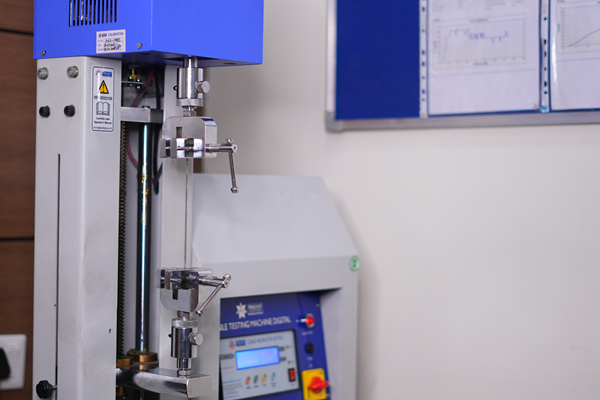
Presto Stantest’s universal testing systems are ideal for both single-pellet and bulk crush testing. Robust frames, precision load cells, and user-friendly software enable high-frequency data capture, clear graphical representation of fracture events, pass/fail determination, and exportable results. A full suite of self-aligning compression plates and custom or standard fixtures ensures compatibility with a variety of catalyst shapes and sizes.
Test Equipment
- Zeus Ultimo 3.0
- Self-leveling compression plates
- Custom or standard succulometer/dual-extrusion fixtures
- Force testing software
Test Standards
- ASTM D7084 – Bulk Crush Strength of Catalysts and Catalyst Carriers
- ASTM D6175 – Radial Crush Strength of Extruded Catalyst Particles
- ASTM D4179 – Single Pellet Crush Strength of Formed Catalyst Shapes

1.png)
.png)
.png)