
- /
- Blog / How a Torque Tester Can Improve Quality Control and Reduce Production Errors
How a Torque Tester Can Improve Quality Control and Reduce Production Errors
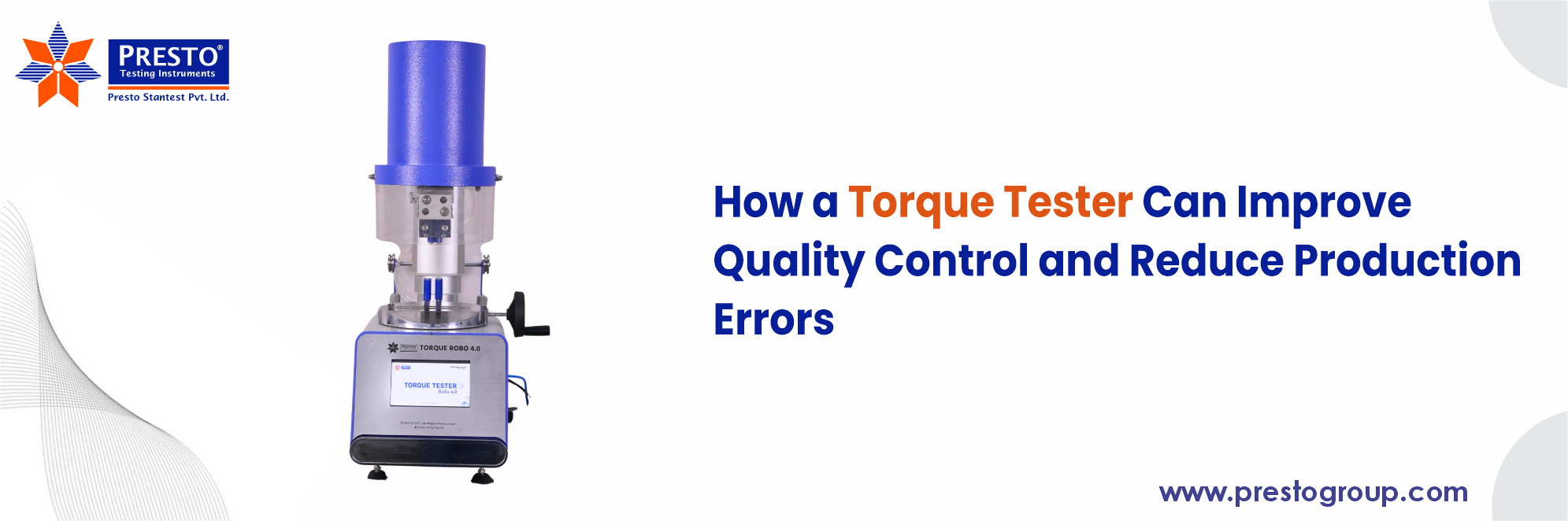
A loose bottle cap causes leaks. A loose car brake bolt causes accidents. Both problems start with a twisting force, known as torque, that a factory failed to measure. Workers tighten screws and seal caps thousands of times daily. Visual checks do not measure force. Without a reliable Torque Tester on the production line, no one knows if the applied force was correct. Using a proper torque machine and precise digital torque meter solves this by providing hard data.
The Power of Torque Testing
- ±0.5%: Typical accuracy of modern digital testing tools.
- 40%: Average drop in assembly mistakes after adding a testing process.
- 3 sec: Fast average time to complete one test.
- 100%: Amount of test data saved digitally.
Torque Tester Explained in Simple Terms
Basically, a Torque Tester measures the twisting force applied to a screw, bolt, cap, or turning part. It provides two key pieces of information: the exact force required to tighten the part and the force required to loosen it.
Factories usually run a torque test in two main ways:
- Residual torque testing: This checks the force locked into a part after assembly.
- Applied torque testing: This tracks twisting force while the part is actually being tightened.
Both approaches matter for finding and stopping mistakes.
What Does a Torque Machine Do?
A torque machine is a specific test station designed to apply and measure twisting force under strict control. The main benefit is consistency. When a person tightens a screw, their speed and grip change slightly every time. A torque machine eliminates human error.
Common machines used include:
- Motorized test stands: Apply force at a steady speed.
- Cap torque testers: Test lids on medicine and food containers.
- Inline monitoring systems: Fit directly into the assembly line to check every product.
Why a Digital Torque Tester Beats Analog Every Time
Older analog gauges with mechanical dials worked well for years. Today, modern manufacturing requires better tools. A Digital Torque Tester is now the standard for high quality. The difference comes down to saving data.
| Feature | Old Analog Gauge | Modern Digital Torque Tester |
| Accuracy | ±2 to 5% | ±0.3 to 0.5% |
| Data Storage | None | Stores 1,000+ readings |
| Peak Hold | Mechanical needle | Automatic digital capture |
| Software | Not available | Connects to computers |
The improvement in accuracy is massive. The best feature of a Digital Torque Tester is its automatic paper trail. It records numbers on its own, meaning no worker has to stop and write things down.
Torque Meter vs. Digital Torque Meter
A torque meter is just the physical sensor hidden inside the tool. It changes physical twisting force into an electrical signal. By itself, it has no screen or memory.
A digital torque meter takes that signal and makes it useful. It adds a small computer, a display screen, memory, and connections to factory machines. It serves as the complete package for workers.
Fixing Common Production Errors
| The Production Problem | The Torque Test Used | The Fix / Result |
| Water bottles leaking in shipping | Residual removal check | Proves the cap was sealed tight. |
| Bolts cracking plastic cases | Peak torque test | Stops the tool before plastic breaks. |
| Power tools getting weak | Scheduled tool audit | Catches worn-out tools early. |
| Failing safety inspections | Digital test records | Gives instant proof the factory follows rules. |
Which Industries Use Torque Testing the Most?
Every industry that involves assembling, sealing, or joining parts needs such tools. The most stringent industries are:
- Healthcare and Food Industry: Medicine bottles should have excellent seals to prevent bacteria from entering.
- Automobile Industry: Brake and engine screws require proper torquing to safeguard vehicle owners.
- Aerospace Industry: Airplane screws require documentation showing the torque test to confirm correct installation.
- Electronics Industry: Miniature screws in mobile phones require delicate torqueing to prevent damage.
Picking the Right Torque Tester
The right Torque Tester depends on what the factory builds. Before choosing a tool, check these details:
- Size Range: Choose a tool whose target force falls in the middle of its range.
- Connections: Make sure the digital torque meter connects to factory computers.
- Fixtures: Check for correct adapters to fit specific bolt sizes or caps.
Why Accurate Torque Control Matters More Than You Think
The wrong kind of torque is silent. A screw that’s 15 percent loose appears no different from one that fits perfectly tight. It’s not visible. You don’t feel it. You certainly won’t hear it.
That’s the reason why the use of the Torque Tester is absolutely essential. Each and every torque test ensures that defective products do not leave the plant.
Make Your Quality Checks More Reliable with Torque Testing
In many production lines, small torque variations often go unnoticed, but later they can create real problems. A torque tester helps you keep things in control, so you can catch these small issues early and avoid bigger errors in production.
If you’re thinking to improve your testing process or just want to understand what will suit your setup better, it’s good to talk to someone who has hands-on experience. Our team can help you figure out the right solution without making things complicated.
Call us: +91 9210903903
Email: info@prestogroup.com
Visit: https://www.prestogroup.com/contact-us/
Address: Plot No. I, 42, NH-19, Block C, DLF Industrial Area, Sector 32, Faridabad, Haryana 121003
Recent Blogs
- How to Test and Prevent Metal Corrosion Using a Salt Spray Chamber
- Autoclave in Laboratories and Industry: Principle, Procedure, Components, and Applications
- What is a Water Bath? How It Works, Types, Applications, and Diagram
- What is Adhesion Test? Standards, Methods and Industrial Applications
- GSM Measurement Techniques for Paper, Textile, and Packaging Industries

Related Blogs
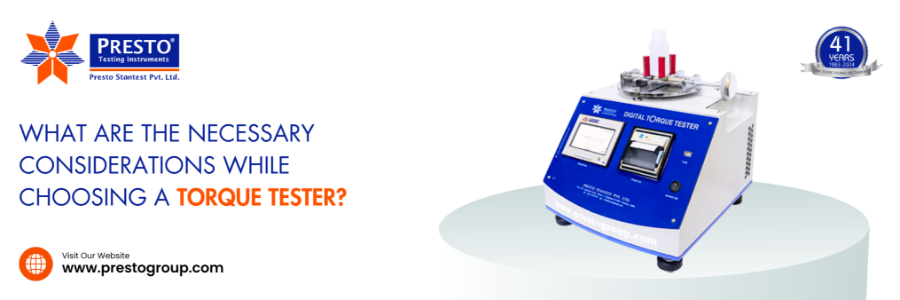
What are the Necessary Considerations while Choosing a Torque Tester?
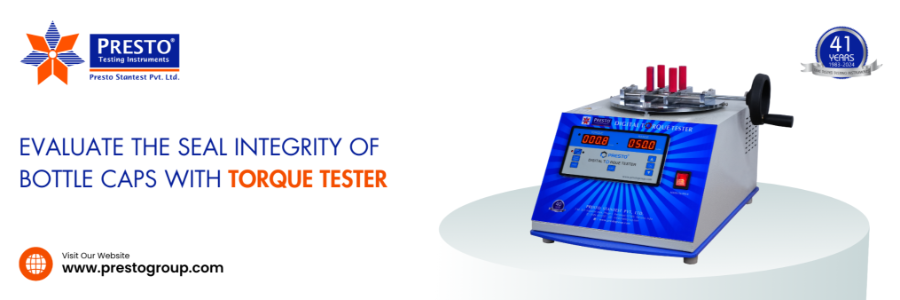
Evaluate the Seal Integrity of Bottle Caps with Torque Tester