
- /
- Blog / Vacuum Leak Tester For Accurate Packaging Leak Detection
Vacuum Leak Tester For Accurate Packaging Leak Detection
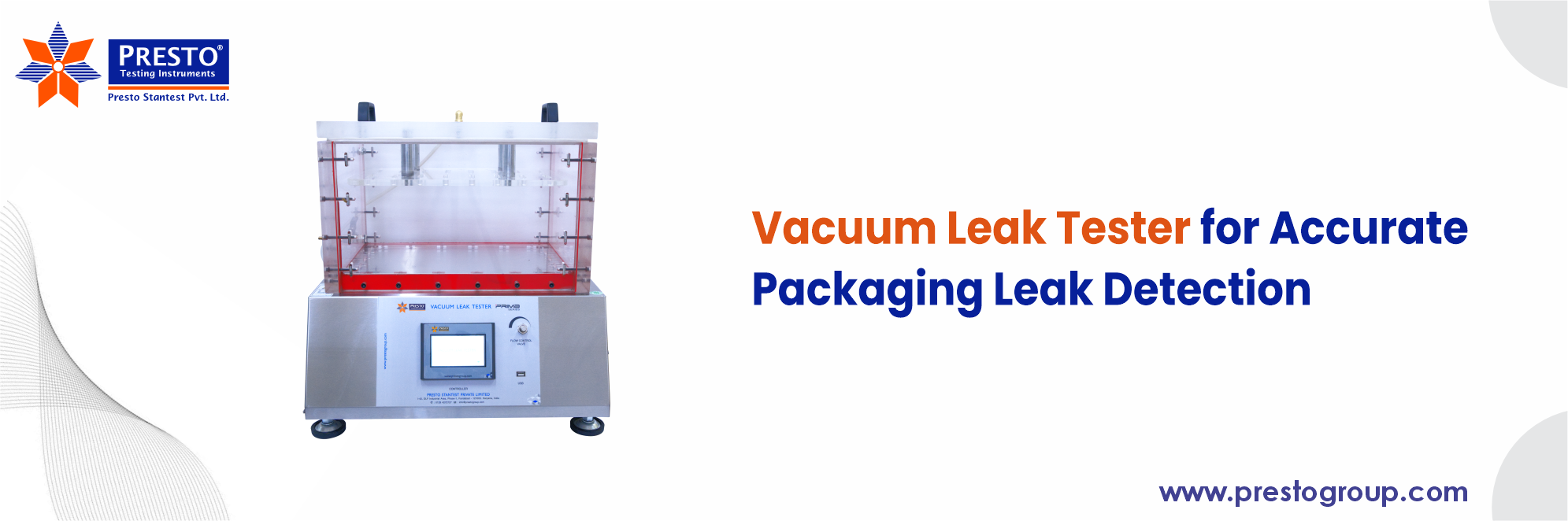
Modern vacuum leak detectors play a crucial role in validating plants whose production lines require packaging materials that create a hermetic seal around their contents to protect food, medical, pharmaceutical, or chemical goods during long transportation routes.
The device makes use of predetermined vacuum values, ramping times, and observation periods to detect seals that have pinholes, channel leakage, and sealing failures, which cannot be detected by naked eye observation.
Standards such as ASTM D3078 for flexible packs and ASTM D4991 for rigid containers transform this basic bubble-emission principle into a set-up, auditable quality-control technique.
For investors, this can be a low-capex asset which directly impacts complaint rates, write-offs, and brand protection.
A Vacuum Leak Tester and Why It Matters for Packaging Quality
A vacuum leak tester is a calibrated system comprising a transparent vacuum chamber, a vacuum pump, pressure-sensing and control hardware, and a timing unit used to evaluate seal integrity under reduced pressure.
The instrument functions as a Vacuum integrity tester by simulating pressure differentials similar to those encountered in altitude, transport, or storage conditions and forcing leaks to manifest as gas flow or bubble emission.
In flexible packs, the headspace gas expands under vacuum and escapes through micro pathways, while in rigid containers the external fluid can be driven into the pack if a leak path exists.
This behaviour makes the method sensitive to gross leaks that compromise barrier performance, even when static pressure tests appear normal.
Core Working Principle of Vacuum Leak Testing (ASTM D3078 Explained)
- The bubble emission method used in ASTM D3078 can be summarised in a few key technical steps.
- The vacuum is drawn in at a controlled pace, normally 1 inch of mercury per second, to ensure that the required level of vacuum is obtained without exerting mechanical strain on the package.
- Common levels for achieving vacuum on flexible packages include 12 inches, 18.5 inches, or 24.5 inches, depending on the type and fragility of the packaging.
- The vacuum is held for a period of time called the dwell time, which is generally not less than 30 seconds.
- Presence of continuous or localized bubbles signifies leakage, whereas no bubbles or fluid entry denotes a passing grade.
ASTM D4991 utilizes a similar approach for testing empty rigid packaging, but using ethylene glycol mixed with water and much higher differential pressures, normally 95 kPa, to prevent unwanted boiling.
Typical Defects Detected
When configured correctly, a Vacuum integrity tester will consistently reveal several important failure modes.
- Pinholes caused by sharp product edges or particulate contamination in the seal area.
- Channel leaks along heat seals due to improper temperature, pressure, or dwell in the sealing jaws.
- Incomplete closure torque or closure deformation in rigid containers.
- Stress cracks and microfractures from handling or transport conditions.
Detecting these defects at QA stage prevents oxygen or moisture ingress that could reduce shelf life or compromise sterility.
Industry Applications of Vacuum Leak Testers Across Sectors
The same hardware from established vacuum-leak-tester suppliers can support a wide range of packaging operations.
- Food and beverage: MAP pouches, thermoformed trays, and PET bottles under varying headspace conditions.
- Pharmaceutical and medical: blisters, sachets, IV bags, and sterile barrier systems validated to ISO 11607.
- Cosmetics and chemicals: rigid bottles and jars tested to ASTM D4991 for leakage under transport pressure differentials.
- Industrial components: sealed units where any fluid ingress or outgassing can impact performance.
This breadth of use allows a single Vacuum integrity tester to serve as a shared validation platform across multiple lines.
Feature Set Investors Should Examine
A scan of current product lines from leading vacuum leak tester suppliers shows several technical differentiators.
| Technical Feature | Investor Relevance | Typical Specification In Market |
| Chamber volume and geometry | Defines maximum pouch or container size supported. | Multiple chamber sizes, custom fixtures. |
| Vacuum range and control resolution | Influences sensitivity and repeatability of tests. | Up to 24.5 inHg for flexible, ~95 kPa differential for rigid. |
| Ramp rate control | Prevents false failures from over stressing packages. | Approx. 1 inHg/s adjustable ramp. |
| Programmable dwell time | Aligns tests with ASTM and internal protocols. | 30 seconds to 30 minutes or more. |
| Fluid management and degassing | Reduces noise from dissolved gases and boiling. | 50/50 water glycol, deep pre vacuum to -950 mbar. |
| Data acquisition and traceability | Critical for audits and trending defect rates. | On board memory, PC connectivity, batch reports. |
Robust control of these parameters lets the plant define sensitivity and repeatability targets that can be defended to regulators and customers.
Manual, Digital, and HMI-Based Platforms
The market still offers basic manual systems, but digital and HMI-based platforms now dominate technically mature sites.
- Manual units rely on analog gauges and operator timing, which can cause variability in applied vacuum and dwell time.
- Digital systems use electronic pressure transducers and programmable controllers to lock in setpoints and hold times for each SKU.
- Advanced HMI models store multiple test recipes and link directly with LIMS or MES platforms for electronic records.
From an investor perspective, digital platforms from a reputable vacuum leak tester manufacturer usually deliver a lower risk of human error and tighter process capability around leak detection.
Standards As A Risk Control Framework
Alignment with key standards is one of the simplest quality signals to validate.
- ASTM D3078: bubble emission leak test for flexible packaging, targeting gross leaks using defined vacuum levels and observation times.
- ASTM D4991: vacuum leak testing of empty rigid containers for transport and handling scenarios.
- Supporting methods such as ASTM E515 and ISO 11607 further strengthen the validation envelope for medical and sterile packaging.
When vacuum leak tester suppliers design equipment and documentation around these standards, plants gain faster qualification, clearer SOPs, and simpler external audits.
Reading Technical Proposals With An Investor Lens
A more technical review of a proposal from a vacuum leak tester manufacturer should cover a few focused points.
- Confirmation of which ISO and ASTM techniques are completely supported, with examples of IQ / OQ documents.
- Evidence of steady vacuum control throughout the specified range, including calibration certificates.
- Specifications of chamber material, fluid selection, and degassing technique, specifically for deep vacuum applications.
- Integration choices with existing LIMS, MES, or PLC systems for data capturing and alerts.
- Community service network, spare parts approach, and suggested calibration intervals for extended uptime.
This style of technical due diligence links a simple piece of lab equipment back to overall risk, compliance, and quality costs.
Final Thoughts: Why Vacuum Leak Testing Is Critical for Modern Packaging
During plant visits or data room reviews, investors can ask one targeted question.
How are ASTM D3078 and ASTM D4991 leak tests implemented today, and which vacuum leak tester or Vacuum integrity tester platform is used to run them on a routine basis.
A well-specified, well-used system from credible vacuum leak tester suppliers is a strong leading indicator that management understands packaging integrity as a controllable, measurable driver of product safety and margin stability.
Contact Presto Group Today!
We specialize in developing some of the best vacuum leak testers that suite a wide variety of industrial applications. To learn more connect with our experts today!
Call us: +91 9210903903
Email: info@prestogroup.com
Visit: www.prestogroup.com
Address: Plot No. I, 42, NH-19, Block C, DLF Industrial Area, Sector 32, Faridabad, Haryana 12100
Recent Blogs
- How to Test and Prevent Metal Corrosion Using a Salt Spray Chamber
- Autoclave in Laboratories and Industry: Principle, Procedure, Components, and Applications
- What is a Water Bath? How It Works, Types, Applications, and Diagram
- What is Adhesion Test? Standards, Methods and Industrial Applications
- GSM Measurement Techniques for Paper, Textile, and Packaging Industries

Related Blogs
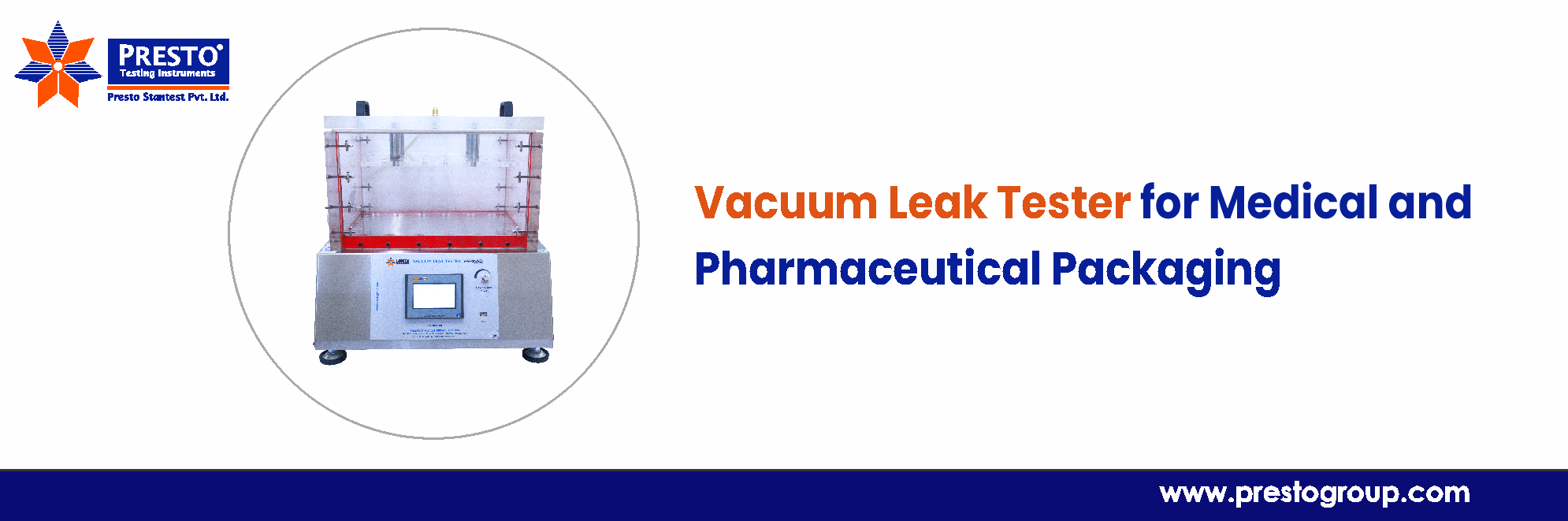
Vacuum Leak Tester for Medical and Pharmaceutical Packaging
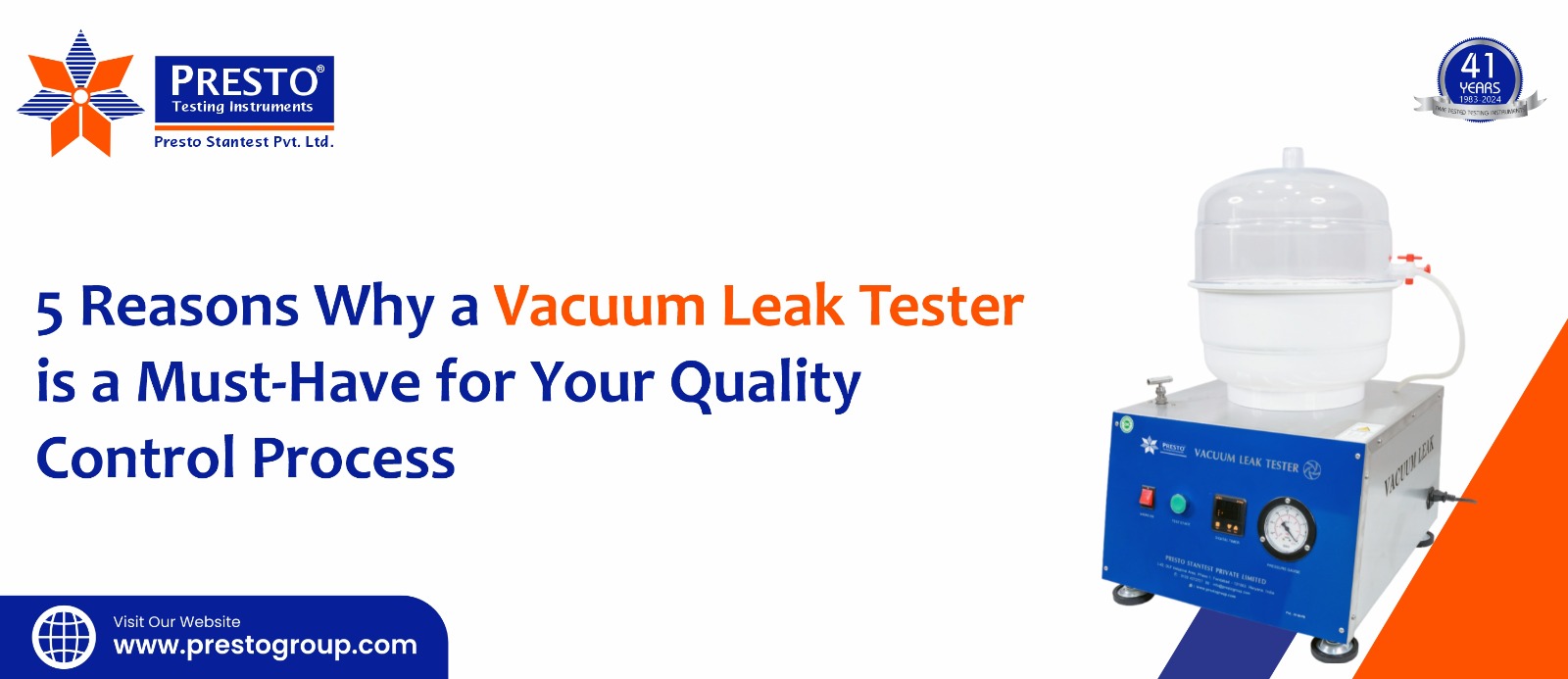
5 Reasons Why a Vacuum Leak Tester is a Must-Have for Your Quality Control Process
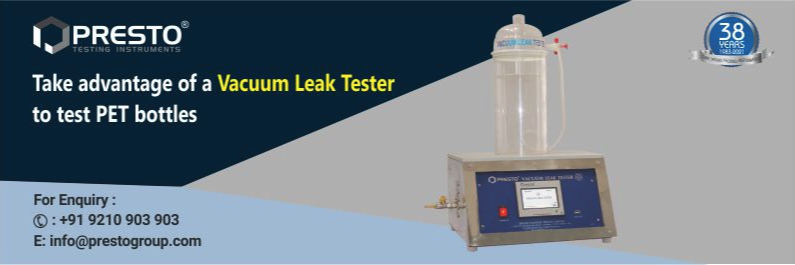
Take Advantage of a Vacuum Leak Tester to Test PET Bottles