

- /
- Article / Climatic Chamber: Working Principle, Uses, Diagram, Price & Top Manufacturers in India
Climatic Chamber: Working Principle, Uses, Diagram, Price & Top Manufacturers in India
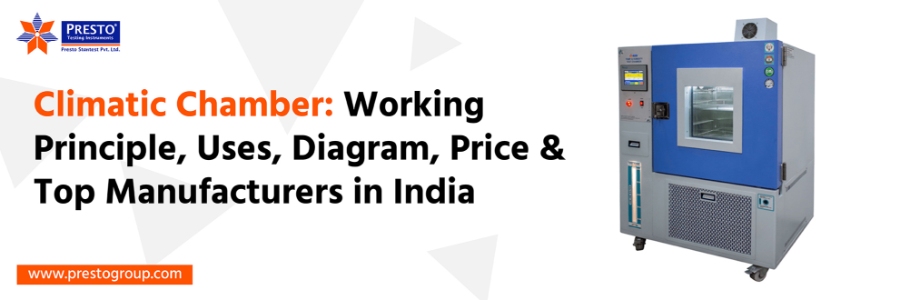
Products of the modern world are supposed to do well in all environments. They can be used in hot summers, winter, wet coastlands, or dry industrial places. To ensure products withstand such conditions, manufacturers use a climatic chamber when testing them.
A Climatic Test Chamber is a controlled environment of temperature and humidity, created in a sealed enclosure. It assists manufacturers in testing the performance of products prior to reaching the customers. Electronics, automotive parts, packaging, and pharmaceuticals are some of the areas these chambers support in quality control and research.
In this guide, you will learn about the climatic chamber working principle, its applications, major components, price factors, and how to choose the right climatic chamber manufacturer in India.
What is a Climatic Chamber and Why is It Used?
An environmental test chamber or a climatic chamber is a machine used in a laboratory that provides a simulated environment. It is capable of simulating various temperatures and humidity in order to test the products in real-life conditions.
The chamber can be used to subject products to intense heat, cold, moisture, or weather variations without necessarily waiting for them to occur in natural weather.
Why is it used?
A climatic chamber helps manufacturers:
- Check product durability
- Test reliability in various climates.
- Identify design weaknesses
- Improve product quality
- Adhere to national and international testing standards.
- Minimise post-launch failure of products.
Since many products move across countries with varying climates, testing them within a Climatic Test Chamber will keep them safe and reliable.
Climatic Chamber Working Principle and Temperature-Humidity Control
The principle of the working of the climatic chamber is not very complex.
The chamber works by controlling two important conditions:
- Temperature
- Relative humidity
These values are constantly monitored by sensors that transmit information to a digital controller.
The controller automatically regulates heating, cooling, humidification, and dehumidification systems to ensure the conditions required for testing.
Step-by-step working process
1. Temperature Control
Electric heaters are used to raise the temperature of the chamber whilst a refrigeration system cools it down, when necessary.
2. Humidity Generation
A humidifier is used to turn water into moisture and increase humidity.
3. Moisture Removal
When the humidity is to be lowered, excess moisture is removed by the cooling system.
4. Air Circulation
Powerful fans spread air evenly so that all test specimens are subjected to the same conditions.
5. Continuous Monitoring
During the test, temperature and humidity sensors control the chamber and ensure that the right settings are maintained at all times.
Systems of modern environmental test chambers are capable of sustaining a highly stable test environment over a few hours or even a few weeks.
Climate Test Chamber Diagram and Main Components
Knowing the key components will help you understand the climate test chamber better by having a diagram of it.
Main components
Test Chamber
This is where the samples are placed for testing.
Heating System
Electric heaters rapidly and uniformly raise the temperature of the chamber.
Refrigeration System
The compressors and cooling coils lower the temperature as needed.
Humidity System
This system creates humidity to keep it at a needed level.
Air Circulation Fans
Fans distribute air uniformly throughout the chamber.
Digital Controller
The controller can be set by the user to temperature, humidity, test length, and operating Cycles.
Sensors
The environmental conditions are continuously measured by precision sensors and are used to maintain the accuracy of testing.
Environmental Test Chamber vs Climatic Test Chamber: Is There a Difference?
These terms are used interchangeably by many people, yet they have a slight difference.
| Feature | Climatic Test Chamber | Environmental Test Chamber |
| Controls temperature | Yes | Yes |
| Controls humidity | Yes | Yes (depending on model) |
| Simulates climate conditions | Yes | Yes |
| Can perform vibration, dust or salt spray tests | Yes | Some advanced models can |
A Climatic Test Chamber is primarily used to test temperature and humidity.
An environmental test chamber is a wider term, which could have other types of environmental testing like vibration, dust, rain, UV exposure, or salt spray; it varies depending on the equipment.
In most product life testing with climatic conditions, the two names are used interchangeably.
Industrial Applications of Climatic Chambers
Today, climatic chamber uses extend across almost every manufacturing industry.
Electronics Industry
Electronic devices get tested in humid conditions and extreme temperatures to sustain long-term functions.
Automotive Industry
Climatic tests of vehicle parts are done, i.e., sensors, batteries, switches, and plastic parts, before production.
Pharmaceutical Industry
The lab tests are done on medicines under controlled environmental conditions to research their stability and shelf life.
Packaging Industry
The packaging material is assessed on its ability to withstand moisture and its storage and transportation periods.
Plastic and Polymer Industry
Manufacturers test plastic products, which may crack, shrink or deform as temperatures vary.
Textile Industry
Fabrics are tested in terms of dimensional stability, colour fastness and moisture behaviour.
Aerospace Industry
An aircraft component should be able to operate efficiently in a highly dynamic environment.
Due to these broad climatic chamber uses, this equipment has become a vital component of contemporary quality testing characterisations.
Factors Affecting Climate Chamber Price
The price of the climate chamber will differ based on various factors. Price doesn't have a single value since various industries have various specifications.
The price is determined by the following factors:
Chamber Size
Large chambers are more expensive as they would allow large samples for testing.
Temperature Range
Ultra-low temperature models require advanced refrigeration systems, increasing the overall price.
Humidity Range
Greater accuracy in humidity control is an added cost to equipment.
Accuracy
The sensors and controllers are highly precise and work better, but cost more.
Testing Features
Programmable cycles, touch screen displays, remote monitoring and data logging may all increase the total cost of the climate chamber.
Construction Material
High-quality stainless steel chambers are more resistant to corrosion and offer greater durability.
Buyers need to focus on performance, reliable services, after-sales support, and calibration services instead of the lowest price.
How to Choose the Right Climatic Chamber Manufacturer in India
Selecting a trusted climatic chamber manufacturer in India is worthwhile only when comparing equipment.
Below are some of the aspects to look at:
Industry Experience
Select manufacturers that have several years of experience in testing equipment.
Product Quality
The chamber is supposed to provide constant temperature and humidity during testing.
Calibration Support
Regular calibration ensures accurate test results.
Compliance with Standards
Find equipment that is developed based on accepted testing requirements.
Technical Support
Quick installation, training, maintenance, and availability of spares are critical.
Customisation
Certain industries might need special chamber sizes or special testing schemes.
Key Features to Look for Before Buying a Climatic Chamber
A climatic chamber should contain all the features that you might require in your test before investing in it.
Look for:
- Precise temperature and humidity management.
- Uniform air circulation
- Stainless steel interior construction
- User-friendly digital controller
- Programmable testing cycles
- Data logging capability
- Protection systems and safety alarms.
- Energy-efficient operation
- Easy maintenance
- Reliable after-sales support
These features enhance testing accuracy while reducing maintenance downtime and expenses.
A climatic chamber is important to guarantee product quality, durability, and long-term reliability. A climatic test chamber can be used to test electronic products, packaging materials, automotive parts, pharmaceuticals, or plastics, whether you need to test the material or understand the real environmental conditions of the product before market entry.
Presto has one of the most reputable names in testing instruments and has decades of providing service to industries in India. Presto, being one of the top manufacturers of climatic chambers in India, has high-quality testing solutions that are meant to be accurate, durable, and long-lasting.
Need Accurate Environmental Testing Solutions?
Test your products under real-world temperature and humidity conditions with Presto Stantest Pvt. Ltd.'s advanced Climatic Chambers. Built for precision, reliability, and compliance with global testing standards, our solutions help you improve product quality and durability.
CTA Button: Request a Free Quote
Call: +91 9210903903
Email: info@prestogroup.com
Recent Articles
- Climatic Chamber: Working Principle, Uses, Diagram, Price & Top Manufacturers in India
- Izod vs Charpy Impact Test: Difference, Method & Standards
- Colorimeter vs Spectrophotometer: Accuracy, Working Principle, and Industrial Uses
- Quality Assurance and Quality Control: Two Pillars of Product Excellence
- Hardness Test: Types, Testing Methods, Procedures, and ASTM Standards
Need more information
Connect with us for your business enquiries. Generally, we respond within one or two working days.