
- /
- Article / Izod vs Charpy Impact Test: Difference, Method & Standards
Izod vs Charpy Impact Test: Difference, Method & Standards
Automotive, aerospace, packaging, construction, and consumer products materials should be made strong to resist sudden force without breaking. A material can be strong in terms of tensile strength and still fail upon being impacted by some unexpected load. This is the reason why manufacturers do an impact test before approving materials to be used in production.
The Izod impact test and Charpy impact test are some of the most frequently used tests. Both quantify the amount of energy absorbed by a material before it fractures; however, they vary in terms of the position of the specimen, notch position, and usage.
Under our guide, we will discuss Izod vs Charpy, their working principle, testing method, their standards, and how to select the suitable test. We will also examine the current systems of Izod and Charpy impact testers that are used in industries.
What is Impact Testing and Why is It Important?
Impact testing is a process whereby the strength of a material against abrupt shock or impact loading is determined. The material is hit with a rapid blow by a swinging pendulum, rather than a slow application of force. The energy absorbed during fracture shows the material's toughness.
Impact strength testing assists manufacturers in knowing when a material would crack or break in actual working conditions.
Impact testing is significant as it assists in:
- Measure material toughness
- Compare different materials
- Check product quality
- Detect brittle behavior
- Improve product safety
- Adhere to international quality standards.
The plastics, metals, automotive, aerospace industries, and the construction industries often undergo an impact test to ascertain the reliability of their products before manufacture.
Izod vs Charpy Impact Test: What's the Difference?
When comparing Izod vs Charpy, both tests measure impact resistance, but the testing setup is different.
| Feature | Izod Impact Test | Charpy Impact Test |
| Specimen Position | Vertical | Horizontal |
| Support | Fixed at one end | Supported at both ends |
| Notch Direction | Faces the striker | Faces away from the striker |
| Common Material | Plastics | Metals |
| Standard | ASTM D256 | ASTM E23 / ISO 148 & ISO 179 |
The main difference between Izod and Charpy testing lies in how the specimen is held and struck.
The charpy and izod test both use a pendulum hammer to break the sample. After the strike, the tester calculates the energy absorbed during fracture.
Izod Impact Test: Principle, Test Method, and Applications
Izod impact test is primarily applied to plastics and engineering polymers. It determines the extent of energy to which a notched specimen absorbs and then breaks.
Principle
Using a clamped specimen, one end is fixed vertically. A pendulum, above the notch, gives a strike on the upper part.
The tester compares the energy that the pendulum loses when the sample is broken. Greater impact resistance is exhibited by greater absorbed energy.
Test Method
The testing procedure typically incorporates:
- Make a standard notched specimen.
- Clamp the sample vertically.
- Keep the notch facing towards the hammer.
- Release the pendulum.
- Measure the absorbed impact energy.
- Determine impact strength depending on the specimen size.
This impact strength test is undertaken on many plastic manufacturers to compare various grades of resin.
Applications
Izod impact tests are applied in:
- Plastic packaging
- PVC products
- Automotive interior components
- Consumer goods
- Electrical housings
- Engineering polymers
- Composite materials
It is especially useful when evaluating materials that may be subject to accidental impacts during normal use.
Charpy Impact Test: Principle, Test Method, and Applications
One of the most common tests that is conducted to test metals and structural materials is the Charpy impact test.
Principle
The specimen is held on two supports in the horizontal position. A pendulum strikes the center opposite the notch until the sample fractures.
The absorbed energy represents the toughness of the material.
Test Method
The standard testing process includes:
- Make the typical notched specimen.
- Put it on supports horizontally.
- The notch should be at a distance from the striker.
- Release the pendulum.
- Measure the fracture energy.
- Compare and record results.
Similar to the Izod technique, this impact test will assist in assessing the ability of a material to handle abrupt loading.
Applications
Charpy impact test is usually employed in:
- Steel manufacturing
- Structural metals
- Pipelines
- Pressure vessels
- Bridges
- Railway components
- Heavy engineering
It is particularly necessary in materials used at low temperatures, where brittle fracture is more likely.
Specimen Preparation and Testing Requirements for Izod and Charpy Tests
Proper preparation of the specimen is important to give accurate results.
Notable testing requirements are:
- Correct specimen dimensions
- Standard notch geometry
- Smooth surface finish
- Before the test, proper conditioning.
- Correct testing temperature
- The correct choice of the pendulum energy.
- Machine calibration
In the case of plastics, conditioning temperature and humidity can influence the outcomes. Also, metals might need to be tested at controlled temperatures to assess low-temperature toughness.
If both the Charpy and Izod tests are to give consistent results, they must follow normal procedures of preparation.
ASTM D256 and Other Impact Testing Standards
International standards ensure that findings from various laboratories are consistent.
ASTM D256 is the most popular plastic testing standard, which includes the Izod impact test. It defines the specimen size, notch design, conditioning, equipment, and reporting procedures.
Other popular standards are:
- ASTM D256 Standard for plastic Izod impact resistance.
- ASTM E23 - metallic material Charpy testing.
- ISO 148-1 – Charpy impact testing for metals
- Tests ISO 180- Izod impact testing on plastics.
- ISO 179 – Plastic testing Charpy.
Adherence to these standards enhances the accuracy of results and helps meet international product quality standards.
How to Select the Right Impact Test for Your Material
The selection of the right impact testing method depends on the material and its use.
Take into account the following:
Material Type
- Plastics tend to rely on the Izod impact test.
- The Charpy impact test is commonly used to test metals.
Industry Standard
Most industries indicate the standard that is to be used to get certification.
Product Application
Take into account the effects that the product will face in actual usage.
Temperature Conditions
However, some materials are brittle at lower temperatures, and Charpy testing is more applicable.
Customer Requirements
Particular customers or industries demand either the Izod or Charpy technique. Knowing the difference between Izod and Charpy enables manufacturers to select the appropriate test and get useful results.
Izod Charpy Impact Tester: Features, Working, and Industrial Applications
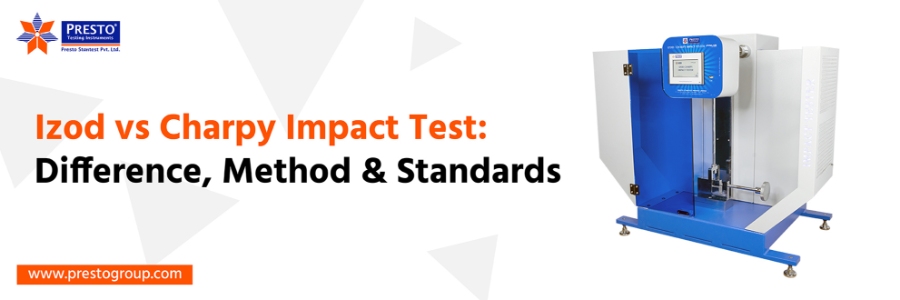
An impact tester (Izod Charpy) is a modern-day testing instrument that enables laboratories to carry out impact testing with a high rate of repeatability.
Key Features
- Digital display for easy reading of results.
- High testing accuracy
- Strong pendulum mechanism
- Multiple pendulum options
- Easy specimen positioning
- Operator protection guard.
- Coarse or rugged structure to protect life span.
Working Principle
The specimen will be placed as per the method chosen to be used in testing. The pendulum is lifted to a height and set free. After striking the specimen, the machine calculates the absorbed energy automatically.
The advanced systems also archive new test data and provide quality documentation reports.
Industrial Applications
An Izod Charpy impact tester is widely used in:
- Plastic manufacturing
- Packaging industry
- Automotive industry
- Pipe manufacturing
- Polymer research
- Universities and laboratories
- Metal fabrication
- Quality control departments
As a manufacturer of reliable material testing equipment, Presto has innovative Izod Charpy impact tester equipment lines that are manufactured to perform with precision, repeatability, and to adhere to global requirements. Presto testing equipment assists industries in conducting efficient impact testing, enhancing product quality, and meeting international testing requirements.
Need Accurate Impact Testing Solutions?
Ensure reliable material performance with Presto Stantest Pvt. Ltd. advanced Izod Charpy Impact Tester, designed for precise, repeatable, and standards-compliant testing.
Call us: +91 9210903903
Email: info@prestogroup.com
Visit: https://www.prestogroup.com/contact-us/
Recent Articles
- Climatic Chamber: Working Principle, Uses, Diagram, Price & Top Manufacturers in India
- Izod vs Charpy Impact Test: Difference, Method & Standards
- Colorimeter vs Spectrophotometer: Accuracy, Working Principle, and Industrial Uses
- Quality Assurance and Quality Control: Two Pillars of Product Excellence
- Hardness Test: Types, Testing Methods, Procedures, and ASTM Standards
Need more information
Connect with us for your business enquiries. Generally, we respond within one or two working days.
.png)