
- /
- Article / Colorimeter vs Spectrophotometer: Accuracy, Working Principle, and Industrial Uses
Colorimeter vs Spectrophotometer: Accuracy, Working Principle, and Industrial Uses
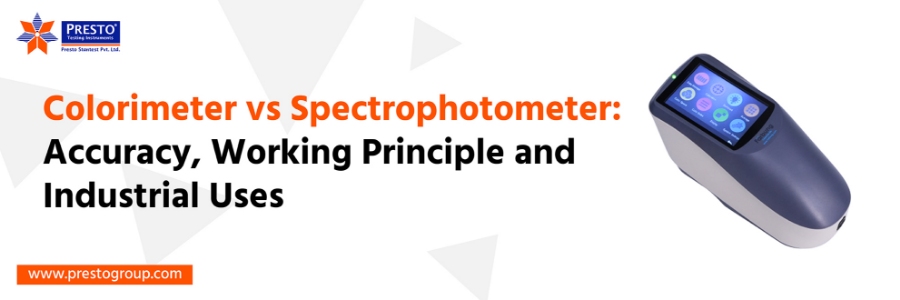
Color is a significant attribute of product quality. Whether it is a paint, plastic, textile, food, cosmetic, or pharmaceutical product, it must be the same color in all instances. Thus, even a slight color change may affect product quality and customer satisfaction.
This would explain why instruments such as the colorimeter and the spectrophotometer are used to measure color in businesses. The two instruments are employed in measuring color, but they are different in how they operate and in their purpose. Knowledge of the difference between a colorimeter and a spectrophotometer will enable industries to select the correct tool for their quality control regime.
We discuss the colorimeter and the spectrophotometer, how they work, their accuracy, the applications in the industry, and how to choose the most suitable instrument for your testing needs in this guide.
What are a Colorimeter and a Spectrophotometer?
A colorimeter is a meter that measures the color of an object by sensing the quantity of red, green, and blue light (RGB) bounced back or passed through the material. It is made to correspond to the eye's perception of color. Due to its plain construction, it is fast and dependable in getting results of color checks because of quality check-ups of regularities.
A spectrophotometer, on the other hand, is a more sophisticated instrument. Rather than quantifying three major colors, it quantifies the entire visible range of reflected or transmitted light by a sample. This offers much more detailed color data and greater measurement accuracy.
Both instruments contribute to ensuring consistency of colors in manufacturing, and they also vary in terms of technology, performance, and usage.
Colorimeter vs Spectrophotometer: Key Differences Explained
The following table explains the main differences between the colorimeter and spectrophotometer.
| Feature | Colorimeter | Spectrophotometer |
| Measurement Method | Measures RGB values using color filters | Measures the complete visible light spectrum |
| Accuracy | Good for routine testing | Very high accuracy |
| Data Output | Basic color values | Complete spectral data |
| Speed | Faster measurements | Slightly slower due to detailed analysis |
| Cost | Lower | Higher |
| Best For | Daily production quality checks | Research, product development, and critical quality control |
A colorimeter is ideal when manufacturers need quick color verification during production. A spectrophotometer is preferred when products require detailed color matching or strict international quality standards.
Colorimeter Working Principle and How It Measures Color
The colorimeter's working principle is dependent on the intensity of the red, green, and blue light that is presented or transmitted through a sample to a colorimeter.
The instrument contains:
- A stable light source.
- Optical filters
- Photo detectors
- An electronic processing unit
The process of measuring is as follows:
- The sample is illuminated by the light source.
- Red, green, and blue filters filter reflected or transmitted light.
- Photodetectors quantify the light passing through each filter.
- The device translates these readings into color values such as CIE Lab or XYZ.
As the colorimeter's working principles are a replication of the human color perception, the device provides quick and reproducible results in the manufacturing setting.
The latest digital colorimeters have integrated calibration, a touchscreen, data storage, and computer connectivity to facilitate quality control.
Spectrophotometer Working Principle and Measurement Process
The spectrophotometer's working principles are based on measuring the amount of light reflected or transmitted at many different wavelengths across the visible spectrum.
Unlike a colorimeter, this device does not rely solely on RGB filters. Rather, it quantifies color at narrow spectral intervals, typically 400-700 nanometers.
The working process consists of:
- The controlled light source illuminates the sample.
- The reflected or transmitted light is passed through a diffraction grating or prism.
- The light is dispersed into single wavelengths.
- The intensity at each wavelength is measured by highly sensitive detectors.
- This spectral data is processed by the software into accurate color values.
Since the spectrophotometer's principles of operation capture all spectral data, it can measure even minute changes in color that cannot be easily seen by the human eye.
This high degree of analysis enhances the utility of spectrophotometers in research laboratories, color formulations, product development, and industries where a major concern is color accuracy.
Accuracy Comparison: Colorimeter vs Spectrophotometer
In terms of accuracy, a spectrophotometer is better than a colorimeter because it quantifies the entire visible light spectrum rather than just the three primary colors. This enables it to detect the slightest color differences that might not be seen by the human eye.
A colorimeter provides precise, repeatable readings for daily quality checks. It can be used to determine the similarity of a product to a color standard, as defined in the production process. It is simpler to use since it involves the application of simple optical filters.
Industries that demand high accuracy in matching colors, color formulation, and international quality standards prefer to use a spectrophotometer. It is also more accurate when scanning textured, glossy, or complex colored materials.
In simple terms:
Select a colorimeter to complete speedy checks of production.
Use a spectrophotometer in situations where optimal accuracy and color characterization are needed.
Colorimeter and Spectrophotometer Uses Across Industries
The two instruments are significant for quality control in various manufacturing industries. The colorimeter applications are primarily aimed at standard checks, whereas the spectrophotometer applications are advanced color analysis and product development.
Common Colorimeter Uses
- Coating/paint Inspection.
- Plastic manufacturing
- Textile color matching
- Food and beverage quality control.
- Printing and packaging
- Cosmetic product testing
Common Spectrophotometer Uses
- Automotive paint development
- Pharmaceutical quality testing
- Research laboratories
- Chemical manufacturing
- Textile dye formulation
- Precise color matching in manufacturing.
Even though levels of overlap in their usage may be made, the selection of the appropriate tool can be determined by the extent of accuracy required and the complexity of the product.
How to Choose Between a Colorimeter and a Spectrophotometer
The choice of the appropriate instrument will be based on your requirements for various tests and the production process.
Select a colorimeter in case you require:
- Fast and simple color measurements
- Routine quality inspections
- Simple use by production personnel.
- A low-cost strategy for frequent testing.
Select a spectrophotometer as needed:
- Detailed color analysis
- High measurement accuracy
- Formulation and research of color.
- Meeting strict industry standards.
Knowledge of the difference between the colorimeter and spectrophotometer assists manufacturers in investing in the appropriate solution to enable quality control over the long term.
Factors to Consider Before Buying a Color Measurement Instrument
When buying a color measurement device, it is important to take into consideration the following:
- Required measurement accuracy
- Type of material being tested
- Production volume
- Industry quality standards
- Calibration requirements
- Data storage and program interoperability.
- Ease of operation
- Maintenance and service in the long term.
At Presto, we have good-quality color testing tools that are used to provide quality, repeatable, and efficient color measurements. Our innovative products enable manufacturers in different fields to ensure the highest quality of products and meet every quality control threshold without fear.
FAQs
Q1. What is the primary difference between the colorimeter and spectrophotometer?
Ans: A colorimeter measures color using RGB filters. In contrast, a spectrophotometer measures the entire visible spectrum and performs detailed color analysis with greater accuracy.
Q2. Which is a more accurate instrument?
Ans: A spectrophotometer would be more precise since it gathers more in-depth spectral information at various wavelengths.
Q3. What are common uses of a colorimeter?
Ans: Common applications of a colorimeter are in testing paints, plastics, textiles, food products, packaging materials, and cosmetics in normal quality control.
Q4. What are significant spectrophotometer applications?
Ans: Common applications of spectrophotometers are in research, tests in pharmaceutical and automotive finishes, chemical analysis, matching dyes in textile dyeing, and sophisticated industrial quality control.
Q5. Why choose Presto color testing instruments?
Ans: Presto has quality and easy-to-operate color measurement tools that are useful in assisting manufacturers to ensure consistency in product quality. With precision in testing, high-quality construction, and assured performance, Presto solutions support efficient quality management across multiple industries.
Get Expert Guidance on Color Measurement Solutions
Ensure accurate and consistent color quality with the right testing instrument for your industry.
 Connect with Presto's experts for personalized recommendations on colorimeters and spectrophotometers. Call +91 9210 903 903 or email [email protected] to choose the ideal color testing solution for reliable and efficient quality control.
Recent Articles
- Climatic Chamber: Working Principle, Uses, Diagram, Price & Top Manufacturers in India
- Izod vs Charpy Impact Test: Difference, Method & Standards
- Colorimeter vs Spectrophotometer: Accuracy, Working Principle, and Industrial Uses
- Quality Assurance and Quality Control: Two Pillars of Product Excellence
- Hardness Test: Types, Testing Methods, Procedures, and ASTM Standards

Need more information
Connect with us for your business enquiries. Generally, we respond within one or two working days.
.png)