

- /
- Article / Coefficient of Friction Testing Machine Importance in Packaging & Material Testing
Coefficient of Friction Testing Machine Importance in Packaging & Material Testing
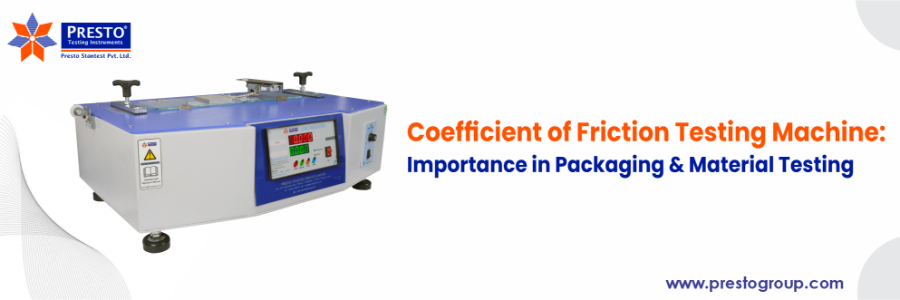
Coherence, safety, and quality are fundamental concepts in modern packaging and material manufacturing. Among important parameters for surface performance is the coefficient of friction - how materials behave when sliding over each other. The industry uses a coefficient of friction testing machine to evaluate different parameters.
Coefficient of Friction (COF)
The coefficient of friction quantifies the resistance of one surface sliding over another. This equals the frictional force divided by the normal force acting between two surfaces.
- Static COF equals the frictional force needed to cause movement.
- Kinetic COF, or sliding COF, measures resistance once motion begins.
For instance, excessively high COF packaging film may stick during processing or jam in machines. Alternatively, too low a COF will cause packages to slip or misalign and cause inefficiency or safety hazards.
What is the coefficient of friction testing machine?
A coefficient of friction testing machine (also called a friction tester or slip tester) measures static and kinetic COF between two surfaces. It eliminates guesswork with numbers and allows proper tracking.
Set-up of a COF Tester:
- A flat test bed to hold the specimen
- A sled (a weighted block) that sits on the specimen or moves across it
- A drive system that pulls the sled at a controlled speed
- A load cell that measures the pulling force during the test
- A controller or software that calculates and reports static and kinetic COF
By holding speed, load, and test length steady, the machine makes results comparable across batches, suppliers, and production days.
Working Principle of a COF Testing Machine
The operator places the sample on the platform and sets the test conditions. The sled rests on the sample surface, creating a known normal load. When the machine starts, it pulls the sled forward. The load cell measures force continuously.
- The peak force at the start corresponds to static friction
- The average force during steady sliding corresponds to kinetic friction
COF is then calculated as:
COF=Frictional Force (F)/Normal Force (N)
N is the normal force from the sled's weight. This simple relationship is what makes COF testing both powerful and widely used.
Importance of COF Testing in Packaging
Packaging materials do not just protect products. They must run through equipment, survive distribution, and look consistent on shelves. COF influences each stage.
1. Ensuring Packaging Efficiency
Many packaging issues show up only at production speed. A film that feels “fine” by hand can still cause jams, web breaks, or feeding instability. The COF testing machine helps confirm that friction stays within a workable range for:
- Unwinding and rewinding behavior
- Form-fill-seal performance
- Pouch feeding and alignment
- Label dispensing and application
When COF drifts, operators often compensate by changing tension, temperature, or speed. Those changes can create new defects. A controlled COF target reduces the need for frequent adjustments.
2. Enhancing Product Safety
Finished packages must withstand stacking, palletizing, and transit. When external surfaces are too slippery, stacks can lean, cartons can shift, and loads can become unstable.
3. Maintaining Consistent Quality
Coatings, treatments, inks, and lamination make notable changes to surface friction. For instance, the use of slip additives improves runnability but can influence print adhesion or surface bonding behavior. COF testing gives a clear indication when a coating changes or an additive adjustment alters surface behavior.
4. Optimizing Material Formulation
COF testing supports incoming inspection and supplier qualification. If a film supplier changes the additive level, resin, or treatment, COF may change regardless of thickness and appearance. Regular COF checks eliminate hidden variability and improve performance.
5. Meeting Industry Regulations
Many industries require COF testing against recognized methods. Typical reference standards include ASTM D1894 and ISO 8295 for plastic film and sheeting. Paper and board applications require TAPPI or DIN methods based on product type and region.
Advantages of Using a COF Testing Machine
COF testing has value anywhere surface slip affects processing or end-use. Common areas include:
- Flexible packaging films: BOPP, PET, LDPE/LLDPE, multilayer coextrusions, laminates
- Paper and board: sheet feeding, stacking, converting, and lamination behavior
- Labels and release liners: smooth dispensing and stable application
- Textiles and nonwovens: handling feel and functional slip
- Rubber and polymer parts: grip characteristics and wear behavior
- Automotive interiors: perceived touch and abrasion-related slip behavior
Even within one material type, the “right” COF depends on the application. A film designed for easy machine feeding may need a different COF than a film designed for stable stacking.
Common Factors Affecting COF Values
COF is sensitive. However, it also makes testing vulnerable to the following factors:
- Surface roughness and texture
- Contact pair
- Slip and anti-block additives
- Corona or plasma treatment levels
- Coatings, lacquers, and print layers
- Humidity, contamination, and temperature (dust, powder, oil)
- Sample orientation (machine direction vs transverse direction)
COF changes after production as additives move up to the surface. A film that passes COF on day one may drift after a week in storage. Hence, a good QA plan is necessary for proper conditioning and retest intervals.
Benefits for Quality, Cost, and Operations
A COF testing machine pays back through fewer issues that are expensive to troubleshoot on a running line. Key advantages include:
- Faster root-cause analysis when jams, scuffing, or stacking failures occur
- Lower material waste due to early detection of off-spec friction
- Higher line uptime from stable feeding and reduced stoppages
- Better documentation for audits and customer approvals
- Cleaner communication between production, QA, and suppliers using measurable targets
Instead of debating whether a film feels slippery, teams can compare COF values and act quickly.
How To Choose The Right COF Testing Machine
Selection should match the material types, standards, and reporting needs. A practical checklist includes:
- Standards compatibility, such as ASTM D1894 or ISO 8295, as required
- Static and kinetic measurement capability
- Stable speed control and consistent pull mechanism
- High-quality load cell and repeatable sled design
- Clear reporting and data export for records and trend analysis
- Calibration support and service availability
- Ease of use for routine QC testing
For busy plants, data logging and simple test setups matter as much as accuracy. If operators avoid using the instrument because it feels complicated, the value drops.
Good Practice: Building COF into a QC workflow
COF testing works best when it becomes routine rather than reactive. Many plants place it at three points:
- Incoming inspection for films, liners, paper, or laminates
- In-process checks after coating, printing, or lamination
- Final release testing before dispatch
This approach helps isolate where variation enters the process and prevents off-spec material from moving forward.
COF Testing and Sustainability Materials
Recyclable mono-material structures, compostable films, and water-based coatings can behave differently from older structures. They may need new COF targets to run reliably on existing lines. COF testing supports this transition by helping teams compare candidate materials, tune formulations, and validate performance without relying only on trial-and-error runs.
It also reduces waste. When friction is controlled, fewer reels get rejected, fewer packs scuff, and fewer shipments face stability problems.
Ensure Reliable Packaging Performance with COF Testing
A coefficient of friction testing machine helps manufacturers control a property that directly impacts runnability, quality, and transport safety. With regular COF measurement, packaging and material teams can reduce downtime, maintain consistent output, and meet customer and standard requirements with confidence.
To improve process stability, they should evaluate COF testing equipment that supports relevant standards, provides repeatable results, and offers strong calibration and service support.
Contact Presto Group Today!
COF Testing machines help measure values with accuracy. We offer instruments that aid in evaluating fine-tuning material behaviour, controlling slip characteristics, and understanding surface interaction. These tools ensure smarter decision-making with consistent results.
Call us: +91 9210903903
Email: [email protected]
Visit: www.prestogroup.com
Address: Plot No. I, 42, NH-19, Block C, DLF Industrial Area, Sector 32, Faridabad, Haryana 121003
Recent Articles
- Climatic Chamber: Working Principle, Uses, Diagram, Price & Top Manufacturers in India
- Izod vs Charpy Impact Test: Difference, Method & Standards
- Colorimeter vs Spectrophotometer: Accuracy, Working Principle, and Industrial Uses
- Quality Assurance and Quality Control: Two Pillars of Product Excellence
- Hardness Test: Types, Testing Methods, Procedures, and ASTM Standards
Need more information
Connect with us for your business enquiries. Generally, we respond within one or two working days.