

- /
- Article / Lab Equipment & Testing Machines: Complete Guide to Industrial and Laboratory Testing Instruments
Lab Equipment & Testing Machines: Complete Guide to Industrial and Laboratory Testing Instruments
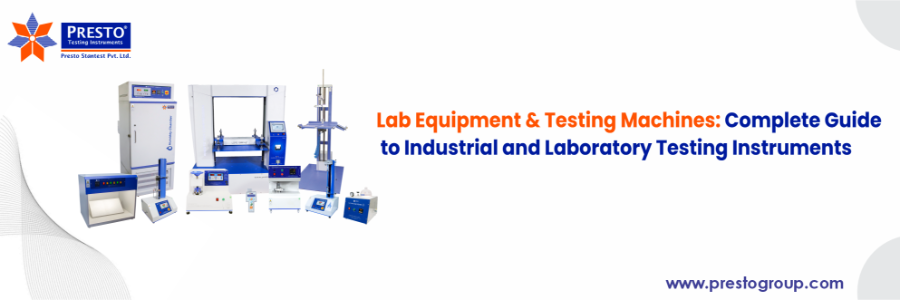
Quality control has always been the core aspect of modern manufacturing and material science. Each part is tested for strength and reliability. The manufacturers must be able to measure the strength of a steel beam supporting a bridge or a polymer resisting pressure. The solution includes precision lab equipment and material testing machines. In the following section, we will describe common industrial and laboratory testing instruments and their uses.
What Are Material Testing Machines?
Material testing machines are instruments to evaluate the mechanical properties of raw materials and related components. Such systems apply controlled stress to a specimen until deformation or failure. It helps in evaluating factors like critical yield strength, tensile strength, and ductility data. Engineers use this data to draw stress-strain curves to understand the behavior of the materials under load. Without proper testing and evaluation, failure of a component can cause severe damage to life and property.
Mechanical Testing Equipment
Mechanical testing involves physical forces. These machines determine how a material will stretch, compress, or twist.
Universal Testing Machines
A Universal Testing Machine conducts tensile, compression, and flexural tests using electromechanical and hydraulic systems. This is a basic instrument for force measurement, and an extensometer for strain measurement. Engineers use UTMs to find the Modulus of Elasticity, commonly known as material stiffness.
Impact Testing Machines
Materials behave differently at high strain rates. An impact tester measures energy absorption and toughness. It strikes a notched sample with a swinging pendulum of known weight. This test helps in determining whether the material is ductile or brittle. For automotive safety components, it is essential. The two major standard methods are the Charpy test (horizontal beam) and the Izod test (cantilever beam).
Hardness Testers
Hardness testing measures a material's resistance to permanent indentation. A calibrated machine presses a diamond cone or hardened steel ball onto the surface. The depth or size of the indentation correlates with a hardness value. This is vital for heat-treated steels and alloys. Common scales include:
- Rockwell: Penetration depth is measured directly.
- Brinell: Use a large ball indenter for coarse surfaces such as castings.
- Vickers: Use a diamond pyramid for micro-hardness testing on thin foils.
Fatigue Testing Machines
Repeated loading of materials causes them to fail below their yield strength. Fatigue testers cycle a sample through millions of cycles of cyclic stress. This simulates the life of components like springs, turbine blades, and axles.
Environmental & Corrosion Test Chambers
Real-world conditions are harsh. These chambers simulate extreme conditions to test durability.
Salt Spray Chambers
Corrosion is the main problem of industries in real-world conditions. Salt spray chambers create a saline mist, which helps in corrosion testing of coatings, paints, and plated metals.
UV Weathering Testers
Sunlight degrades plastics and fades colors. UV testers use fluorescent lamps to simulate ultraviolet radiation. This tells us how materials will age outdoors over a period of years.
Plastic and Polymer Specific Testing
Polymers have special viscoelastic properties. These instruments characterize their flow and thermal behavior.
Melt Flow Index (MFI) Testers.
The flow rate of molten plastic is measured by the Melt Flow Index. It pushes heated resin under a standard die. This value allows the manufacturers to control injection molding.
Heat Deflection Temperature (HDT) Teasters
Plastics soften when heated. The HDT tester determines the temperature at which a polymer deforms under a load. This is very important when designing parts that sit near engines or heat sources.
Surface, Paint, and Coating Instruments
Aesthetic and protective qualities are measured with optical and physical gauges.
Spectrophotometers and Colorimeters
Color is measured digitally on spectrophotometers. They determine the batch-to-batch consistency of paints, textiles, and plastics by studying light reflectance.
Gloss Meters
Gloss is an indication of surface finish quality. A gloss meter points a light beam at an angle and measures the reflection. It is standard for automotive paints and polished stones.
Coating Thickness Gauges
Measurement of dry film thickness is an important step in corrosion protection. Magneto- and eddy current gauges measure paint thickness on metal substrates without damaging the part.
Packaging and Transit Testing
The contents of the package must be safe during shipping. These machines simulate the logistics chain.
- Box Compression Testers (BCT): The stacking strength of cardboard cartons is measured.
- Vibration Testers: Simulate the shaking of trucks & trains
- Drop Testers: Test the cushioning design of the package by simulating free-fall impacts.
Essential General Laboratory Instruments
Apart from mechanical testing, analytical instruments report chemical composition and microstructure.
Laboratory Ovens
Thermal processing ensures material stability. Laboratory ovens use PID controllers to achieve temperature uniformity. They can be used for ageing, annealing, and curing polymers.
Microscopes and Metallography
Macroscopic failure begins at the microscopic level. Grain boundaries & phase structures are examined using Optical and Scanning Electron Microscopes (SEM). This visual data can help identify inclusions or micro-voids that cause fractures.
Sample Preparation Equipment
Exact testing requires precise specimen preparation. Metallographic sample preparation includes sectioning, mounting, and polishing. Abrasive cutters and polishing machines produce a mirror finish. This makes the microstructure easily visible under magnification.
Chemical Testing Instruments
Chemical instruments determine composition, concentration, and contamination. These are needed for pharmaceuticals, food & water treatment, textiles & paints, and industrial chemicals.
Typical tools include:
- pH meter: Acidity or alkalinity checks in water, beverages and process liquids
- Conductivity meter: Test for dissolved salts in water & solutions.
- Titration setup/automatic titrator: Find the concentration of acids, bases, and other chemicals.
- 1H NMR: Helps in bond determination in chemical structure.
- UV-Vis spectrophotometer: This measures how much light the sample absorbs and is used for quantification.
- FTIR spectrometer: Chemical bonds and materials are identified - useful for polymer and coating checks.
- Gas Chromatography and HPLC: Finding impurities & separation compounds in pharma & chemicals.
Conclusion
Lab equipment and testing machines serve as the core of industrial safety and quality. Each instrument validates product performance - from the precise load control to the accelerated weathering conditions. Top-grade testing equipment ensures reliability and gives a clear competitive edge in the market.. Hence, at the time of buying lab equipment, the buyer needs to focus on factors like standards, accuracy, calibration, and service support.
Contact Presto Group Today!
Poor material checks show up in the form of compromised quality and long-term expenses. Explore our range of high-tech precision testing devices and lab equipment for accurate results and unmatched reliability.
Call us: +91 9210903903
Email: [email protected]
Visit: www.prestogroup.com
Address: Plot No. I, 42, NH-19, Block C, DLF Industrial Area, Sector 32, Faridabad, Haryana 121003
Recent Articles
- Climatic Chamber: Working Principle, Uses, Diagram, Price & Top Manufacturers in India
- Izod vs Charpy Impact Test: Difference, Method & Standards
- Colorimeter vs Spectrophotometer: Accuracy, Working Principle, and Industrial Uses
- Quality Assurance and Quality Control: Two Pillars of Product Excellence
- Hardness Test: Types, Testing Methods, Procedures, and ASTM Standards
Need more information
Connect with us for your business enquiries. Generally, we respond within one or two working days.