
- /
- Blog / What is the Coefficient of Friction: Key Concepts, Formula, and Industrial Applications?
What is the Coefficient of Friction: Key Concepts, Formula, and Industrial Applications?
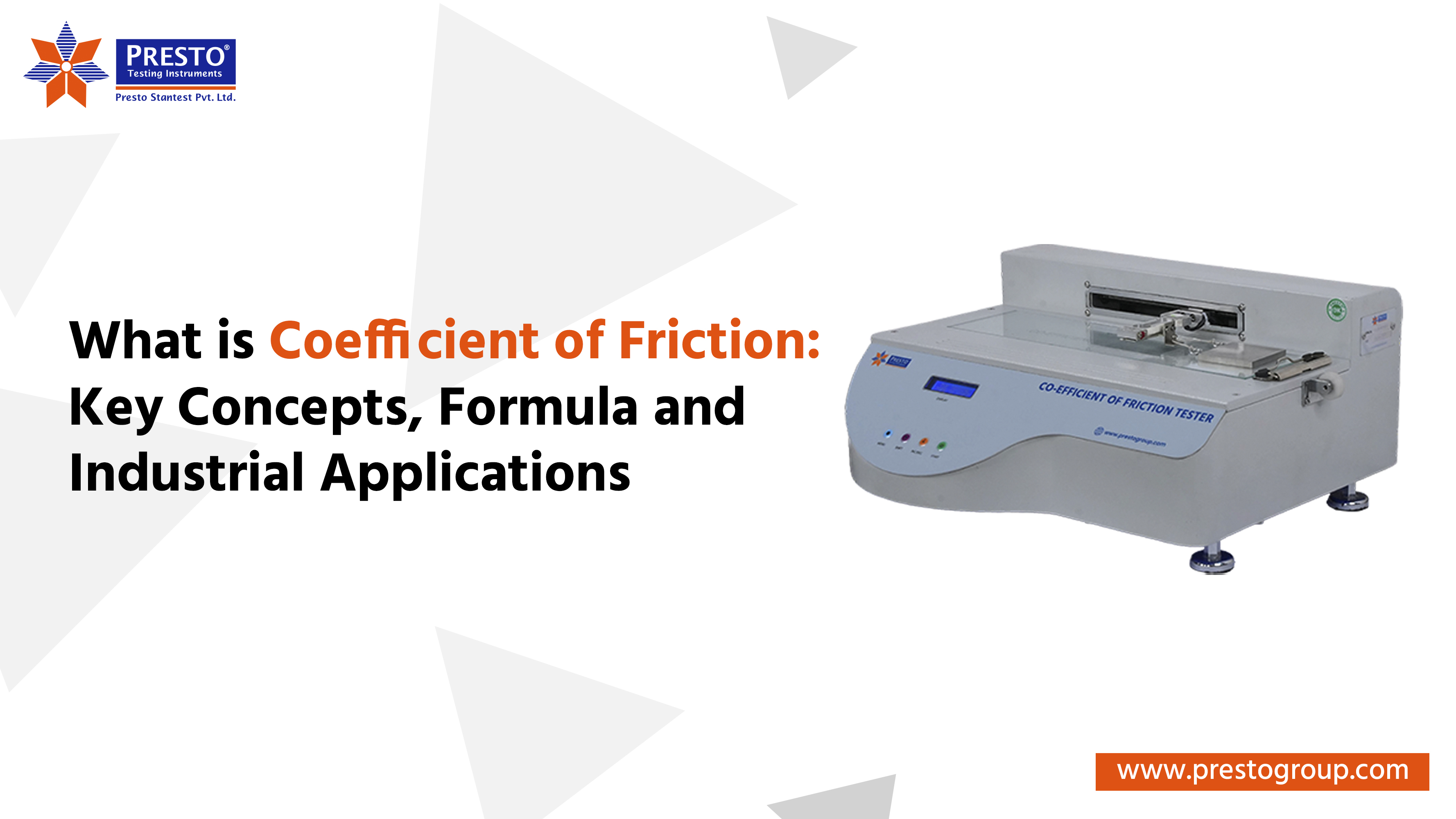
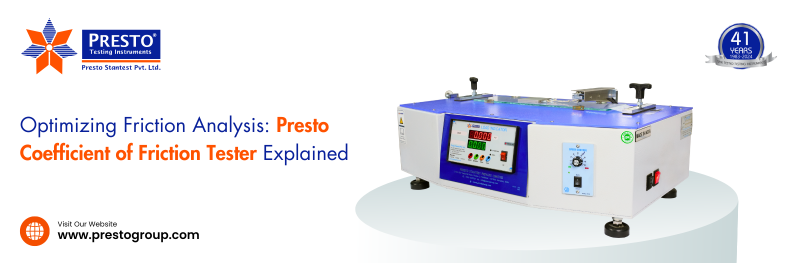
In factory setups where precision is always paramount, even the tiniest issue with surface movement could affect the quality of the final product. That is why how well machines perform always matters. Its resulting impact is on customer happiness and the overall outcome. The friction coefficient is a number that industries use to figure out how materials slide, grip, and perform when handled, packed, and moved. This is why testing the coefficient of friction (COF) has become a step to assess the quality of materials like packaging, plastics, paper, and other materials used in industry.
What is the COF Full Form and Why Does It Matter in Material Testing?
In today’s manufacturing quality era, any product material must go through production, packaging, and transport without any glitches. Although the surface movement may be simple, it can lead to friction control failure, slip, block, tear, failure to stack, and machine downtime. Thus, a coefficient of friction test is now an integral part of material inspection.
Coefficient of Friction: Definition, Types, and Key Concepts
Most businesses working with packaging films, plastic sheets, paper, labels, laminates, and many other coated surfaces always require test results. It is mandatory before the dispatch process and thus before sending products to their customers’ destinations. There are certain methods for measuring the friction of plastic film and sheeting, as specified in ASTM D1894 and ISO 8295. A good testing method provides consistent results for manufacturers. It makes the business owners more confident in their products, and thus helps them improve their packaging.
Coefficient of Friction Formula: How Friction is Measured
COF Full Form means Coefficient of Friction, and that must be understood in a specific context of its terminology. COF is therefore an important factor in material testing because packaging and industrial materials need to move, catch, and stack properly for their intended production and use. That is why measuring friction is always mandatory.
What is a Coefficient of Friction Test and Why is it Important?
Keeping aware of the terminology makes things hassle-free. Coefficient of Friction is the ratio between the frictional force and the normal force. The static COF is the force required to initiate or begin to move, and the kinetic COF is the force required to keep an object moving. These two values provide information about the company’s initial grip and running performance.
Coefficient of friction formula is μ = F/N,
- Where μ is considered to be coefficient of friction,
- F is the frictional force,
- N is the normal force.
The lower the value, the smoother the sliding, and the higher the value, the more resistance to it. Use of this formula to compare two material surfaces under controlled test conditions in laboratories.
How a COF Tester Works? Testing Process and Measurement Principles
A Coefficient Of Friction Test measures the sliding resistance between two surfaces. Since a visual check cannot necessarily identify actual slip behavior, it’s important. The test is useful for detecting variations in the coating, surface contamination, the use of incorrect additives, moisture effects, and material non-uniformity that can cause production problems. This concept is very simple yet needs to be understood thoroughly and effectively.
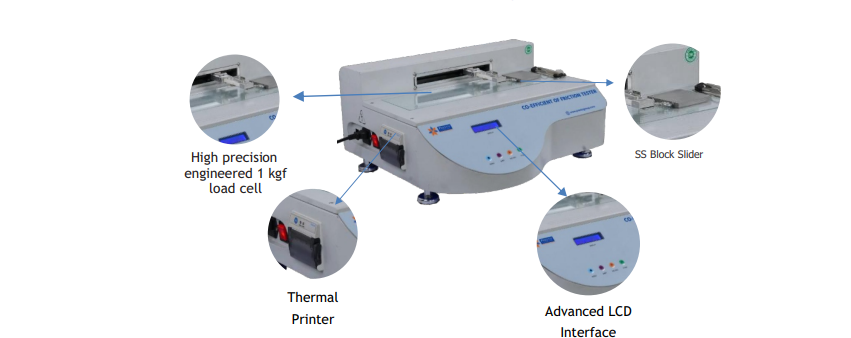
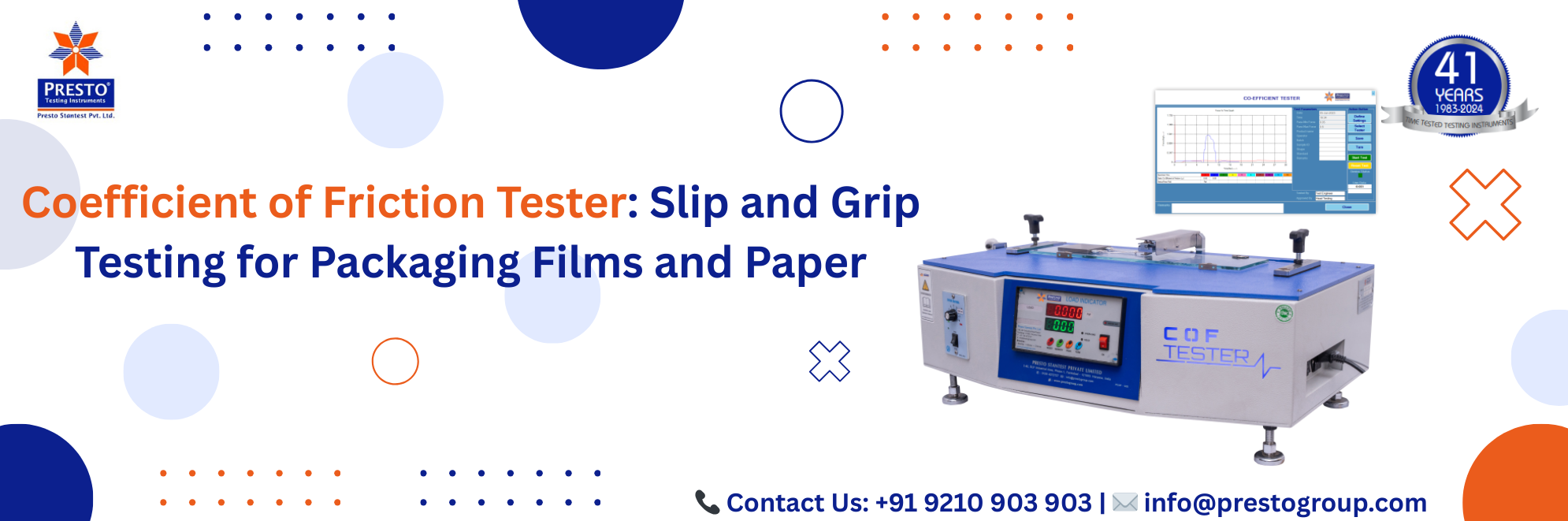
A COF Tester usually includes a flat test bed, a calibrated sled, a clamp, a motorized pulling system, a load sensor, and a digital display. It is a sample fixed, with a sled gliding at a controlled speed across it. Modern-day Coefficient of Friction Testers display static and kinetic CF values, which can be recorded for repeatable reporting.
Significance of the COF Test in Quality Assurance and Product Performance
The Significance of the COF Test is visible in production reliability. Proper COF values ensure the flowability of materials during printing, sealing, filling, lamination, cutting, stacking, and transport. They also minimize machine downtime, product rejection, pouch instability, film blocking, and customer complaints.
Benefits of the COF Tester for Packaging, Plastic, Paper, and Other Industries
The Benefits of the COF Tester include improved process control, reduced waste and better batch consistency. COF data is used by packaging companies to help prevent slips and blocks. Plastic film manufacturers use it to achieve smooth movement and an indispensable grip. It is used in paper and paperboard to increase feeding ability and stacking capacity. A dependable Lab Testing Machine makes these checks faster and more accurate.
Industrial Applications of Coefficient of Friction Testing
Coefficient of friction testing applications include food packaging, pharmaceutical packaging, flexible films, labels, foils, rubber, textiles, paper, adhesives, and printed materials. It helps make decisions about coatings, slip additive use, lamination quality, storage conditions, and supplier approval. In high-speed industries, it prevents material jamming, excessive sliding, and sticking together.
Factors Affecting Coefficient of Friction Test Results
The crucial factors that always affect COF results include surface roughness, coating quality, material thickness, additives, aging, temperature, humidity, dust, and storage conditions. Indeed, readings are also often influenced through test speed, sled weight, pressure, and sample handling related cases. Thus, adequate sample conditioning is mandatory. Furthermore, multiple tests need to be performed on each sample using a similar method.
Choosing the Right Coefficient of Friction Tester for Accurate Testing
The type of material, desired accuracy, speed range, sled size, software, calibration support, and reporting features are all factors to consider when selecting the right test. The machine should support recognized methods such as ASTM D1894 and ISO 8295. Good testing reduces complaints, builds manufacturers’ confidence in approving materials, and ensures stable product performance.
Ensure Accurate Friction Testing with Presto's Advanced COF Tester
Enhance product quality, reduce production issues, and ensure reliable packaging performance with Presto's high-precision Coefficient of Friction Tester. Get expert guidance and industry-compliant testing solutions tailored to your quality control needs.

Call Us: +91 9210 903 903
Email: info@prestogroup.com
Accurate Results | Trusted by Industry Leaders | Fast Delivery
Contact our experts today to find the right COF testing solution for your business and ensure consistent product quality.
Recent Blogs
- Injection Molding: Process Steps, Machine Operation, Diagrams & Testing Instruments
- Peel Strength and Heat Seal Strength Testing for Flexible Packaging
- Industrial and Laboratory pH Meters: Working, Diagram, Uses and Selection Guide
- Industrial Leak Testing: Methods, Technologies, Benefits, and Industry Applications
- PET Preform Quality Test Using Preform Measurement Instruments — Step-by-Step Guide
Related Blogs
Coefficient of Friction Tester: Slip and Grip Testing for Packaging Films and Paper
.png)
How to Find the Coefficient of Friction? A Step-by-Step Guide