

- /
- Blog / Injection Molding: Process Steps, Machine Operation, Diagrams & Testing Instruments
Injection Molding: Process Steps, Machine Operation, Diagrams & Testing Instruments
One of the most popular manufacturing techniques for creating large quantities of plastic parts is injection molding. This process assists automotive components and medical devices manufacturers, packaging, electronics, and household products manufacturers in developing precise and repeatable parts with a high level of speed.
The right machine is not the only thing, however, in producing quality parts. The steps of the injection molding process, management of machine settings, and testing of the produced products are also important. A slight change in temperature, pressure, or quality of material may result in flaws and breakdown of the product.
Here in this guide, you will get to know about the process of an injection moulding machine, injection moulding diagram, some common defects, and injection moulding testing equipment and instruments that are used to maintain the consistency of the quality of a product.
What is Injection Molding and How Does It Work?
Injection molding is a production technique to create plastic-based objects by injecting molten plastic into a particularly structured mold. Once the plastic is cooled and hardened, the mold is opened and the completed product taken away.
The procedure is very effective, as the same mold could make thousands or millions of the same parts with very high precision.
The fundamentals of working involve:
- Feeding plastic granules into the machine
- Heating the plastic in a heated barrel.
- Injecting the molten material into a mold under pressure
- Allowing the plastic to cool until it hardens.
- Opening the mold and ejecting the finished component
Modern machines have computer-controlled systems to ensure proper temperature, injection pressure, cooling time, and consistency of the cycle. This enhances the quality of products, and also waste is minimized.
Injection Molding Process Steps: From Raw Material to Finished Product
Knowledge of the process steps of injection molding allows manufacturers to generate the same quality components.
Step 1: Material Preparation
The plastic pellets are dried to remove moisture. Moisture may form bubbles, weak spots, or a poor finish.
Step 2: Feeding the Material
The dried pellets get into the hopper and pass into the hot barrel.
Step 3: Melting
The plastic is melted into a uniform molten material by rotating screws and heaters in the barrel.
Step 4: Injection
The screw presses forward and forces the molten plastic into the mold at high pressure. This is a very important step in the injection molding process as it decides the degree to which the mold fills.
Step 5: Packing and Holding
Further pressure is exerted to offset the shrinkage of the material during cooling.
Step 6: Cooling
The mold remains closed while the plastic cools and solidifies into its final shape.
Step 7: Mold Opening
The mold opens automatically after it is cooled down.
Step 8: Part Ejection
Ejector pins force the completed part out of the plastic.
This full injection moulding process step-by-step cycle normally requires a few seconds to a few minutes, depending on the size of the product and material.
Injection Moulding Process Diagram and Machine Components
A standard injection moulding process figure shows the flow of materials through the machine to the mold.
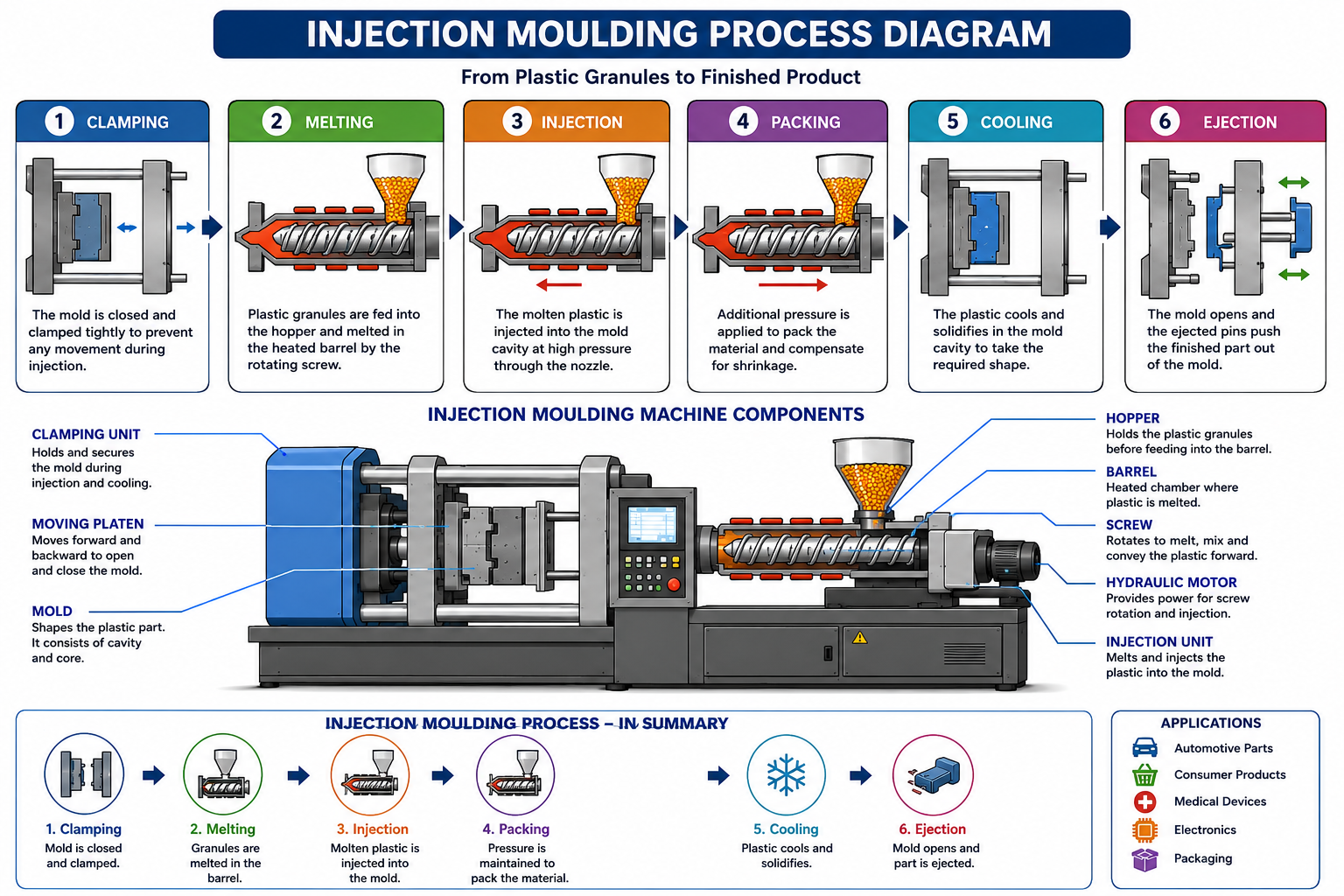
The main components include:
| Component | Function |
| Hopper | Stores plastic pellets |
| Heated Barrel | Melts plastic material |
| Screw | Mixes and pushes molten plastic |
| Nozzle | Transfers plastic into the mold |
| Mold | Forms the final product shape |
| Clamping Unit | Holds the mold tightly closed |
| Cooling Channels | Remove heat from the mold |
| Ejection System | Removes finished parts |
The injection moulding diagram usually displays the flow of the material out of the hopper through the barrel by way of the screw to the mold cavity and the finished product.
Knowledge of the injection moulding machine process assists the operators in maximizing cycle time, minimizing material wastage, and enhancing efficiency in the production process.
Common Defects in Injection Molding and Their Causes
With such advanced equipment, defects can still take place when machine settings or material conditions are not correctly regulated.
The most common defects are:
Flash
Additional plastic is found along the edges of the mould, and it is caused by injection pressure that is too large or misalignment of the mould.
Sink Marks
Due to an uneven cooling process or little packing pressure, small depressions are observed on the surface of the product.
Short Shot
The cavity mold is not filled to the maximum due to low injection pressure or low material flow.
Warpage
Cooling is done improperly, and the final part becomes bent or twisted.
Weld Lines
When the flow fronts of two molten plastics meet in the mold, visible lines can be seen.
Air Bubbles
Bubbles within the molded product are caused by trapped air or excess moisture.
Frequent checking and testing assist makers of such products in identifying such defects prior to their delivery to consumers.
Quality Testing in Plastic Injection Molding
Testing is an essential part of modern plastic manufacturing. It confirms that products are of the required quality and industry-conformity.
Quality testing usually comprises:
- Dimensional inspection
- Tensile strength testing
- Compression testing
- Impact resistance testing
- Melt flow analysis
- Hardness testing
- Environmental testing
- Heat resistance testing
These tests assure that products retain their strength, durability, look, and performance during service life.
Proper Injection Molding Testing Equipments are effective in cutting defects in production and enhancing customer satisfaction.
Essential Testing Instruments Used in Injection Molding
There are several Plastic Injection Molding Testing Instruments applied to assess the physical and mechanical characteristics of molded products.
UTM Testing, Ray Testing (URT)
Tests tensile, compression, and flexural strength of plastic parts.
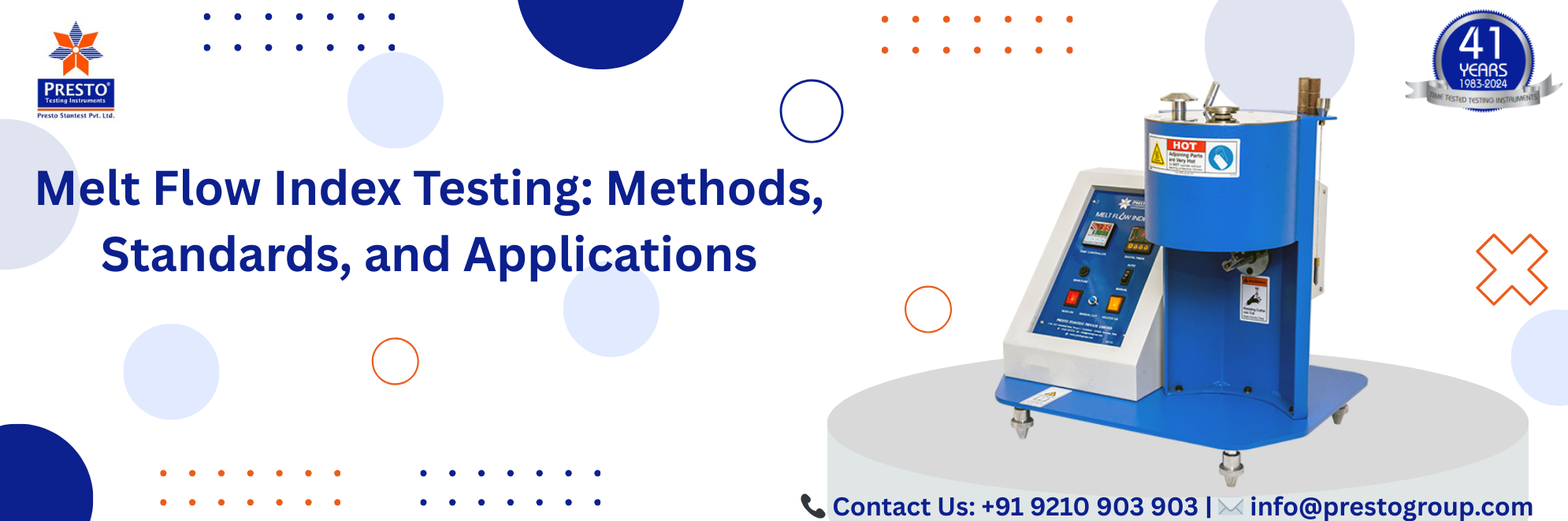
Melt Flow Index Tester.
Determines the ease of flow of molten plastic in the process. It aids manufacturers in choosing the appropriate raw materials to be used in injection molding.
Izod and Charpy Impact Tester
Measures the strength and resistance to sudden loads.
Heat Deflection Temperature (HDT) Tester
Assesses the behavior of plastic during heating and loading.
Vicat Softening Point Apparatus
Determines the temperature at which plastic begins to soften.
Hardness Tester
Checks the hardness of product surfaces to ensure durability.
Environmental Test Chamber
Tests the performance of the product in various temperature and humidity conditions.
Digital Thickness Gauge
Checks dimensional consistency and wall thickness.
Presto, which is a major manufacturer of testing equipment, provides modern Injection Molding Testing Equipment that is also applicable to quality control laboratories and factory production. These instruments help manufacturers verify material performance, maintain production consistency, and meet international quality standards.
Best Practices to Improve Injection Molding Quality and Efficiency
A constant flow of production enhances quality and productivity.
There are recommended practices that are:
- Process raw materials that are dry.
- Keep adequate molding temperature.
- Use correct injection pressure and speed.
- Perform regular machine maintenance.
- Clean molds frequently.
- Keep watch on cooling time.
- Inspect products throughout production.
- Regularly calibrate instruments.
- Train machine operating staff to control the processes properly.
Adhering to these practices helps reduce defects and enhance machine efficiency.
How to Select the Right Testing Equipment for Injection Molded Products
The choice of testing equipment varies according to the material, the application of products, and quality demands.
Take into account the following factors:
Product Type
The mechanical and thermal tests of various goods are different.
Testing Standards
Use equipment that complies with ASTM, ISO, or other applicable standards.
Measurement Accuracy
Test results are reliable when the instrument used is high-precision.
Ease of Operation
User-friendly equipment saves time on training and enhances productivity.
Automation Features
Automatic data collection enhances repeatability and reduces human error.
Calibration Support
Choose the equipment with simple calibration and long durability.
After-Sales Service
Reliable technical support and maintenance are essential for uninterrupted production.
Conclusion
Injection molding is also one of the most effective processes for creating quality plastic parts. Knowledge of the entire injection moulding process steps, examination of the injection moulding process schematics, and optimization of the injection moulding machine process enable manufacturers to increase productivity and minimize defects.
Equally important is product testing. Dependable Injection Molding Testing Equipment and Plastic Injection Molding Test Instruments assist in the testing of strength, durability, dimensional precision, and material performance of products prior to market release.
Presto provides a diverse set of Plastic Injection Molding Testing Instruments, which provide flawless, consistent, and standards-conforming data to customers in all fields.
Optimize Your Injection Molding Process with Accurate Testing
Reduce defects, improve product consistency, and achieve reliable quality with advanced testing instruments from Presto Stantest Pvt. Ltd.
Call us: +91 9210903903
Email: info@prestogroup.com
Recent Blogs
- Injection Molding: Process Steps, Machine Operation, Diagrams & Testing Instruments
- Peel Strength and Heat Seal Strength Testing for Flexible Packaging
- Industrial and Laboratory pH Meters: Working, Diagram, Uses and Selection Guide
- Industrial Leak Testing: Methods, Technologies, Benefits, and Industry Applications
- PET Preform Quality Test Using Preform Measurement Instruments — Step-by-Step Guide
Related Blogs
Melt Flow Index Testing: Methods, Standards, and Applications
.png)
The Ultimate Guide to Universal Testing Machines (UTM)

How Melt Flow Index Calculation is Important for Plastic Quality Assurance?
.png)
Test The Tensile & Compression Both With UTM