

- /
- Blog / Industrial and Laboratory pH Meters: Working, Diagram, Uses and Selection Guide
Industrial and Laboratory pH Meters: Working, Diagram, Uses and Selection Guide
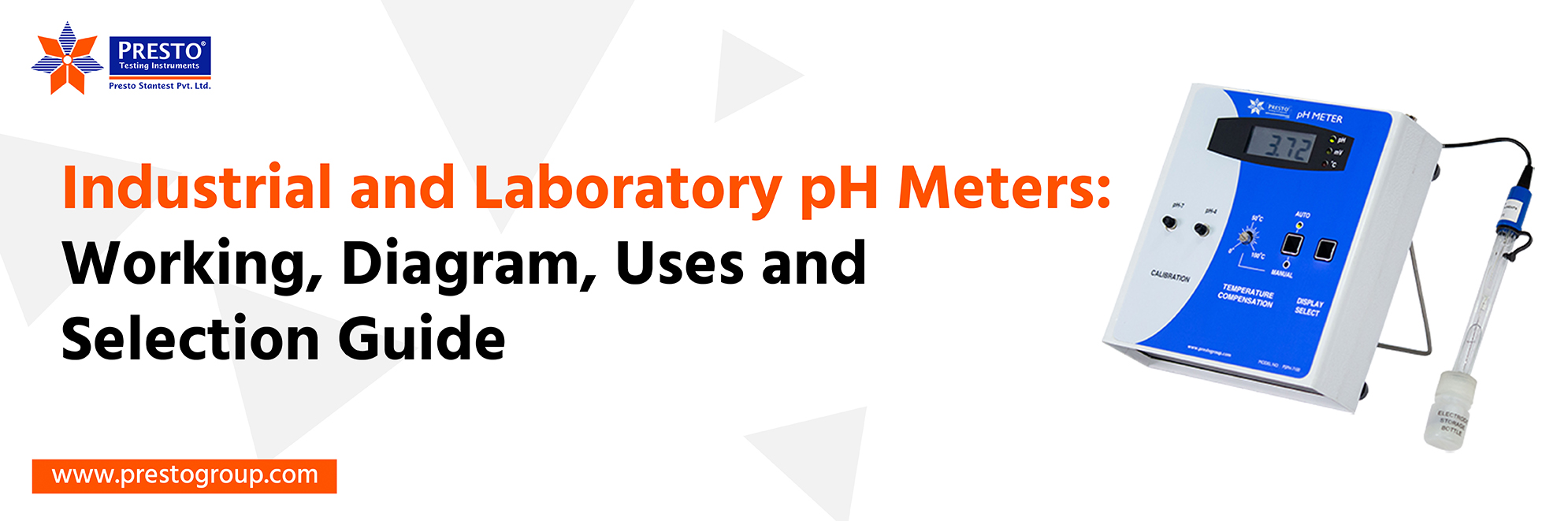
The determination of the pH is a significant aspect of quality control in most industries. Whether containing water, medicines, food products, or chemicals, the right pH value is used to enhance the quality of products and the safety of the process. That is why the use of a digital pH meter has turned into a routine testing method in laboratories and manufacturing plants.
Electronic pH meter systems have emerged in the modern world and are fast, reliable and accurate. From small lab models to high-tech industrial pH meter systems that can monitor continuously, they are all used to ensure that the industry produces the same high-quality product and meets the standards.
Here in this guide, we shall discuss the working principle of a pH meter, its key parts, uses, and a way of choosing the right pH meter manufacturer to suit your needs.
What is a pH Meter and How Does It Measure pH?
A pH meter is a device used to determine the acidity or alkalinity of a liquid. It is a pH scale of 0 to 14:
Below 7 = Acidic
7 = Neutral
Above 7 = Alkaline
A digital pH metre has very accurate numerical readings as opposed to pH paper; hence, it is appropriate in research, quality control and in testing in industries.
A laboratory pH meter is usually characterised by:
- Glass measuring electrode
- Reference electrode
- Temperature sensor (many models)
- Electronic measuring circuit
- Digital display
The meter is used to test the activity of hydrogen ions in a solution. It transforms the electrical signal that was generated by the electrodes to the value of pH that is displayed on the display screen.
Working Principle of a Digital pH Meter
The working principle of a digital pH meter is based on electrochemical measurement.
On insertion of the probe in a liquid:
- The glass electrode reacts with hydrogen ions.
- The reference electrode maintains a stable electrical potential.
- Between the two electrodes, a small voltage is generated.
- This voltage is measured by the meter.
- The internal processor then uses the standard calibration data to
- convert it to a pH value.
- The final reading appears on the digital display.
The majority of modern electronic pH meter models also incorporate Automatic Temperature Compensation (ATC) that can modify readings depending on the temperature of the solution to enhance accuracy.
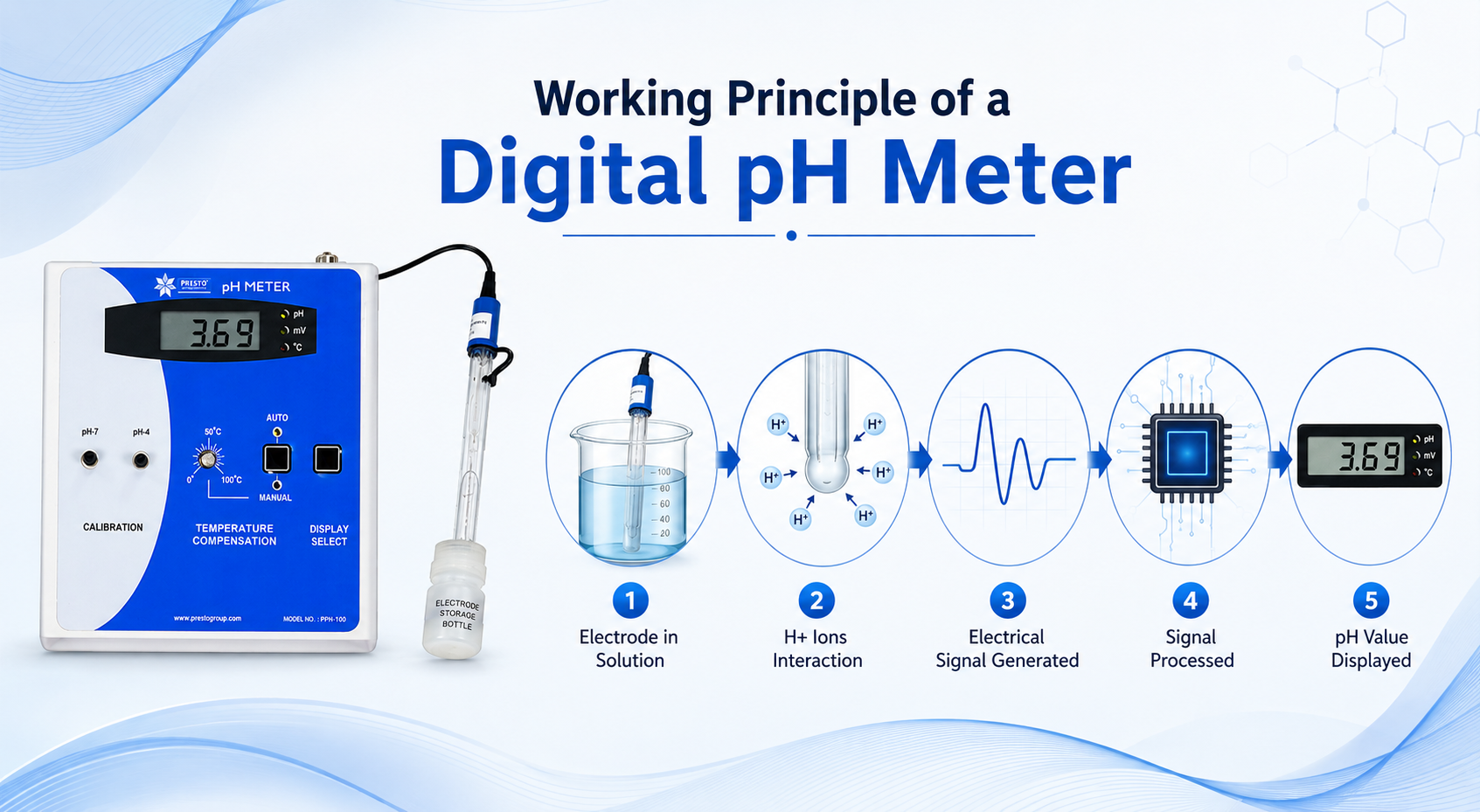
This technology enables laboratory pH meter systems as well as industrial pH meter systems to give consistent and reproducible results even in the case of continuous testing.
pH Meter Diagram and Main Components Explained
A pH meter diagram assists users in grasping how various components cooperate to measure pH.
Main Components:
| Component | Function |
| Glass Electrode | Detects hydrogen ions in the solution |
| Reference Electrode | Provides constant reference voltage |
| Temperature Sensor | Corrects readings for temperature changes |
| Amplifier | Strengthens weak electrical signals |
| Microprocessor | Converts voltage into pH values |
| Digital Display | Shows the final pH reading |
The fundamentals of a pH meter diagram include the electronic display device and the measuring probe. A glass electrode, reference electrode, and temperature sensor are incorporated in one probe in many modern instruments, which simplify the testing and make it more precise.
Industrial vs Laboratory pH Meters: Key Differences
Even though both instruments are targeted at measuring pH, they are suited to different applications.
| Feature | Laboratory pH Meter | Industrial pH Meter |
| Application | Research and quality control | Continuous process monitoring |
| Installation | Bench-top or portable | Fixed online installation |
| Accuracy | Very high | High with continuous monitoring |
| Environment | Clean laboratory | Harsh industrial conditions |
| Data Output | Manual or digital storage | PLC, SCADA, automation systems |
A laboratory pH meter is usually employed in sample testing, whereas an industrial pH meter is necessary to continuously test production lines, wastewater plants, chemical processing units, and food manufacturing facilities.
How to Operate pH Meter for Accurate Results
To have the correct measurements, it is important to know how to operate pH meter equipment.
Step 1: Meter Calibration.
Before testing, use standard buffer solutions (usually pH 4, 7 and 10).
Step 2: Rinse Electrode.
Wipe the probe with distilled water to prevent contamination.
Step 3: Place the Probe in the Sample
Insert the electrode, totally avoiding contact with the container walls.
Step 4: Wait until the reading is stable.
Let the display stabilise and then record the value.
Step 5: Clean After Use.
Wipe the electrode, then rinse it and place it in the suggested storage solution.
These steps guarantee correct measurements and prolong the lifespan of the electrode. When using a digital pH meter regularly in the laboratory or in industrial quality control, it is particularly important to perform regular calibration.
Automatic and Digital pH Meters: Features and Benefits
New models of automatic pH meters comprise more advanced features that enhance speed and accuracy of testing.
Some typical characteristics are:
- Automatic Temperature Compensation (ATC).
- Automatic calibration
- Large LCD display
- High-resolution readings
- USB connectivity and data storage.
- Stable reading indicators
- Long-lasting electrodes
Advantages of a digital pH metre are:
- Faster measurements
- Reduced human error
- Better repeatability
- Easy operation
- Improved quality control
- Higher measurement accuracy
An automatic pH meter has been favoured by many industries due to its ease of routine testing and the ability to provide consistent results even at high-volume production.
Applications of pH Meters Across Different Industries
An electronic pH meter is popular in many industries where precise pH control is required.
Water Treatment
Checks the quality of water, wastewater, and industrial water.
Food and Beverage
Analysis of pH in dairy processing, beverages, ferments, sauces, and packaged food production.
Pharmaceutical Industry
Ensures adequate pH in formulating, manufacturing and quality assurance of drugs.
Chemical Industry
Manages chemical reactions and guarantees uniformity of products.
Agriculture
Checks pH of soil and irrigation water to enhance crop production.
Environmental Laboratories
Monitors environmental compliance in tests of lakes, rivers, groundwater, and wastewater.
Research Laboratories
A laboratory pH meter supports chemical analysis, biological studies, and educational research.
Industrial Manufacturing
The production processes are continuously checked using an industrial pH meter to enhance efficiency and minimise variation in products.
How to Choose the Right pH Meter Manufacturer
Before choosing an instrument, the right pH meter manufacturer is crucial. A trusted manufacturer offers precise equipment, trustworthy service, and long service life.
Take into account the following aspects:
- Proven industry experience
- High measurement accuracy
- Adherence to international standards
- Calibration support
- Strong after-sales service
- Accessibility to substitute electrodes.
- Easy-to-use software and controls.
- Technical support and training.
Presto provides excellent testing equipment to laboratories, educational institutions, food processing facilities, pharmaceutical companies, and industrial plants to ensure precise and repeatable measurements. Presto pH meters are constructed using quality parts, with easy calibration functions, digital displays, and reliable performance suitable for both laboratory routine and industrial quality control.
The digital pH meter has emerged as a mandatory tool in the support of quality, safety and control in numerous industries. You may need a pH meter to analyse a sample with greater accuracy, or an industrial pH meter to monitor it continuously. Knowing the basic principle of work, pH meter scheme, operating system, and main characteristics will help you choose the right one.
Find the Right pH Meter for Your Application
Whether you need a laboratory pH meter for research or an industrial pH meter for continuous monitoring, Presto offers dependable solutions backed by expert support.
Call us: +91 9210903903
Email: info@prestogroup.com
Recent Blogs
- Industrial and Laboratory pH Meters: Working, Diagram, Uses and Selection Guide
- Industrial Leak Testing: Methods, Technologies, Benefits, and Industry Applications
- PET Preform Quality Test Using Preform Measurement Instruments — Step-by-Step Guide
- How to Test and Prevent Metal Corrosion Using a Salt Spray Chamber
- Autoclave in Laboratories and Industry: Principle, Procedure, Components, and Applications
Related Blogs
How pH Meters Help Maintain Food Safety in the Food and Beverage Industry
What Is a pH Meter and How Does It Work?
.png)