
- /
- Blog / Salt Spray Chamber - The Best Corrosion Testing Equipment
Salt Spray Chamber - The Best Corrosion Testing Equipment
Quick Summary
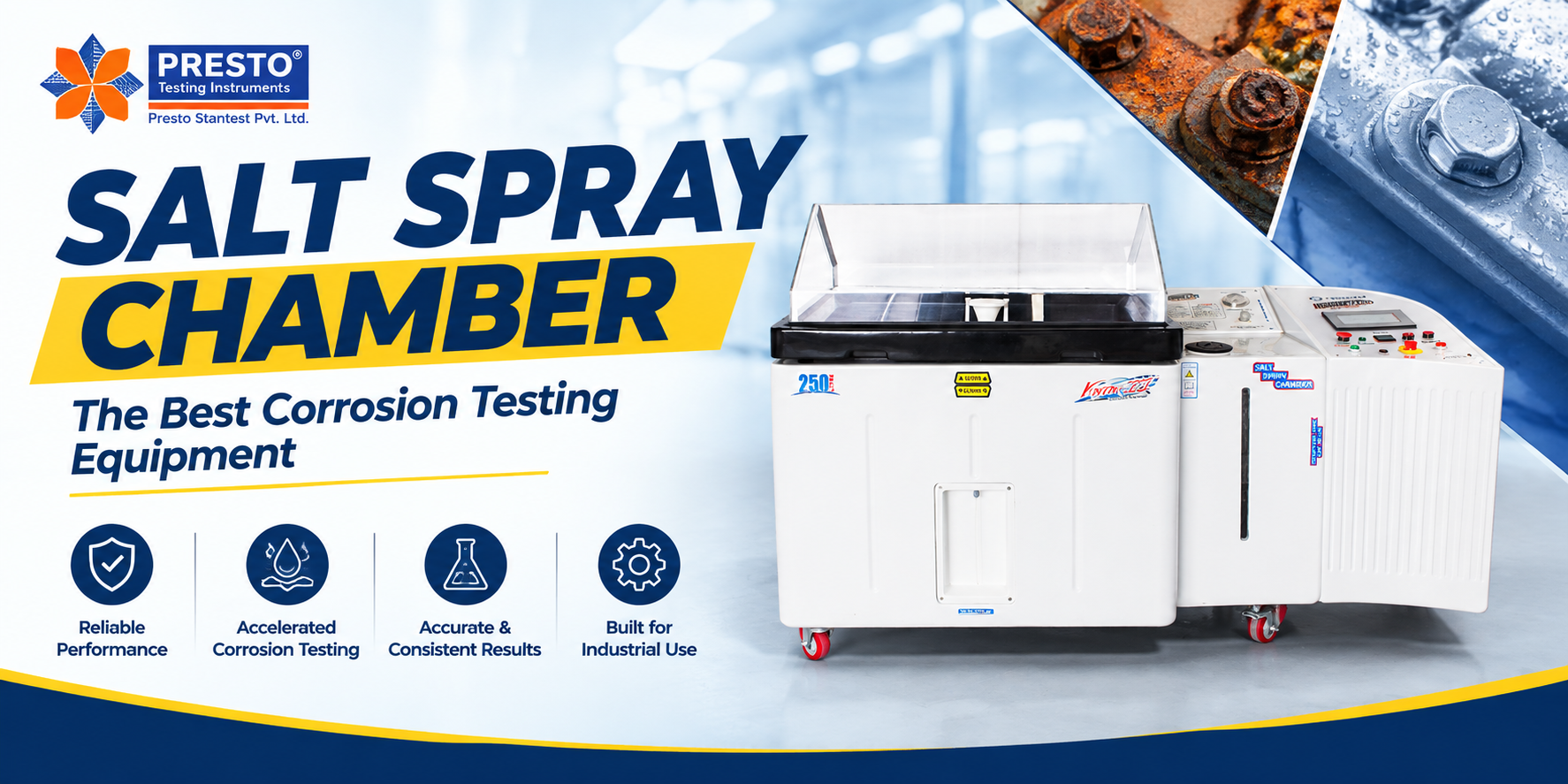
Corrosion testing equipment is often referred to as a salt spray chamber or salt fog chamber. It allows companies to simulate years of real-world exposure in hours or days. This testing helps determine how metals, coatings, and platings will hold up before a product is ever put to use. There are two standards you should know: one is ASTM B117, which is the primary standard used in North America. The other is ISO 9227. ISO 9227 includes types of tests like acetic acid salt spray and copper-accelerated acetic acid salt spray. Choosing the chamber depends on several factors. You need to consider how you plan to test, the size of the chamber, the standards you must meet, how well you need to control temperature, how much fog the chamber produces, and the concentration of salt in the solution. In what follows, we will explain how the equipment works, how the test is carried out, how to interpret the results, and how to pick a machine that fits your lab’s needs. This advice is based on the experience of Presto Group, a manufacturer of corrosion testing equipment that ships salt spray testing machines around the world. For concrete corrosion testing equipment, contact Presto Group [email protected].
.gif)
What Is Corrosion Testing, and Why Does It Matter?
Corrosion testing shows how metals, alloys, and coated parts stand up to conditions. Accelerated corrosion testing is used to speed up this process. In corrosion testing, samples are exposed to salt fog and controlled humidity and temperature inside a test chamber. This approach lets you predict product life and spot coating failures. Corrosion testing also protects strength and electrical performance. By doing corrosion testing, you can reduce warranty risks and meet the rules of industry, regulators, and OEMs.
Industries that depend a lot on corrosion testing are automotive, aerospace, marine, construction, electronics, oil and gas, and general metal fabrication and finishing. A corrosion assessment tool is essential for all these industries.
How Salt Spray Chambers Work
A salt spray or salt fog chamber is a sealed container that maintains a temperature. It turns a saltwater solution into a thin mist. The solution is usually made with 5% sodium chloride. This mist covers the items being tested continuously.
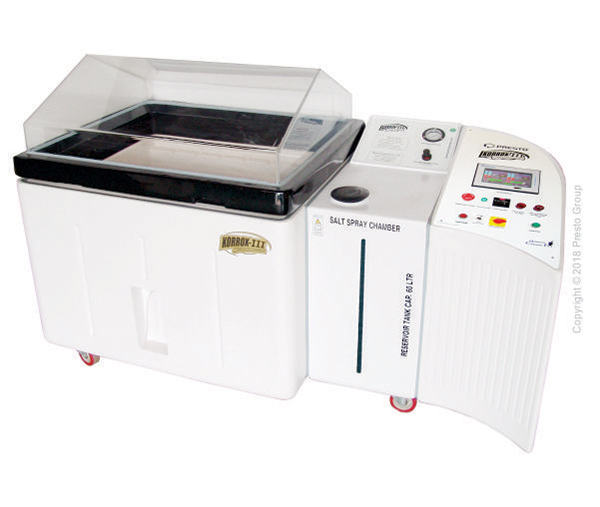
The core components of a typical corrosion assessment tool include:
- Spray/fog tower—atomizes the salt solution using compressed air, producing a fine, even mist.
- Air saturator tower—pre-humidifies and heats incoming air so it doesn't dry out the fog before it reaches the specimens.
- Chamber body—usually constructed from corrosion-resistant materials like fiberglass-reinforced polyester or PVC, since the interior itself is exposed to constant salt fog.
- Heating system and temperature controller—maintains the chamber at a stable test temperature (commonly 35°C for neutral salt spray).
- Specimen racks—hold samples at a specified angle (typically 15°–30°) so condensate drips off rather than pooling or dripping onto adjacent specimens.
- Fog collection funnels—measure the fallout rate of the salt fog to confirm the chamber is operating within specification.
- Reservoir and dosing system—stores and feeds the salt solution to the atomizer at a controlled rate.
During a test, we load specimens onto the racks. We seal the chamber. Let the system spray salt solution continuously for a set period. That period can be as short as 24 hours for a screening test or more than 1,000 hours for a long‑duration durability test. During the test, operators check the chamber temperature, the air pressure, the pH of the solution that is collected, and the rate at which fog is collected. They do this to make sure the test conditions stay within tolerance for the run.
Key Standards: ASTM B117 vs. ISO 9227
| ASTM B117 | ISO 9227 | |
| Region | Primarily North America | International |
| Test type | Neutral salt spray (NSS) | NSS, plus acetic acid salt spray (AASS) and copper-accelerated acetic acid salt spray (CASS). |
| Solution | 5% NaCl, pH 6.5–7.2 | 5% NaCl, with pH adjusted per variant. |
| Chamber temperature | 35°C | 35°C (NSS/AASS), 50°C (CASS) |
| Typical use case | US automotive, aerospace, and general industrial. | Global automotive, decorative plating (especially chrome), and export-facing manufacturers. |
The two standards are very similar when it comes to the basics—both require a 5% salt solution that is turned into a mist at 35°C. ISO 9227 covers more areas. It includes a severe test called the CASS test. This test is used a lot to check chrome plating and layered coatings. If your products are sold around the world, or if you are working with a European or Asian company that makes big machines, you will probably need to follow ISO 9227. You might need it along with ASTM B117.
Types of Corrosion Testing Equipment
Not every application calls for the same chamber. Common variants include
- Salt Spray / Fog Chambers are the NSS setup, and it is used for general coating and plating evaluation.
- CASS Chambers, which stand for Copper-Accelerated Acetic Acid Salt Spray, run hotter at fifty degrees Celsius and contain copper chloride. This makes corrosion happen faster and more aggressively. CASS Chambers are commonly used for chrome and nickel-chrome plated automotive trim.
- Cyclic Corrosion Chambers cycle between salt fog, dry‑off, and humid conditions during one test. This approach replicates outdoor weathering more closely than a test that keeps the fog constant. Cyclic Corrosion Chambers provide a test environment.
- Combined salt spray and humidity chambers allow the user to perform both salt fog testing and standard temperature and humidity cycling in a unit. This feature is especially useful for labs that have limited floor space. Combined salt spray and humidity chambers save space while providing results.
Choosing the Right Equipment for Your Lab
When evaluating corrosion testing equipment, consider:
1. Which standards you need to follow. If you sell to different areas, choose a chamber that meets both ASTM B117 and ISO 9227 (including CASS) instead of buying different machines later.
2. Chamber size and how many samples it can hold. Make sure the inside space matches the number of samples you test—chambers that are too small cause too many samples in one place, uneven exposure to fog, and incorrect results.
3. Material the chamber is made from. Fiberglass-reinforced polyester and PVC inside resist damage from salt fog over time better than metal, which will itself rust eventually.
4. Temperature evenness and how accurate the control is. Choose a chamber with a control (±1°C or better) because even small changes can change how fast things corrode.
5. Automation and keeping track of data. Chambers that have settings you can program and that record how much fog is used and how long the test runs cut down on needing to watch manually and create records that are ready for checking—this is important if you need to show that your results are reliable according to ISO 17025.
6. Checking the equipment. Salt fog can damage the machine itself; care, having spare parts available, and help with checking the machine all have a big effect on how much the machine costs to own over time.
Presto Group makes salt spray chambers in several models. These include the CASS cum salt spray chamber, the salt spray korrox III, and the salt spray chamber eco model. All these models are built to meet the standards and construction requirements mentioned above.
Reading and Interpreting Results
After the exposure period, the samples are taken out, washed, and checked—usually based on rules like
- Time until the first clear sign of corrosion appears (for example, rust on plain or coated steel, white rust on zinc or galvanized materials).
- Amount of surface area that is damaged, usually looked at with the eyes. Compared to a standard chart.
- Coating adhesion and blistering after exposure.
- Pitting depth or mass loss, for more quantitative evaluations.
Because salt spray testing speeds up the corrosion process and it doesn't always match what happens in life exactly, the results are best used as a way to compare different materials. They can be used as a test—for example, when you test coating A and coating B under the same conditions—rather than as a way to say exactly how long something will last in real life. Many laboratories use salt spray results along with types of testing such as cyclic corrosion testing or actual field testing to get a better understanding.
To perform quality testing of materials with corrosion testing, Presto Stantest are renowned for offering tailored solutions across the globe in the form of high quality of Salt Spray Chamber.
Salt Spray Chamber is the best testing instrument which is used to test the corrosion resistance of various metal products and alloys. Presto offers three different models of Salt Spray Chamber i.e. CASS cum Salt Spray Chamber, Salt Spray Korrox III model, and Salt Spray Chamber Eco Model. The test machine offers highly precise and reliable test results. The instrument conforms to various national and international standard test methods. The device is provided with user-friendly features to operate it easily.
Get a Quote
When you are specifying, upgrading, or troubleshooting corrosion testing equipment for your laboratory, start by comparing your needs with the standards that your customers or regulators truly require. Do not purchase capability that you will never use, and do not choose a chamber that is too small and will slow down your QA throughput.
Talk to Presto Group about chamber volume, dual ASTM B117/ISO 9227 compliance, and data-logging capability before you commit. For concrete corrosion testing equipment, contact: [email protected]
Conclusion
Corrosion testing equipment is very important for checking how strong metals, coatings, and platings are before they are put into service. Many projects fail because corrosion testing equipment was not used properly. Salt spray chambers are still the tool because they are well known and follow standards such as ASTM B117 and ISO 9227. They are also fast and give results that are the same every time. Choosing corrosion testing equipment that's the right size, made properly, and controlled to fit your testing needs turns corrosion testing into a real early-warning system for product quality. Presto Group provides salt spray chambers that are made to meet these needs. They also offer continuing help with technical support and maintenance.
FAQs
Q1. What is the difference between a salt spray test and a salt fog test?
Salt spray and salt fog are the same thing. In corrosion testing standards, these two terms are used interchangeably to refer to the atomized saline mist that is created inside the chamber. It's the same mist, just called by different names depending on who is talking or which standard is being followed.
Q2. How long should a salt spray test run?
The time needed depends on the product and the standard that applies. Screening tests can run anywhere from 24 to 96 hours. Qualification tests for coatings or plated components can run for 500 to over 1,000 hours. Usually, the product specification or the customer requirement tells you how long to run the tests.
Q3. Can salt spray testing predict exact real-world product lifespan?
Not quite. It is a comparative test instead of a true real‑time simulation. The accelerated comparative test works best when comparing materials or coatings under the same conditions. Many people also add corrosion or field‑exposure tests to get a more complete picture.
Q4. What materials are salt spray chambers made from, and why does it matter?
Most quality chambers use fiberglass‑reinforced polyester or PVC inside. These materials can withstand a salt fog environment better than metal. In a chamber, if bare metal were used, the metal would start to corrode. Corrosion inside a chamber would alter the test results over time.
Q5. Do I need both ASTM B117 and ISO 9227 compliance?
When you sell within North America, ASTM B117 is usually enough. However, if you export to or deliver to Asian original equipment manufacturers, especially for decorative or plated parts, you will probably need ISO 9227 compliance, and you must also have CASS capability.
Recent Blogs
- Industrial Leak Testing: Methods, Technologies, Benefits, and Industry Applications
- Autoclave in Laboratories and Industry: Principle, Procedure, Components, and Applications
- Uses of BST in Packaging, Paper, and Corrugated Box Testing
- Leak Testing Procedures for Packaging Materials in Accordance with ASTM D6653
- Bursting Strength Testing: ASTM, ISO, and TAPPI Standards for Packaging Evaluation