
- /
- Blog / Leak Testing Procedures for Packaging Materials in Accordance with ASTM D6653
Leak Testing Procedures for Packaging Materials in Accordance with ASTM D6653
Packaging failures rarely announce themselves loudly. Most of the time, it starts with a tiny leak nobody noticed during inspection. A small channel near the seal. A pinhole created during handling. Sometimes even a microscopic defect caused by uneven heat sealing.
And once the product reaches the market, those tiny defects suddenly become expensive problems.
That is exactly why ASTM D6653 leak testing has become a standard practice across packaging industries, especially where sterile, moisture sensitive, or high value products are involved.
Whether you work with pharmaceutical pouches, food packaging, medical device packs, or flexible laminates, proper leak testing of packaging materials helps identify weak seals before products leave the facility.
How Vacuum Leak Testing Works Under ASTM D6653
ASTM D6653 is a standard test method used for determining leaks in flexible packaging using a vacuum decay or vacuum chamber method.
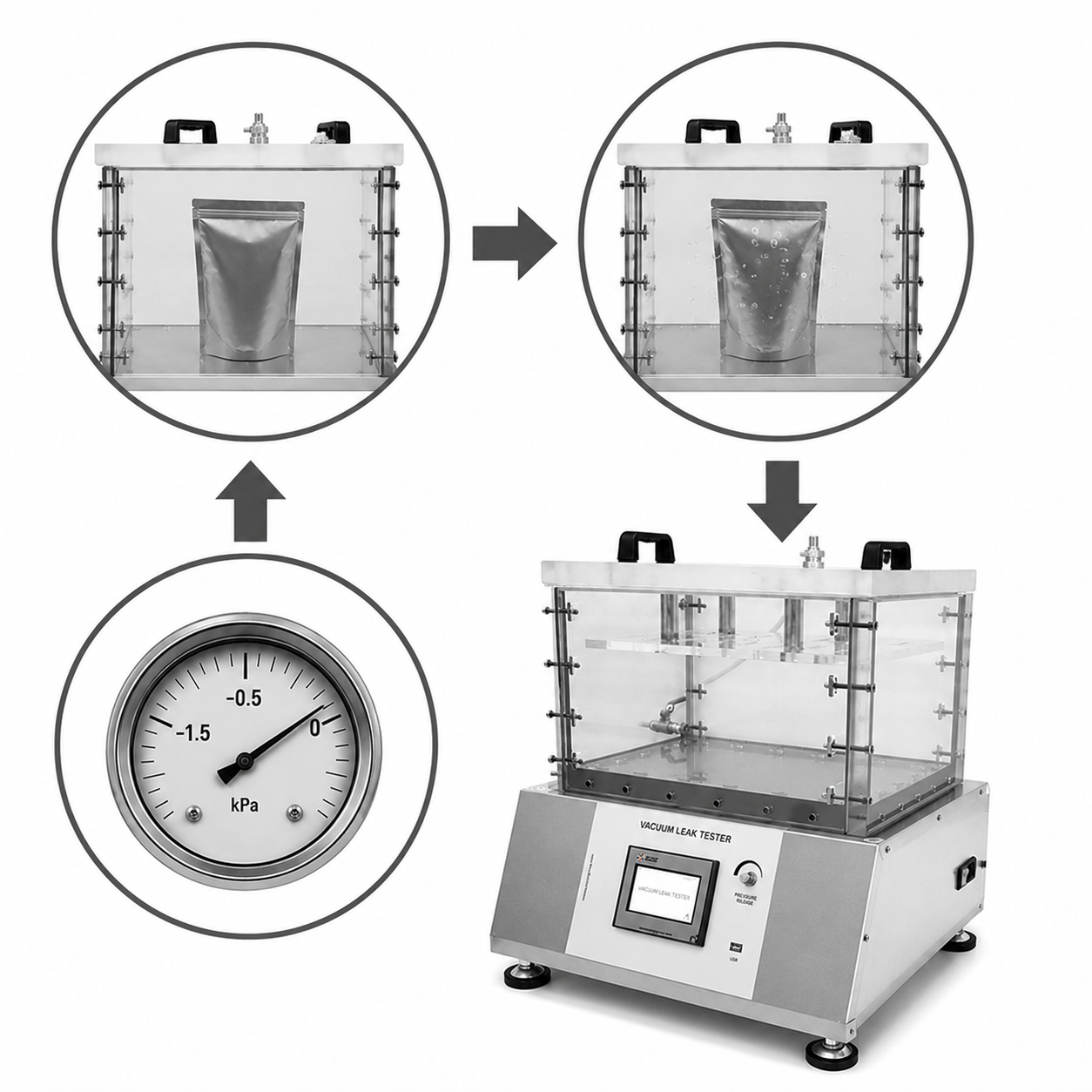
The principle sounds simple. The package is placed inside a Vacuum Tank (Chamber), vacuum pressure is applied, and the operator observes whether air escapes from the package. If bubbles appear continuously, there is likely a leak.
Simple in theory. But execution matters a lot.
Small deviations can ruin the results.
Many labs assume applying vacuum quickly saves time. Actually, rapid pressure changes can create false failures, especially in lightweight flexible packs. ASTM D6653 procedures are designed to avoid that.
Why Leak Detection Matters in Packaging
Leak detection in packaging is not only about product quality. It directly affects:-
- Shelf life
- Product sterility
- Moisture protection
- Transportation safety
- Regulatory compliance
- Customer trust
In pharmaceutical packaging, even a tiny seal defect can compromise sterile conditions.
In food packaging, oxygen ingress can shorten shelf life dramatically.
And in industrial packaging, leaks often allow moisture contamination during shipping.
This is where a proper vacuum leak test ASTM D6653 setup becomes valuable.
Equipment Used for ASTM D6653 Leak Testing
The most commonly used system for this test includes:-
- Vacuum Tank (Chamber)
- Vacuum pump
- Transparent observation chamber
- Vacuum gauge
- Sample holding platform
- Bubble observation setup
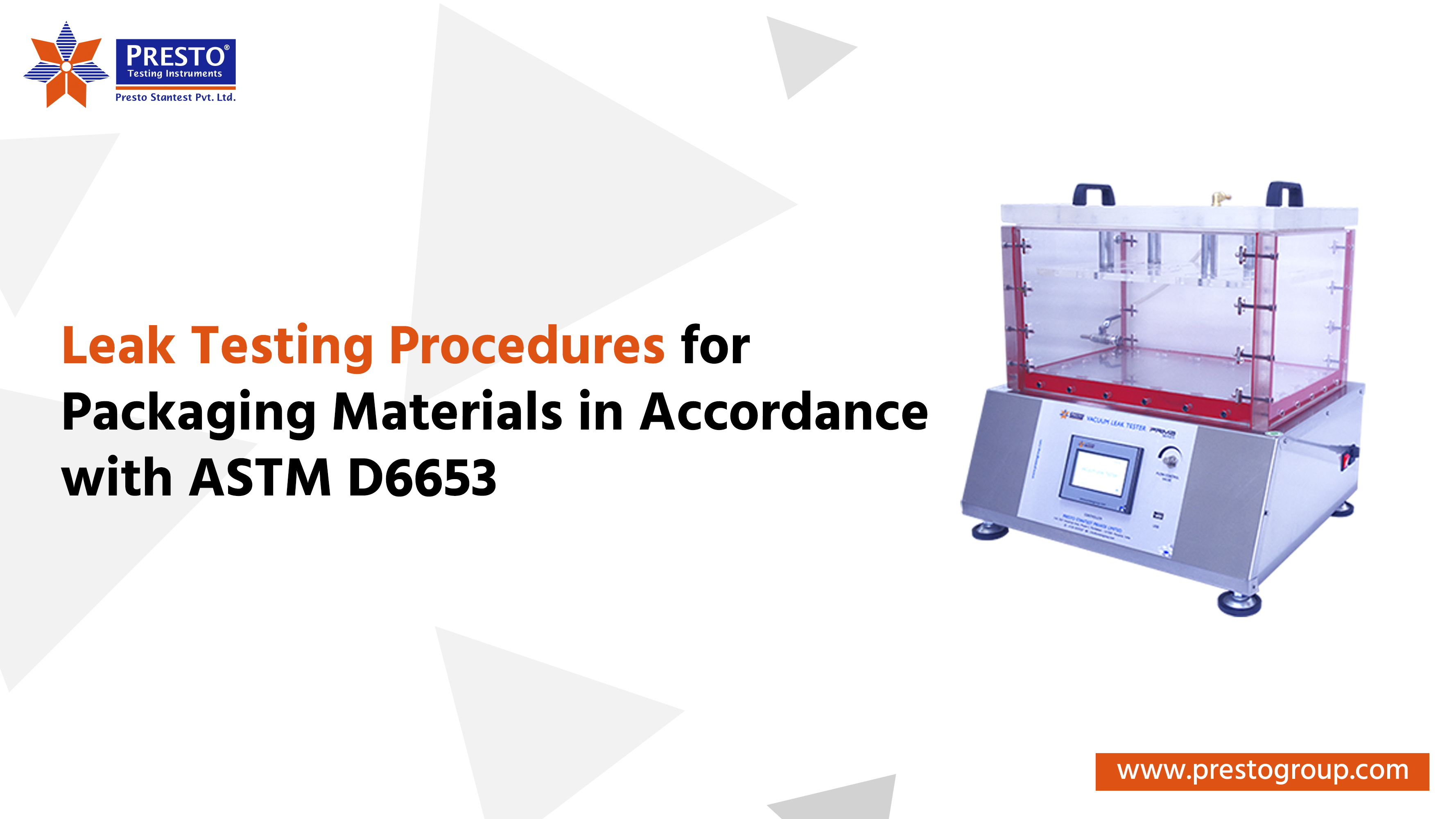
Most modern labs now prefer automated systems like the Presto Vacuum leak detection system because it offers controlled vacuum generation and repeatable testing conditions.
Manual systems still exist, but repeatability becomes difficult after continuous testing cycles.
This is where many labs make mistakes.
Operators often depend too much on visual judgment without controlling vacuum consistency.
Step-by-Step Packaging Leak Testing Procedure
Let’s walk through the actual packaging leak testing procedures commonly followed under ASTM D6653.
1. Sample Preparation
First, select representative packaging samples from production.
Avoid visibly damaged samples unless the purpose is failure analysis.
Check the seals carefully before testing. Dust, wrinkles, or folded edges can affect results.
For liquid-filled packs, ensure proper fill levels because trapped air expansion may influence bubble formation.
Don’t rush this part.
Bad sample preparation usually creates misleading results later.
2. Fill the Vacuum Chamber
The Vacuum Tank (Chamber) is typically filled with water to a suitable level.
The sample package is then submerged completely beneath the water surface.
Transparent chambers are preferred because bubble detection becomes easier during testing.
3. Apply Vacuum Pressure
Vacuum is applied gradually inside the chamber.
As external pressure reduces, air trapped inside the package tries to escape through any existing leak path.
If leakage exists, bubbles appear from the defective area.
Continuous bubbling generally indicates a leak.
A few random trapped-air bubbles during initial vacuuming are normal. Experienced operators learn to distinguish between trapped surface air and actual leak paths.
That comes with practice.
4. Observation Phase
The operator observes the package carefully for:-
- Continuous bubble streams
- Seal edge leakage
- Pinhole leaks
- Channel leaks
- Material rupture
Observation time matters.
Removing the vacuum too early may miss slow leaks completely.
5. Release Vacuum Slowly
Once testing is complete, vacuum release should happen gradually.
Sudden pressure release may damage sensitive packages or distort test findings.
After removal, inspect the package again for visible seal deformation.
Common Packaging Defects Identified During Testing
A properly conducted ASTM D6653 leak testing procedure can identify several packaging problems:-
- Seal Channel Leaks: Usually caused by contamination during sealing.
- Pinholes: Often created by handling damage or sharp product edges.
- Weak Heat Seals: Common in inconsistent sealing temperatures.
- Material Cracks: Seen frequently in multilayer laminates under stress.
- Seal Delamination: Occurs when adhesive layers fail internally.
Some failures are obvious. Others require patience and repeated observation.
Industries Using Vacuum Leak Testing
Leak test equipment for packaging is widely used in:-
- Pharmaceutical packaging
- Medical device packaging
- Food and beverage packaging
- Flexible pouch manufacturing
- Cosmetic packaging
- Industrial chemical packaging
Pharmaceutical companies, in particular, rely heavily on ASTM D6653 because regulatory inspections increasingly focus on package integrity validation.
Advantages of Vacuum Leak Testing
The biggest advantage of vacuum-based testing is simplicity.
It provides:-
- Reliable leak visualization
- Non-destructive or minimally destructive testing
- Fast inspection cycles
- Better seal integrity assessment
- Cost-effective quality control
Modern systems like the Presto Leak Tester also improve operator consistency by controlling vacuum settings more precisely.
That reduces subjective interpretation significantly.
Things Operators Should Be Careful About
A few practical points that experienced quality teams usually follow:-
- Never overfill the chamber
- Avoid testing wet seal areas immediately after sealing
- Ensure stable vacuum hold time
- Calibrate gauges regularly
- Replace worn chamber gaskets on time
- Keep observation water clean for accurate bubble visibility
These small details sound minor until inconsistent results start appearing.
Then suddenly everybody is troubleshooting the machine when the issue was procedural all along.
Choosing the Right Leak Test Equipment for Packaging
When selecting leak test equipment for packaging, focus on:-
- Chamber size compatibility
- Vacuum stability
- Observation clarity
- Automation level
- Ease of calibration
- Repeatability
For high-volume production environments, automated systems usually reduce operator variability and testing fatigue.
Many packaging labs and manufacturers today use systems like the Presto Vacuum leak detection system for routine quality assurance because repeatability becomes easier to maintain across shifts.
Why Consistent ASTM D6653 Leak Testing Matters for Reliable Packaging Quality
Leak testing is one of those quality checks that looks simple until failures begin reaching the market.
ASTM D6653 provides a practical and reliable framework for detecting packaging leaks before they become costly product complaints or regulatory issues.
The key is consistency.
Consistent vacuum application. Consistent observation. Consistent sample handling.
That is what makes the difference between reliable data and misleading results.
For manufacturers looking to improve leak detection in packaging, systems like the Presto Leak Tester from Presto Group are commonly used for controlled and repeatable vacuum leak testing applications across multiple industries.
Get Reliable ASTM D6653 Leak Testing Solutions from Presto Group
If you are regularly checking seal integrity and packaging performance, having stable and accurate testing equipment matters more than most people realize. A small leak missed during testing can easily turn into damaged products, rejected batches, or customer complaints later.
That Is why many packaging manufacturers and quality labs prefer using dependable systems for vacuum leak testing instead of relying on inconsistent manual checks.
Presto Group provides practical solutions for ASTM D6653 leak testing, including the Presto Leak Tester and Vacuum Tank (Chamber) systems designed for routine packaging inspections across pharmaceutical, food, flexible packaging and industrial applications.
If you want to understand which setup fits your packaging type or production environment, simply get in touch.

Call: +91 9210 903 903
Email: [email protected]
Because when it comes to leak detection in packaging, even a tiny seal failure is something you don’t want to discover after dispatch.
Recent Blogs
- Industrial Leak Testing: Methods, Technologies, Benefits, and Industry Applications
- Autoclave in Laboratories and Industry: Principle, Procedure, Components, and Applications
- Uses of BST in Packaging, Paper, and Corrugated Box Testing
- Leak Testing Procedures for Packaging Materials in Accordance with ASTM D6653
- Bursting Strength Testing: ASTM, ISO, and TAPPI Standards for Packaging Evaluation