
- /
- Blog / How to Test and Prevent Metal Corrosion Using a Salt Spray Chamber
How to Test and Prevent Metal Corrosion Using a Salt Spray Chamber
Metal components are utilized in a wide variety of industries, such as automotive, aerospace, construction, electronics, and manufacturing. These areas are usually exposed to water, salt, chemicals, and fluctuating weather. In the long term, this may lead to scratches and loss of strength of the metal. This is termed metal corrosion. Failure to identify corrosion at an early stage might result in faults in a product, increased maintenance expenses, and accidents.
To prevent such issues, manufacturers would conduct a corrosion test before coming up with a product. A salt spray chamber is one of the most reliable means of assessing the effectiveness of a material or coating in a controlled atmosphere in resisting rust. In Presto, it has advanced corrosion test solutions, which assist manufacturers in conducting quality Corrosion Testing and enhance the quality of various products by indicating their weaknesses at an early stage when the products are still in the market.
What is Metal Corrosion and Why Does It Matter?
The gradual breakdown of a metal due to interaction with moisture, oxygen, salts, or chemicals in its environment is referred to as Metal Corrosion. Such a reaction gradually weakens the metal surface and leads to rust, cracks, pitting, or any other breakages. Both coated and uncoated metals (when not properly protected) can also be affected by corrosion.
Even minor cases of corrosion may end up decreasing the life span of a product. To illustrate, rust on car components can diminish the safety of cars, whereas rust in manufacturing machinery can cause the malfunction of the equipment, and repairs can cost a lot. Corrosion can also cause electrical parts to lose their functionality as the metal connections can be harmed.
This is the reason why manufacturers conduct corrosion resistance tests when they are developing products as well as in quality control. Such tests aid in determining a material's behaviour under extreme conditions and whether it can perform as required by industry. Properly conducted corrosion testing enables a company to enhance the dependability of its products, minimise warranties, and guarantee customer satisfaction.
Types of Metal Corrosion and Their Causes
| Type of Corrosion | Main Cause |
| Uniform Corrosion | Continuous exposure to moisture and oxygen across the metal surface. |
| Pitting Corrosion | Local damage caused by chlorides or protective coating failure. |
| Crevice Corrosion | Moisture trapped in small gaps, joints, or narrow spaces. |
| Galvanic Corrosion | Contact between two different metals in the presence of an electrolyte. |
| Stress Corrosion Cracking | Combined effect of tensile stress and a corrosive environment. |
What is a Salt Spray Chamber, and how does it work?
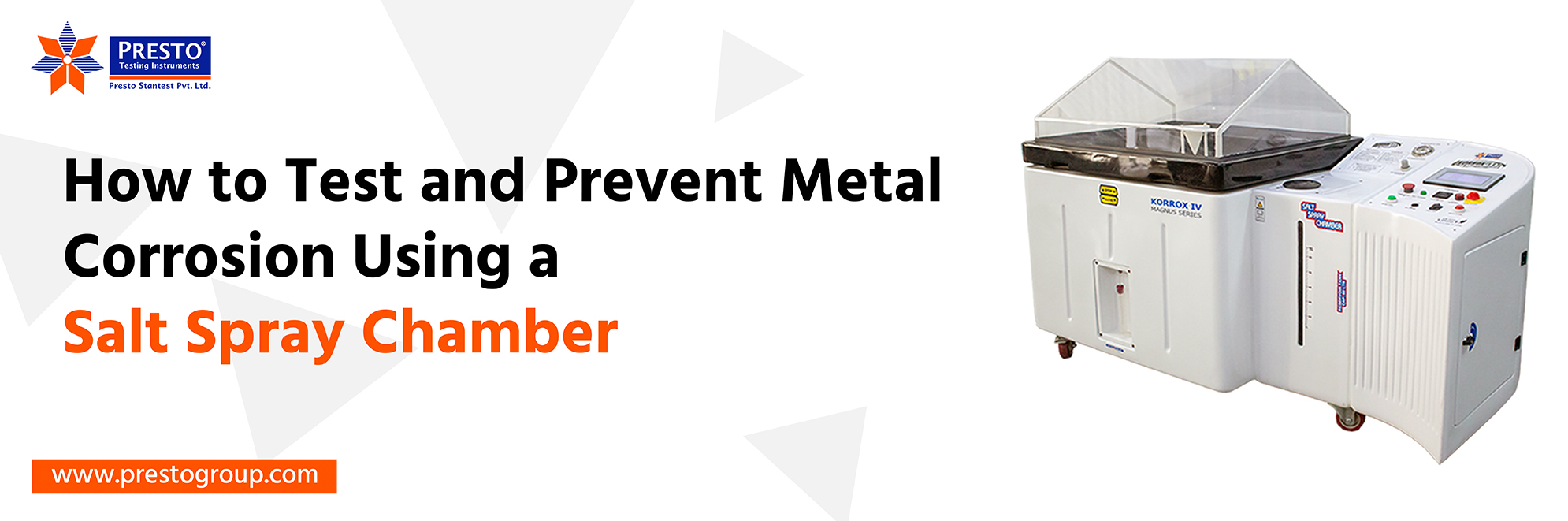
A salt spray chamber is a laboratory testing device that is used to test the effectiveness of metals and protective coatings to resist corrosion. It mimics an adverse environment to produce a controlled condition that is similar to the harsh ones, particularly contact with moisture that contains salt. This enables manufacturers to test the natural life of metal products within a significantly limited time as compared to the natural outdoor life.
A fine spray of salt solution is applied throughout the chamber on the test samples. The humidity, salt concentration, and temperature are closely monitored to get the correct and reproducible results. The samples, after a certain period of testing, will be examined to detect any traces of rusting, blistering, coating failures, or any surface damage.
Salt Spray Test Procedure: Step-by-Step Corrosion Testing Process
When using the corrosion tests, the correct salt spray test methodology would guarantee that all the corrosion tests would be conducted in the same controlled environment to be compared properly.
- Prepare the Test Sample: Clean the surface of the metal and add the coating needed where necessary.
- Prepare the Salt Solution: A 5% solution of sodium chloride and DM water 95 % is prepared as per test standards. pH value has to be maintained with 6.5 to 7.2 as value.
- Install Samples in the Chamber: Before placing the samples in the chamber, the recommended angle of 15 to 30 degrees from Vertical should be set to give even exposure to the salt fog.
- Begin the Test: This chamber sprays a continuous spray of salt on the mist and sustains the needed temperature and humidity.
- Alternative: Test Duration Check: The exposure time can be 24 hours to many hours, depending on the quality of the product being tested and the test standard.
- Check the Samples: Check the metal after testing by looking at it as to whether it is rusty, pitted, blistered or coated and note down the findings.
When the appropriate salt spray test protocol is followed, it enables the manufacturers to benchmark coating performance, enhance the overall quality of products and determine the appropriate corrosion prevention strategies.
It is also a significant component of a series of corrosion-resistance testing projects conducted just before the products are launched into hard service conditions.
ASTM B117 Standard for Salt Spray Corrosion Testing
ASTM B117 is one of the most popular, agreed-upon standards of Corrosion Testing. It is a standard created by ASTM International describing the procedures of a laboratory-controlled corrosion test of a neutral type of salt spray. It also defines the concentration of the salt solution, temperature of the chamber, rate of spray collection, pH level and conditions of testing to guarantee the results will be consistent and reproducible.
Conforming to ASTM B117 enables manufacturers to test and compare various coatings and materials through the same tests. It is typically applied in the automotive, aerospace, metal finishing, and construction sectors to check the quality of the applied coating and to conduct a reliable test of corrosion resistance.
Corrosion Resistance Test and Cyclic Corrosion Test Chamber.
A corrosion resistance test is conducted to determine the ability of a metal or coated surface to resist corrosion. The conventional salt spray chamber offers an unlimited availability of salt mist, so it can be used in numerous quality control studies.
But in certain industries, they need tests that better reflect actual outdoor conditions. The test chamber is a cyclic corrosion test that combines salt spray, humidity, and temperature variations in a sequence of cycles. The process is more realistic with regard to the real scenario of environmental conditions and offers a more realistic evaluation of coating performance over a long period.
Corrosion Prevention Methods for Long-Term Metal Protection
Good corrosion prevention techniques can be applied to extend the service life of metal products and minimise maintenance expenses. Some of the methods used are:
- The use of protective coatings like powder coating, galvanising, or paint.
- Using corrosion-resistant material, such as stainless steel or alloys of aluminium.
- Drying off metal surfaces and keeping them dry.
- Carrying out frequent maintenance and inspection.
- By undertaking routine Corrosion Testing using a salt spray chamber to help identify some of the problems before using the products.
Applications of Salt Spray Chambers Across Different Industries
To test the stability of metals and coating materials used in various industries, a salt spray chamber is commonly used for Corrosion Testing. Common applications include:
- Auto: Checking parts and finish of vehicles.
- Aerospace: Tests of aeroplane parts.
- Construction: Inspections of metal and structural steel structures.
- Electronics: Testing metal enclosures and connectors.
- Marine: Examination of equipment that comes in contact with salty water.
- Metal Finishing: Conducting tests on coated and plated items for corrosion resistance.
In Presto Stantest, the salt spray chamber is equipped with high-level controls and a balanced salt spray tank with a uniform distribution of salt to offer reliability and consistency of the Corrosion Testing results across various industries.
FAQs
Q1. What is a salt spray chamber?
Ans: Accelerated corrosion testing and assessments of the long-term durability of a metal or protective coating are conducted in a salt spray chamber.
Q2. What is ASTM B117?
Ans: ASTM B117 is the standard test procedure to perform a neutral salt spray test under controlled testing conditions in the laboratory.
Q3. What is the difference between a salt spray chamber and a cyclic corrosion test chamber?
Ans: A salt spray chamber is exposed to constant exposure to salt fog, and a cyclic corrosion test chamber switches between salt spray, humidity, drying, and temperature cycling to more closely mimic the real world.
Q4. What is the importance of corrosion resistance tests?
Ans: Corrosion resistance tests can be useful in ensuring that manufacturers test how long the products can last, comparing such coatings, refining quality, and choosing viable means of corrosion prevention before the products hit the market.
Protect Your Products with Reliable Corrosion Testing
Ensure long-lasting product performance with Presto’s advanced Salt Spray Chambers for accurate corrosion testing. Call +91 9210 903 903 or email info@prestogroup.com to speak with our experts today.
 Partner with Presto to ensure superior corrosion resistance, enhanced product quality, and long-term reliability for every application.
Recent Blogs
- How to Test and Prevent Metal Corrosion Using a Salt Spray Chamber
- Autoclave in Laboratories and Industry: Principle, Procedure, Components, and Applications
- What is a Water Bath? How It Works, Types, Applications, and Diagram
- What is Adhesion Test? Standards, Methods and Industrial Applications
- GSM Measurement Techniques for Paper, Textile, and Packaging Industries