

- /
- Blog / Gloss Measurement in Plastic Packaging Films: Principles, Methods, and Industrial Applications
Gloss Measurement in Plastic Packaging Films: Principles, Methods, and Industrial Applications

Vishal Malhotra-Testing Instrument Expert
19-5-2026
Surface appearance operates as a precision-engineered property rather than an incidental manufacturing outcome. Directional reflectivity serves as an immediately perceived visual attribute of packaged products. As surface topography drives retail sales, gloss measurement in plastic films is a mandatory industrial protocol. Engineers treat specular reflection as a traceable parameter governed by precise optical instruments. Proper testing maximizes brand perception and guarantees excellent print clarity. Strict visual standards demand highly precise optoelectronic instrumentation and rigorous laboratory procedures continuously.
What Is Gloss in Plastic Packaging Films?
At its fundamental level, gloss operates as a strict photometric property describing directional reflectance. Industrial engineers evaluate the visual appearance of flexible barriers to categorize their exact optical characteristics reliably. Understanding these core reflective mechanics prevents major manufacturing defects. Surface microtopography dictates this critical light distribution entirely.
The Optical Mechanics of Fresnel Reflection
Directional reflectance relies entirely on Fresnel equations. Reflectance functions are dynamically based on the material refractive index and the incidence angle. A smooth plastic surface featuring a 1.5 refractive index yields a specular reflectance of nearly four percent. Microscopic roughness averages below 0.05 micrometers produce highly coherent reflection, concentrating energy heavily into the specular direction rather than scattering it diffusely.
Categorizing Surface Finishes and Roughness
Manufacturers produce varying visual effects based on strict brand requirements. Utilizing different finishes communicates deliberate psychological messages to consumers.
High-gloss films measure above 80 units at 60 degrees, including cast PET and metallized BOPP.
Semi-gloss options range between 20 and 80 units for flexible food pouches.
Matte finishes sit below 10 units for artisan labels and pharmaceutical leaflets.
Why Gloss Matters in Packaging Applications
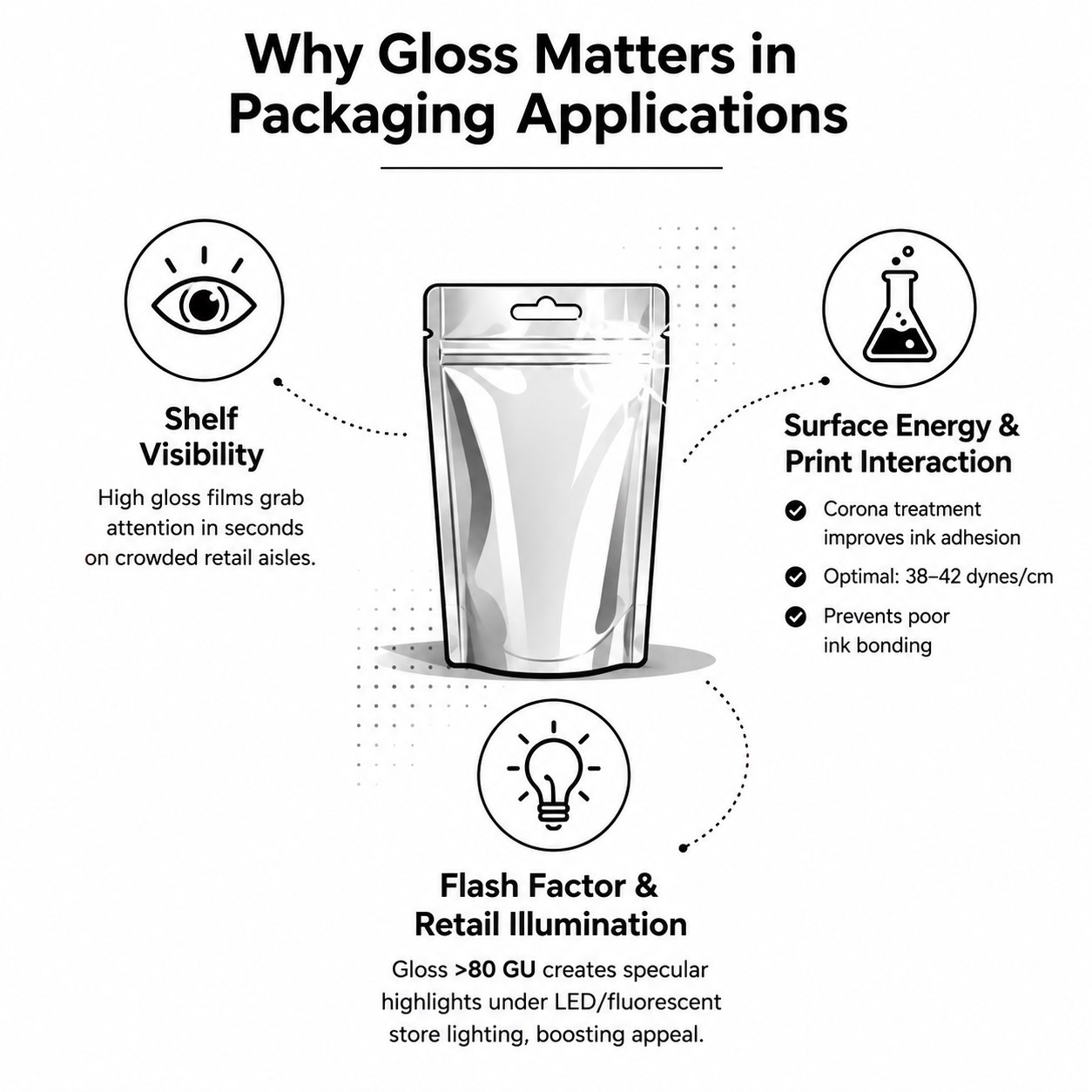
Shoppers scan crowded retail aisles in absolute seconds. Utilizing precise plastic packaging film gloss measurement guarantees maximum shelf visibility against competing retail brands. Corporations leverage these specific reflective properties to secure a strong global market positioning constantly. A dull package subconsciously signals an expired product.
Surface Energy and Print Interaction
The relationship between film shine and ink adhesion remains technically significant. High gloss BOPP films undergo corona treatment to raise surface energy for proper ink wettability. Optimal surface energy levels sit between 38 and 42 dynes per centimeter for solvent-based inks. Heavy UV inks require up to 44 dynes per centimeter. Without adequate surface energy, ink adhesion fails completely.
Flash Factor and Retail Illumination
Packaging interacts actively with standard fluorescent and LED store lighting. A film measuring above 80 units creates a visible specular highlight, drawing the human eye instantly. Designers calculate this momentary flash factor carefully when specifying visual merchandising elements. Premium beverage brands treat these exact reflection levels as proprietary specifications defining their unique retail identity.
Principles Behind Gloss Measurement
Quantifying visual shine requires exact mathematical ratios and precise optical geometry. Technicians compare reflected light against highly certified polished black glass standards. Strict angular geometry dictates the entire analytical testing process completely. The quantitative measurement standardizes optical evaluation across the global supply chain flawlessly.
Photometry and Refractive Standards
A collimated beam from an incandescent tungsten-filament lamp operating at 2856 Kelvin strikes the sample. A silicon photodetector captures the returning specular reflection. The absolute reference is polished black optical glass featuring a 1.567 refractive index. This standard reflects exactly ten percent of incident light at 60 degrees, earning an official baseline value of 100.0 Gloss Units.
Measurement Angles
Different topographies require different viewing angles for accurate assessment. Selecting the correct angle remains critical for diagnostic accuracy because geometric sensitivity changes drastically across surface variations.
| Measurement Angle | Applicable Gloss Range | Typical Packaging Film Application |
| 20 Degrees | High gloss (>70 GU) | Metallized BOPP, cast PET, glossy labels |
| 45 Degrees | Intermediate | Transparent plastic films (ASTM D2457) |
| 60 Degrees | Universal (10–70 GU) | Standard flexible packaging films |
| 75 Degrees | Low-sheen | Plastic siding and heavy soffit applications |
| 85 Degrees | Matte (<10 GU) | Matte BOPP and premium soft-touch films |
Governing Standards
- ASTM D523: Covers specular gloss measurement of non-metallic surfaces at 20°, 60°, and 85° geometries. Requires measurements on a flat, homogeneous, clean surface of at least 1 cm² (3" × 6" preferred), with 10 readings per specimen at 23 ± 2°C and 50 ± 5% RH.
- ASTM D2457: Specifically addresses plastic films (both opaque and transparent) and solid plastics. Includes the 45° geometry for transparent and low-gloss film specimens, which is not covered under D523.
- ISO 2813: The internationally equivalent standard (widely used in Europe), covering geometries of 20°, 60°, and 85° for paint films and coatings. Methodology is compatible with ASTM D523 for cross-standard comparison.
Methods and Instruments Used for Gloss Testing
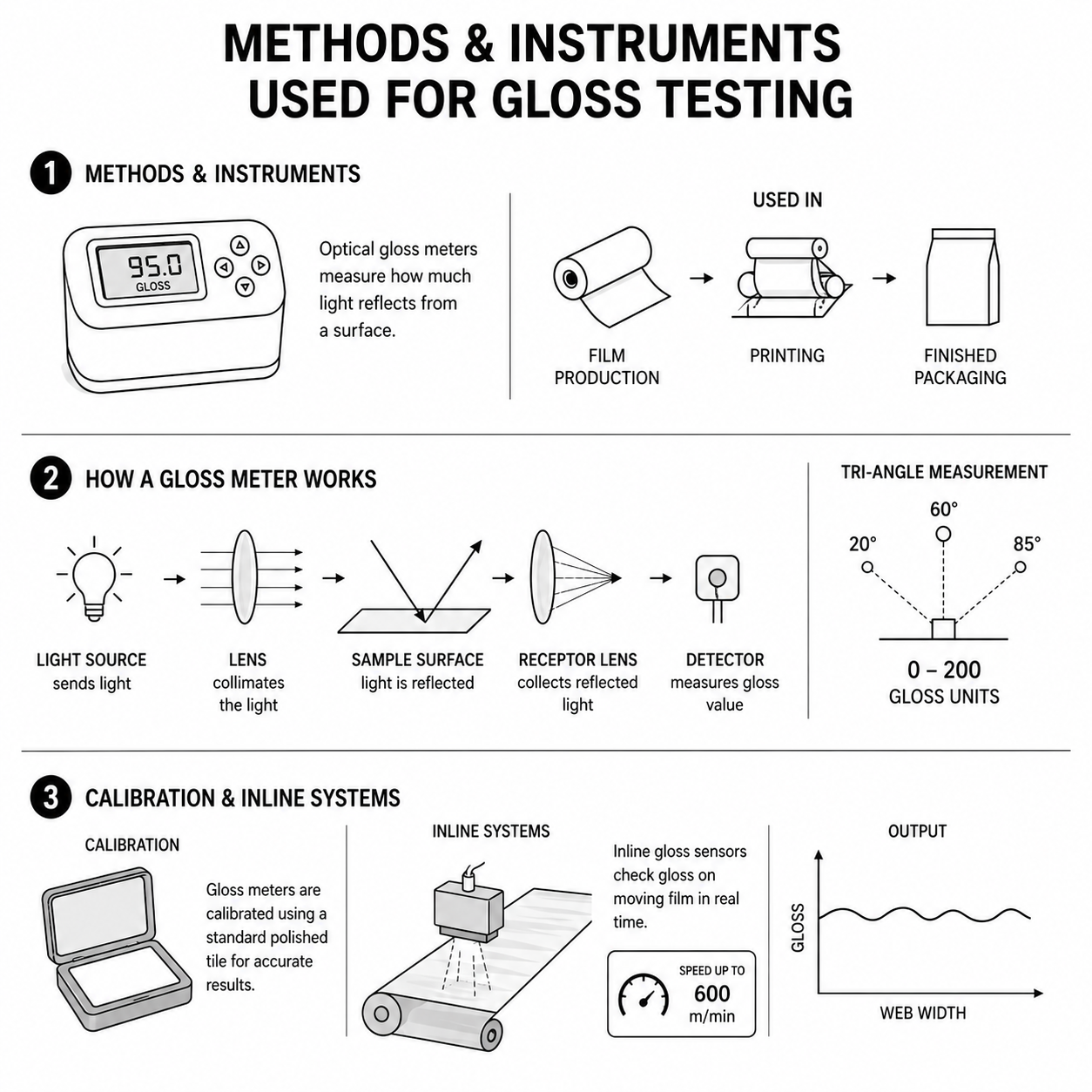
Modern quality assurance demands highly reliable optoelectronic testing hardware. Factories deploy sophisticated optical sensors across their entire production workflow to catch anomalies quickly. Choosing the correct gloss measurement device prevents catastrophic manufacturing errors immediately. Implementing strict gloss testing of plastic films protects highly lucrative corporate printing contracts.
Optical Architecture Components
Understanding the gloss meter working principle reveals an internal assembly featuring five functional elements. A precision condenser lens converts divergent source light into a collimated beam. The receptor lens focuses reflected beams precisely onto the photodiode while excluding diffuse scattered light. Portable tri-angle meters feature a 0 to 200 unit range. Proper gloss meter use requires absolute physical alignment of these internal components.
Calibration and Inline Systems
Calibration remains the cornerstone of traceable measurement. The testing protocol uses a certified polished tile carrying an uncertainty of 0.5 units for high calibration. Advanced inline measurement systems mount directly onto fast-moving lamination webs. Traversing sensors generate continuous profiles across web widths at speeds reaching 600 meters per minute.
Factors That Influence Gloss in Plastic Films
Manufacturing flawless polymer webs requires immense technical control over molecular structures. Dozens of complex thermodynamic variables interact continuously during the rapid extrusion process. Proper processing parameter management guarantees flawless final optical outputs entirely. Identifying the root causes of visual defects saves facilities massive amounts of raw material.
Polymer Molecular Structure and Processing
Amorphous cast PET films achieve extreme specular reflection, measuring between 130 and 160 units at 60 degrees. BOPP films provide versatile reflectivity because biaxial stretching refines surface texture significantly. Highly polished chrome chill rolls featuring a roughness average below 0.05 micrometers operate at 15 degrees Celsius during cast extrusion. This rapid thermal quenching prevents crystalline roughness.
Additives and Coating Applications
Chemical additives alter surface topography at a microscopic level. Silica antiblock particles loaded between 0.05 and 0.5 percent act as intense scattering centers. Applying aqueous PVDC coatings increases BOPP measurements from 75 to over 120 units. Facilities frequently encounter specific structural defects requiring mechanical intervention:
- Transverse gloss banding caused by uneven die lip gaps.
- Internal haze drops caused by severe crystallinity variations.
- Mechanical scratch marks originating from harsh slitting blades.
- Heavy oligomer bloom is surfacing frequently in dense PET structures.
Industrial Applications of Gloss Measurement
Nearly every flexible packaging sector relies heavily on precise optical diagnostics. Different manufactured products demand completely unique visual specifications. Continuous inline monitoring eliminates the outdated sampling approach entirely. Modern factories move toward total web inspection to enforce absolute closed-loop process control.
Food, Cosmetic, and Pharmaceutical Sectors
Premium cosmetic packaging demands tight tolerances of plus or minus three units. The food packaging industry utilizes highly reflective snack bags, maintaining strict five-unit tolerances to trigger impulse purchases. Pharmaceutical blister lidding foils require tightly controlled surfaces to verify that printed compliance text remains legible under bright inspection lights.
Decorative Laminates and Flexible Electronics
Beverage companies rely heavily on brilliant decorative laminates and shrink sleeves. Pressure-sensitive labels undergo full inline profiling to detect coating defects before creating print registration errors at converting presses. Flexible ESD-protective electronic films require defined low-shine surfaces measuring between 10 and 30 units to meet anti-reflection specifications perfectly.
Common Challenges in Gloss Evaluation
Capturing perfect optical data presents several distinct physical hurdles. Industrial environments introduce massive amounts of unwanted measurement variations daily. Ignoring these physical obstacles ruins entire quality control programs instantly. Technicians must navigate these complexities to secure reliable numerical data continuously.
Overcoming Transparent Film Complications
Transparent polymers present fundamental optical complications during physical evaluation. The photodetector receives reflected light from both the top primary surface and the bottom secondary surface simultaneously. This double surface reflection artificially inflates readings by up to eight units. Standard protocols require placing flat black non-reflective backing material behind samples to absorb transmitted beams entirely.
Managing Calibration and Environmental Errors
Calibration tile degradation represents a frequently underestimated source of mathematical error. Atmospheric oxidation and microscopic scratches shift certified values gradually, requiring strict annual recertification. Temperature changes of 5 degrees Celsius alter instrument optical path lengths through mechanical thermal expansion. Finally, a one-degree deviation in sample planarity alters geometric alignment drastically at the sensitive 20-degree angle.
The Role of Surface Reflection in Plastic Film Appearance
Evaluating surface reflection in plastic packaging films represents a sophisticated discipline combining optical physics and materials science. As global brands demand tighter visual specifications, tolerance for physical variation narrows drastically. Growing adoption of traversing inline measurement systems with real-time process integration pushes the industry toward flawless web inspection. In a retail market where the visual impression formed in the first 250 milliseconds determines consumer purchase intent, precise reflection diagnostics remain central to total corporate quality.
Need Accurate Gloss Measurement for Plastic Packaging Films?
Enhance packaging appearance, surface quality, and product consistency with advanced gloss testing solutions from Presto Group. Our high-precision gloss meters deliver reliable results for plastic packaging films across multiple industries. Call us: +91 9210903903 | Email: [email protected]

Choose Presto Group for trusted gloss measurement instruments that ensure superior packaging quality, accurate surface analysis, and consistent industrial performance.
Recent Blogs
- Industrial Leak Testing: Methods, Technologies, Benefits, and Industry Applications
- Autoclave in Laboratories and Industry: Principle, Procedure, Components, and Applications
- Uses of BST in Packaging, Paper, and Corrugated Box Testing
- Leak Testing Procedures for Packaging Materials in Accordance with ASTM D6653
- Bursting Strength Testing: ASTM, ISO, and TAPPI Standards for Packaging Evaluation

Related Blogs
Gloss Meter Testing for Paints: Procedure, Standards, and Interpretation of Results
.png)