

- /
- Article / How cupping testing machine can help to ensure quality sheet metal components?
How cupping testing machine can help to ensure quality sheet metal components?
Gaurav Malhotra
20-1-2023
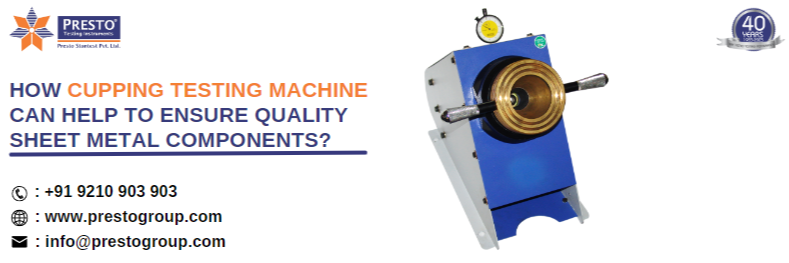
Metal sheets are often used in a variety of industries and have a variety of applications, but ensuring their quality can be a challenging task. Testing the cupping strength of these materials is an important aspect of quality control. This will give a perfect idea to metal manufacturers in determining the drawability of the metal sheet components. Thus, we at Presto have designed a high-quality lab testing instrument known as a cupping strength tester. This is one of the high-quality lab testing instruments that has been designed to test the drawability of metal sheets. In this article, we are going to provide you with information about Presto cupping strength tester and how this quality lab testing equipment is useful in determining their cupping strength. So, let us get started!
Introduction to cupping strength tester
Features of Presto cupping strength tester
- High-Quality rugged structure with the corrosion-resistant main body
- Dial gauge to measure the cupping
- Sturdy Construction and resilient
- Revolving Handle for frictionless movement of the punch
- Fast Guiding Mechanism with hand-operated wheel
- Single-handed hassle-free operation with Spherical punch
- Brass Housing for strong sample clamping
- Highly accurate test results
Technical specifications of Presto cupping strength tester
- Range: 0 – 25mm
- Least count/resolution: 0.01mm
- Outside Body: Mild Steel (Duly Powder Coated.)
- Dial Gauge – 1
- Accuracy – ± 2%
- Sample Thickness – Up to 1.8mm
- Diameter of Punch – 20 ± 0.2 mm
Working of cupping strength tester
- Insert the zero plate in the sample holder slot or adjust it with the ball surface.
- Adjust the dial gauge to zero at this position.
- Remove the zero plate and fit the job sample in the slot.
- Tighten the sample through the front wheel handle.
- Now, test the sample through the front wheel.
- View the condition of the sheet sample manually from the front side and tighten the punching ball to the end position.
- Always view the dial gauge to check the correct stiffness of the sheet.
- On the failure of the sample, note the reading on the dial gauge and release the pressure by moving the bigger gear wheel in an anticlockwise direction and then releasing the smaller gear wheel.
- Remove the sample from the sample holder slot and analyze the testing specimen for any kind of cracks.
Recent Articles
- Moisture Analyzers: Definition, Working, Calibration & Industrial Uses
- Top Analytical Testing Instruments in the Pharmaceutical Industry
- What is LAF? Full Form, Working Principle and Applications
- What is CTM? Full Form, Standards, Applications, and Industrial Importance
- How is CMC Used for Fabric Color Evaluation in Textile Industries?

Need more information
Connect with us for your business enquiries. Generally, we respond within one or two working days.