
- /
- Article / What is CTM? Full Form, Standards, Applications, and Industrial Importance
What is CTM? Full Form, Standards, Applications, and Industrial Importance
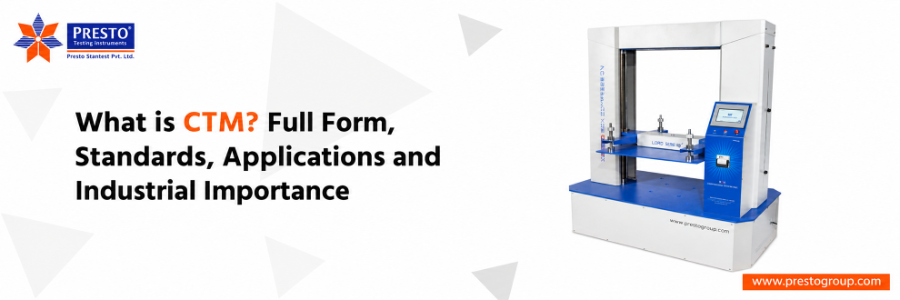
A material may fail due to excessive weakening during use, transport, storage, or even construction. That is why major industries employ CTM to test how much load a given material can withstand before it breaks, collapses, or changes shape.
A compression testing machine is the full form of CTM. This compression testing machine is used to test concrete, cement blocks, boxes, plastic, rubber, metals, and packaging products. In this article, you will learn about the CTM full form, the working principle of the compression test, compressive strength computing, the Compression Testing Machine Diagram, and the compression testing machine used in major industries.
What is CTM Full Form, its Meaning, and Role in Material Testing
A compression testing machine is the full form of CTM. It is a testing machine to measure the compressive strength of a certain material. In other words, a compression testing machine applies pressure to a sample until it cracks, crushes, or deforms.
Doing compression tests allows industries to see whether a product is strong enough to be used or not. For example, concrete must be able to bear the building loads. Packages or boxes must be able to bear the load of stacks. Plastic products must be able to withstand the forces when used.
CTM is useful because it can be used to:
- Examine product strength
- Prevent product failures
- Improve safety
- Adhere to testing procedures
- Ensure product quality
- Prevent customer complaints
For manufacturers, a compression testing machine is not just an instrument for the lab. It is a tool for quality control that helps with better production decisions.
Compression Testing Machine: Purpose, Components, and Industrial Applications
A compression testing instrument can be used to apply a specified force to a test piece. The load at which the test sample failed is obtained. With this data, quality teams can determine if the material meets the required specification.
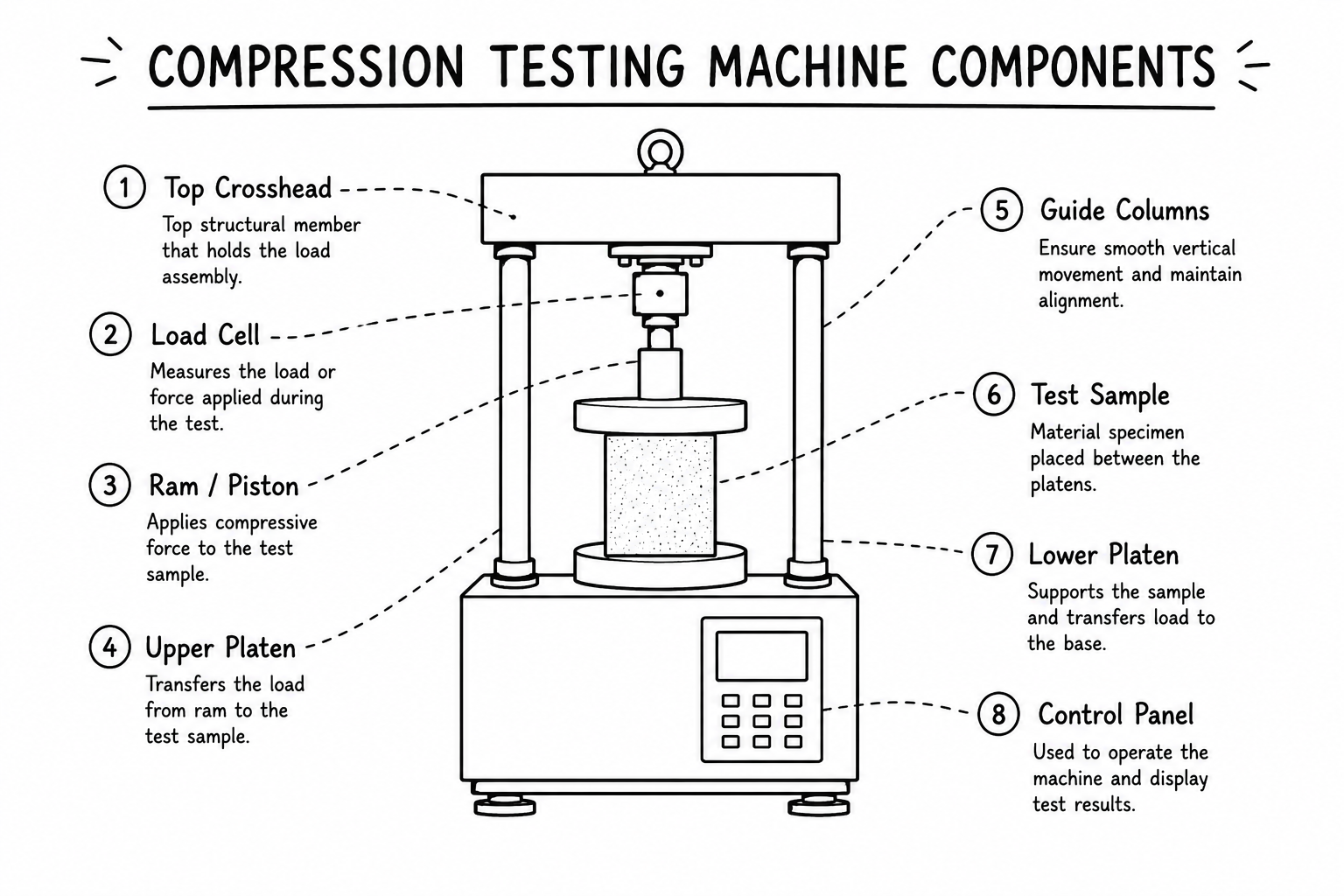
Some parts of the compression testing machine are used for
- Construction material testing,
- Packaging quality testing,
- Plastic and rubber testing,
- Metal component testing,
- paper and board testing and
- product research and development
PRESTO provides testing instruments for industries that require repeatable and accurate quality assessment. In the case of the packaging industry, Presto's solutions for compression testing enable customers to test corrugated boxes, cartons, paperboards, and other products before delivery.
Main Parts of a Compression Test Machine
A typical compression test machine has the following parts:
- Loading frame - The frame that holds the sample during the compression test
- Compression plates - Apply compressive force on the sample
- Load cell/gauge - Measure the applied force
- Control panel – Used to control the machine
- Display unit – Display the test results
- Hydraulic or motor system – Applies the force smoothly
- Safety guards are designed to protect users during testing
Every component plays an important role in determining accurate compression test measurements.
Compression Testing Working Principle: How a CTM Determines Material Strength
The compression testing working principle is very simple. A sample is positioned between two plates. A slow and uniform load is applied by the machine. As the load increases, the sample begins to deform, crack,, or crush.
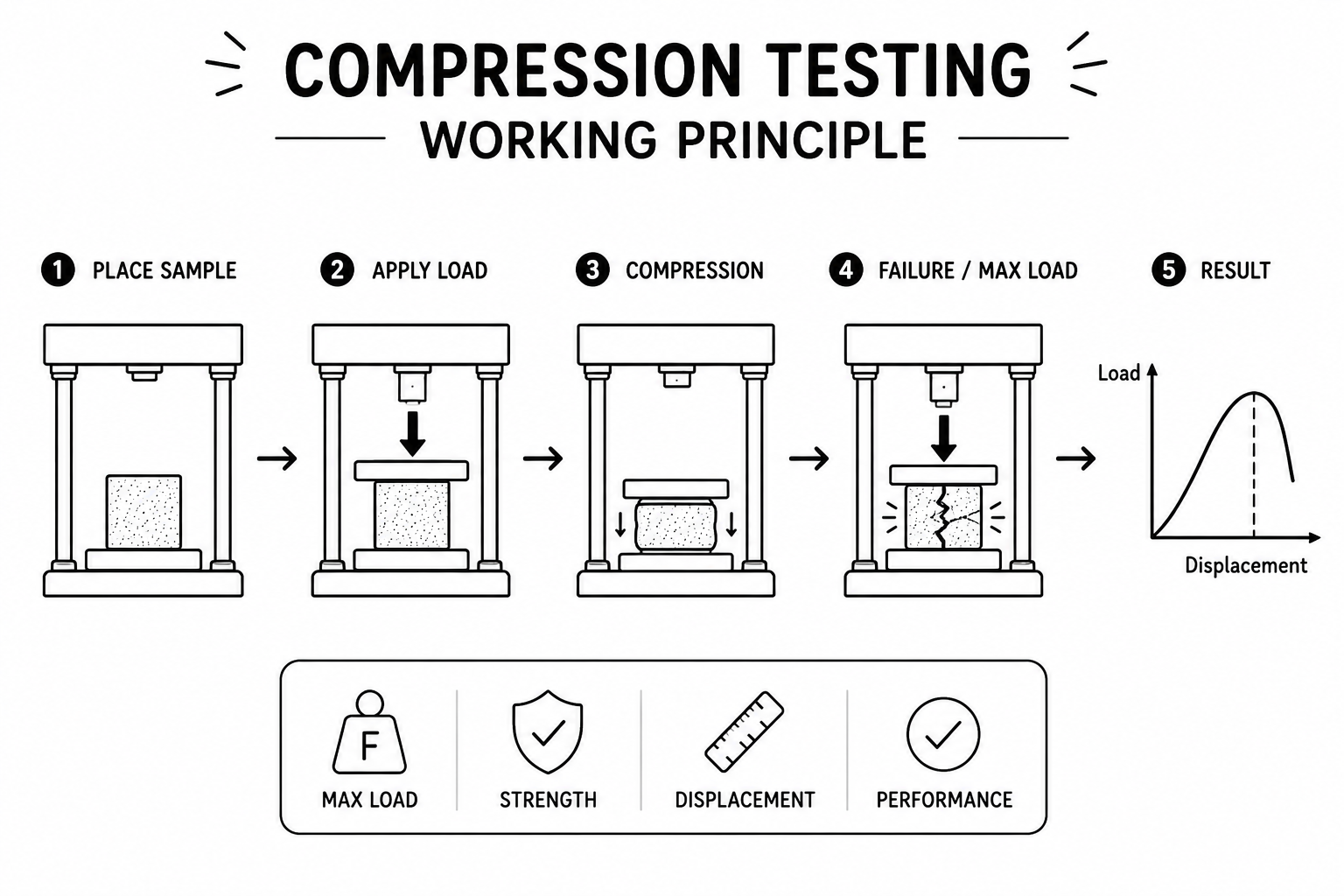
The CTM determines the maximum load a sample can sustain before failure. This is then used to calculate compressive strength.
The general sequence of the operations is:
- Position the sample on the lower plate.
- Position the sample correctly.
- Start compression.
- Apply load at a controlled speed.
- Record maximum load.
- Calculate compressive strength.
A reliable compression testing machine will provide uniform load, accurate measurement, and repeatable measurements, allowing users to compare batches, suppliers, material grades, etc.
Compression Test Procedure, Standards, and Testing Requirements
A compression test is a critical test, and the final value has to be accurate. Incorrect sample size, misalignment, and non-uniform load application can yield undesirable results.
The typical test sequence for a compression test is:
- Prepare the sample as per the test standard.
- Clean the plates.
- Measure the area of the sample.
- Position the sample centrally.
- Apply the load gradually.
- Record maximum load.
- Observe failure pattern.
- Write the Final Result
- Compression Test Standards
Materials have different standards. Packaging boxes can use ASTM D642, ASTM D4169, TAPPI T804, ISO 12048, and JIS Z0212.
There are usually a few basic requirements for a test:
- Type of Material
- Size of Sample
- Capacity of Load
- Speed of the Test
- Accuracy of the Result
- Industry Standard
- End-Use of the Product
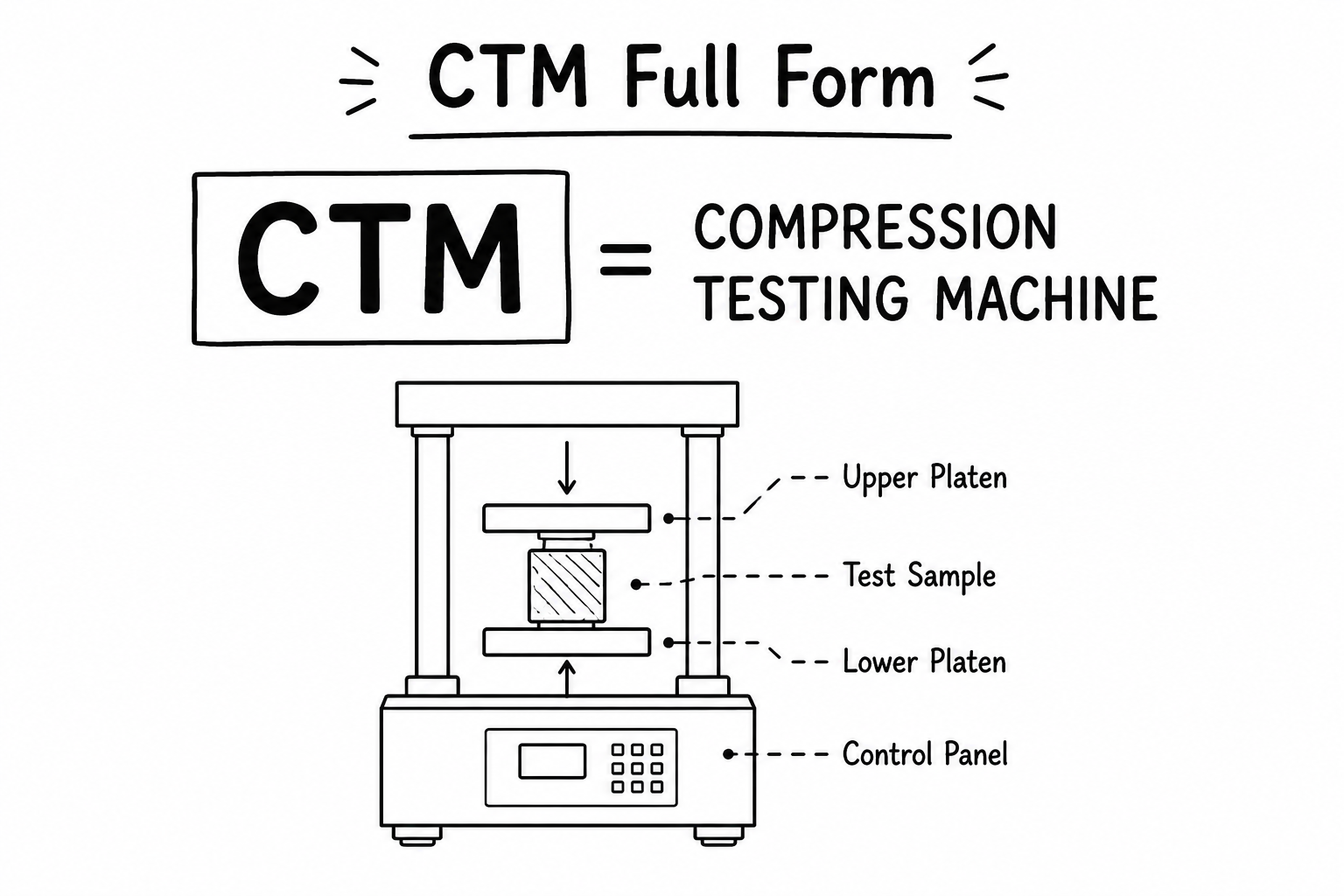
Compression Testing Machine Diagram: Parts and Their Function
A diagram of a compression machine shows the system's main components.
The main components of a compression machine that can be seen in the diagram are:
- Upper platen – Movement down
- Lower platen – Holding the specimen
- Specimen space – Where the sample is placed
- Load indicator – Displays load
- Control unit – Start/stop the test
- Base frame – Provided a stable base
- Motor: or a hydraulic system – generates the compression force
The figure is useful for operators, users, and quality groups to understand what they do and how to use a compression testing machine. This includes where they place the sample, how it is loaded, and how the results are read.
Compression Testing Machine Used in Construction, Packaging, and Manufacturing Industries
A compression testing machine used in several industries is used to verify if the product is able to withstand pressure during use.
In the construction industry, a CTM is used to verify the strength of concrete cubes, concrete blocks, cement, bricks, and mortar, ensuring that building materials perform as required.
In the packaging industry, a compression testing machine is used to test cartons, corrugated and kraft paper boards, cartons, and containers. This is crucial as boxes are usually stacked on top of each other during storage and transport.
The compression testing machine is used for plastics, rubbers, metals, parts, and finished products in the manufacturing industry. This can be used to test product strength before running a production line.
The tested machine can be used in a compression testing machine for companies to reduce the failure of machinery, improve product safety, and maintain customer confidence.
Benefits of Compression Testing Machines for Quality Control and Compliance
The compression testing machine has numerous advantages for quality control. It allows companies to develop safe, strong, and practical products.
The major advantages are as follows.
- Accurate measurement of compression strength
- Improved selection of materials
- Reduced product rejection
- Improved customer satisfaction
- Enhanced quality report
- Improved process control
- Compliance with standards
- Lower risk of product damage
PRESTO offers testing equipment that can help industries improve their quality checks with easy operation, robust design, and reliable performance. If your company is looking for
reliable compression testing solutions, PRESTO offers the compression testing machines you need to test better, control better, and produce higher-quality products.
Ensuring Product Strength and Quality with CTM Testing
The full form of CTM is Compression Testing Machine, which plays an important part in material testing. From compression testing working principle to compressive strength calculation, everywhere/time helps the systematic industry to understand the product strength. A compression test machine is widely used in construction, packaging, industry, quality labs, and so on. Means failure reduction for your business needs.
If you want a reliable compression testing machine for your accurate quality check, Presto provides a testing function from the solution for industrial use and reliable results.
Get the Right Compression Testing Machine for Your Industry
Presto offers reliable and accurate Compression Testing Machines for construction, packaging, plastics, and manufacturing applications. Ensure quality, compliance, and dependable test results with expert support.
 Call +91 9210 903 903 or email info@prestogroup.com today.
Accurate Results | Trusted by Industry Leaders | Fast Delivery
Recent Articles
- Climatic Chamber: Working Principle, Uses, Diagram, Price & Top Manufacturers in India
- Izod vs Charpy Impact Test: Difference, Method & Standards
- Colorimeter vs Spectrophotometer: Accuracy, Working Principle, and Industrial Uses
- Quality Assurance and Quality Control: Two Pillars of Product Excellence
- Hardness Test: Types, Testing Methods, Procedures, and ASTM Standards
Need more information
Connect with us for your business enquiries. Generally, we respond within one or two working days.