

- /
- Article / Moisture Analyzers: Definition, Working, Calibration & Industrial Uses
Moisture Analyzers: Definition, Working, Calibration & Industrial Uses
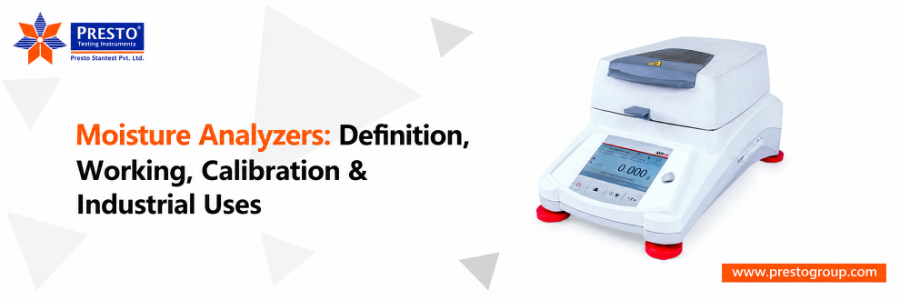
Moisture content is a major consideration for the product quality, storage life, strength, and overall product performance. A slight fluctuation in moisture can impact food, drugs, paper, plastics and packaging products. That is why industries use the Moisture Analyzer Instruments to precisely measure moisture levels in a timely fashion.
To inhibit microbial growth, protect tablet and capsule shells from chemical degradation (such as hydrolysis), and prevent loss of structural integrity, moisture determination is a Critical Quality Attribute (CQA) required by the United States Pharmacopoeia. Manufacturers can guarantee product quality, minimise waste, and increase production efficiency with a modern Moisture Analyser.
Let's talk about the Working Principle of a Moisture Analyzer, various types, calibration techniques, industrial uses, and some points to keep in mind when choosing an analyzer.
What is a Moisture Analyzer? Definition and Importance in Quality Testing
A Moisture Analyzer is a laboratory testing instrument designed for the purpose of finding the moisture content in a sample. It is used to find how much water the sample has lost after evaporation under controlled conditions.
Moisture Analyzer Instruments are installed in industries because moisture is directly related to:
- Product quality
- Shelf life
- Material strength
- Packaging performance
- Regulatory compliance
For instance, an excess moisture content in food products can cause microbial growth, whereas a low moisture content can have an impact on both the texture and taste. Similarly, excessive moisture in powdered pharmaceuticals can compromise product stability.
Key Benefits of Using a Moisture Analyzer
- Quickly delivers test results.
- Ensures product consistency
- Reduces production losses
- Implements quality control programs
- Improves manufacturing efficiency
There is a high-quality requirement across industries to ensure product quality, which can be achieved through moisture analysis.
How Does a Moisture Analyzer Work? Working Principle and Testing Process
The Moisture Analyzer Working Principle is a thermogravimetric method (Loss-on-Drying – LOD) principle.
Here, the sample is placed in the oven, and loss of weight due to the evaporation of moisture is monitored continuously by the instrument.
Step-by-Step Testing Process
- A solid specimen is put in the weighing pan.
- The instrument records the weight it measures at the beginning.
- A Halogen, infrared or other type of heat is used to heat the sample.
- Water boils from the sample.
- The weight loss is measured by the Analyzer.
- The last moisture percentage is automatically shown.
Formula Used
Moisture Content (%) = ((Initial Weight – Final Weight/Initial Weight) x 100)
Most of today's Moisture Machines use halogen heating for rapid, even heating.
Advanced testing solutions that provide accurate and repeatable moisture measurement for a wide range of industrial uses are offered by Presto stantest.
Types of Moisture Analyzer Instruments Used in Industrial Applications
Different Types of Moisture Analyzer are available to meet varying industrial testing requirements.
1. Halogen Moisture Analyzer
It's the most commonly used analyzer.
Features:
- Fast heating
- High accuracy
- Uniform temperature distribution
- Ideal for foods, drugs and plastics.
2. Infrared Moisture Analyzer
These analyzers use infrared radiation for drying the samples.
Advantages:
- Quick drying
- The test is adaptable to bulk testing.
- Easy operation
3. Microwave Moisture Analyzer
The major products analysed by microwave analyzers are those with high moisture contents.
Applications:
- Agricultural products
- Food processing
- Grain testing
4. Karl Fischer Moisture Analyzer
These instruments analyse moisture using the chemical titration method and are highly accurate.
They are found in the following industries:
- Pharmaceutical
- Chemical
- Petrochemical
Each Moisture Measuring Device comes with unique merits, based on the material under assessment.
Moisture Analyzer Calibration: Ensuring Accurate and Reliable Results
Easy to use, Regular Moisture Analyzer Calibration is vital to ensure accurate and repeatable results. Calibration involves setting up the analyzer to deliver the required measurement within a tolerance.
The NIST Metrological Traceability Policy states that traceability is made up of an unbroken chain of comparisons to references that are specified, usually the International System of Units (SI).
Why Calibration is Important:
- Maintains testing accuracy
- Consistently ensures quality standards are met.
- Reduces measurement errors
- Improves repeatability
Calibration Procedure
Temperature Calibration
Temperature calibration is a test to see if the heating system is working properly. The actual temperature is compared with the displayed temperature using special calibration kits.
Weight Calibration
Weight calibrates the balance system with certified standard weights.
Calibration Best Practices
- Calibrate instruments regularly.
- Be sure to use certified calibration weights.
- Maintain the cleanliness of the analyser.
- Follow manufacturer recommendations.
- Maintain calibration records.
Routine Moisture Analyzer Calibration significantly improves measurement reliability.
Moisture Measuring Devices and Their Role in Material Testing
Moisture is a critical component in material testing because it influences physical and chemical properties.
Testing moisture is a valuable aid to the manufacturer:
- Optimize production processes
- Improve storage conditions
- Prevent product spoilage
- Ensure regulatory compliance
For Modern Moisture Analyzer Instruments, moisture can be measured in:
- Powders
- Granules
- Liquids
- Paper
- Plastic pellets
- Packaging materials
These tools are used by several industries with quality assurance laboratories to ensure uniformity of product performance.
Uses of Moisture Analyzer in Food, Pharmaceutical, Packaging, and Manufacturing Industries
The Uses of Moisture Analyzer extend across several industries. Moisture measurement is important because inaccurate measurements can lead to product safety, stability, and performance concerns.
Food Industry
The Moisture Analyzer is used to monitor by food manufacturers:
- Flour
- Dairy products
- Snacks
- Grains
- Spices
Proper moisture levels improve shelf life and product safety.
Pharmaceutical Industry
Moisture Analyzer Instruments are used by pharmaceutical companies for moisture analysis:
- Powders
- Granules
- Tablets
- Active ingredients
Accurate moisture content ensures drug stability and effectiveness.
Packaging Industry
For packaging manufacturers, the moisture test is made using Moisture Machines to:
- Paper
- Corrugated boxes
- Films
- Laminates
Too much moisture can weaken packaging materials.
Manufacturing Industry
Manufacturers use moisture analyzers for:
- Plastic resins
- Chemicals
- Textiles
- Rubber compounds
The listed applications represent the wide range of industrial Quality Control uses for
Moisture Analyzer.
Factors Affecting Moisture Analysis Accuracy and Test Performance
There are a number of factors that affect a Moisture Analyzer's performance.
- Sample Size: Samples that are very large or very small may affect accuracy.
- Heating Temperature: The material may not be dried correctly, or it may break down due to the incorrect temperature setting.
- Sample Distribution: The sample should be uniformly distributed on the sample pan.
- Environmental Conditions: Measurement results can be affected by humidity, vibration and/or airflow.
- Instrument Maintenance: The accuracy of the instruments can be affected by poor maintenance.
- Operator Skill: Proper training ensures consistent testing procedures.
Controlling these factors helps obtain reliable results from any Moisture Measuring Device.
Choosing the Right Moisture Analyzer Instrument: Features, Applications, and Price Considerations
Choosing the appropriate Moisture Analyzer Instruments will depend on your testing needs.
Features to Consider
- Measurement accuracy
- Heating technology
- Testing speed
- Temperature range
- User-friendly interface
- Data storage capabilities
- Calibration functions
Application Requirements
- Type of material
- Testing frequency
- Industry standards
- Required precision
Moisture Analyzer Instrument Price Considerations
The Moisture Analyzer Instrument Price depends on:
- Instrument technology
- Accuracy level
- Automation features
- Brand reputation
- Data management capabilities
The basic laboratory models tend to be cheaper, whereas the advanced industrial versions provide greater accuracy and automation.
Presto stantest quality testing moisture analysers are designed for industries with quality testing requirements and offer reliable measurement, high sensitivity, and high precision.
Need Accurate Moisture Analysis for Your Products?
Ensure consistent product quality, longer shelf life, and reliable testing results with PRESTO's advanced Moisture Analyzer Instruments. Our experts can help you select the ideal solution for your industry-specific moisture testing requirements.
 Call Us: +91 9210 903 903
Email: [email protected]
Get accurate moisture testing solutions with Presto stantest today.
Recent Articles
- Climatic Chamber: Working Principle, Uses, Diagram, Price & Top Manufacturers in India
- Izod vs Charpy Impact Test: Difference, Method & Standards
- Colorimeter vs Spectrophotometer: Accuracy, Working Principle, and Industrial Uses
- Quality Assurance and Quality Control: Two Pillars of Product Excellence
- Hardness Test: Types, Testing Methods, Procedures, and ASTM Standards
Need more information
Connect with us for your business enquiries. Generally, we respond within one or two working days.

.png)