
- /
- Article / What is LAF? Full Form, Working Principle and Applications
What is LAF? Full Form, Working Principle and Applications

Cleanliness is one of the most crucial demands in laboratories, pharmaceutical plants, hospitals, microelectronics manufacturing plants and test centers. Even small dust particles, microbes, or other airborne contaminants can affect product quality and the reliability of test results. This is where a Laminar Air Flow (LAF) System is required.
A Laminar Air Flow System delivers a contamination-free work area by blowing filtered air in a stream. It safeguards sensitive samples, products and processes from airborne particles.
In this blog, you will discover LAF Full Form, Laminar Air Flow Principle, various types of LAF systems, their usage, and how to choose the best-fitting unit for your needs.
What is LAF? LAF Full Form and Its Importance in Cleanroom Environments
The LAF Full Form is Laminar Air Flow.
A Laminar Air Flow System is a handy ventilation system that offers you a clean workplace by pushing air through sophisticated filters. These filters eliminate dust, bacteria and other airborne particles from the air before they reach the work area.
The key function of a Laminar Air Flow Cabinet is to preserve a state of sterility and lower the risk of contamination.
Why is LAF important?
A Laminar Air Flow Unit may provide you with multiple benefits:
- Preserve cleanroom conditions
- Decreases airborne contamination
- Protects samples and products that are highly sensitive
- Increases test accuracy
- Helps to meet requirements of industry standards
The Laminar Air Flow Bench system is critical in fields such as pharmaceuticals, biotechnology, microbiology, electronics, and healthcare.
A Laminar Air Flow System provides a clean and even environment, in which contamination-sensitive operations can be carried out safely.
Laminar Air Flow Principle: How a LAF System Maintains Contamination Control
The Laminar Air Flow Principle requires filtered air to be moved in only one direction and at the same speed.
Unlike the random movement associated with turbulent airflow, laminar airflow moves in parallel layers, which results in little air mixing and prevents contamination from falling onto the work area.
Working Principle of Laminar Air Flow
Ambient air is drawn into the system.
- Larger dust particles are filtered by pre-filters.
- The air moves through a HEPA filter.
- The HEPA filter can capture extremely fine particles.
- Uniform clean air is moved over the work area.
- Contaminants are continually moved out of the work area.
HEPA filters that are used in most current Laminar Airflow Cabinets filter out 99.97% of particles that are 0.3 microns or smaller.
The Laminar Air Flow Principle's effectiveness is dependent upon maintaining a continuous flow of air.
Laminar Air Flow Bench and Cabinet: Components and Working Mechanism
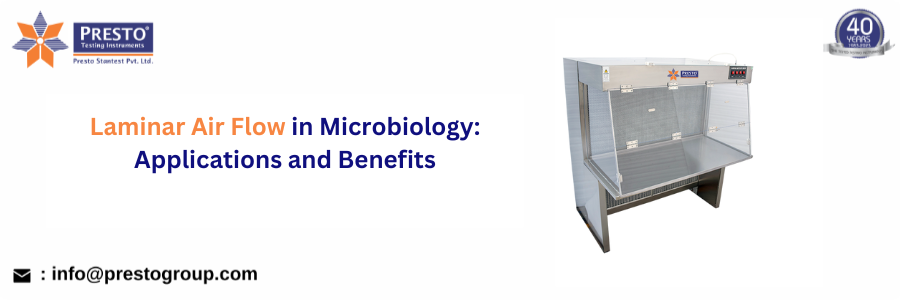
Laminar Flow Bench or Laminar Air Flow Cabinet is built from various critical components to ensure clean air.
Main components of a Laminar Air Flow Cabinet
HEPA Filter
The HEPA filter is a main component that plays the most critical role in removing micro-contaminants and providing a high level of air purity.
Pre-Filter
The pre-filter is a main component that captures larger particles before reaching the HEPA filter, thereby prolonging its lifespan.
Blower / Fan
The blower is a main component that provides airflow and pushes air through the main filter.
Work Surface
The clean area where test, sample preparation or assembly work is carried out.
UV Lamp
Most of the systems are equipped with a UV lamp for additional sterilization effects when the units are off.
Control Panel
Control panel with the ability to control and operate the blower, lighting and other functions.
How Does a Laminar Air Flow Bench Work
The rack or lavatory-box pulls air from the cabinet and processes it through the pre-filter and HEPA filter before reaching the work zone. The clean air then flows over the work tissue in a controlled direction, so as to provide a contamination-free environment.
Types of Laminar Air Flow Systems: Horizontal, Vertical, and Reverse LAF
Different applications have different airflow patterns. That is why you have many different Types of Laminar Air Flow systems manufactured by Consultants.
Horizontal Laminar Air Flow
In Horizontal Laminar Air Flow, the filtered air flows horizontally from the back of the cabinet to the operator.
Benefits
- Smooth airflow across the surface
- Excellent product protection
- Easy sample access
Applications
- Pharmaceutical testing
- Microbiology laboratories
- Electronics assembly
Vertical Laminar Air Flow
In Vertical Laminar Air Flow, the filtered air flows downwards from above the cabinet.
Benefits
- Less chance of cross-contamination
- Better air flow control
- Less floor space needed
Applications
- Medicine Production
- Pharma Production
- Research Laboratories
Reverse Laminar Air Flow
A Reverse Laminar Air Flow system directs air in the opposite direction compared to conventional setups.
These specialized systems are often used in applications requiring unique airflow control and contamination management.
Horizontal Laminar Air Flow vs Vertical Laminar Air Flow: Key Differences
| Feature | Horizontal Laminar Air Flow | Vertical Laminar Air Flow |
| Air Direction | Back to front | Top to bottom |
| User Exposure | Higher | Lower |
| Product Protection | Excellent | Excellent |
| Space Requirement | Larger | Smaller |
| Maintenance | Easy | Moderate |
| Common Use | Testing labs | Pharmaceutical manufacturing |
Laminar Air Flow Diagram: Understanding Airflow Patterns and Design
A Laminar Air Flow Diagram is used to illustrate the flow of clean air.
Basic Air Flow Pattern
Air Intake → Pre-Filter → HEPA Filter → Clean Air Flow → Work Area
Air flow in a Horizontal Laminar Air Flow unit is directed from the rear wall to the front opening.
Air flows downward in a Vertical Laminar Air Flow unit from the front top HEPA filter to the work area.
Having the Laminar Air Flow Diagram is useful because:
- Choosing the right equipment
- Preventing contamination
- Planning workflows
- Boosting cleanroom performance
Applications and Uses of Laminar Air Flow Units Across Industries
Laminar Air Flow has many applications in a variety of industries.
Pharmaceutical Industry
- Sterile drug compounding
- Sample analysis
- Quality control
Biotechnology laboratories
- Cell culture
- DNA research
- Microbiology
Medical Function
- Medical analysis
- Lab analysis
- Sample analysis
Electronics Manufacturing
- Semiconductor production
- Circuit board assembly
- Precision component manufacturing
Food and Beverage Industry
- Microbiology
- Product analysis
Laminar Air Flow units are regarded as vital in contamination control due to the variety of applications found in industry.
How to Choose the Right Laminar Air Flow Cabinet for Laboratory and Manufacturing Needs
Consider the Application
Identify whether your applications are related to pharmaceuticals, electronics, research or biotechnology.
Choose The Correct Air Flow Type
Options include:
- Horizontal Laminar Air Flow
- Vertical Laminar Air Flow
- Reverse Laminar Air Flow
Depending on your contamination risk level and workspace requirements.
Check The Filter Grade
Always choose a unit with high-performance HEPA filters.
Check The Workspace Size
The work area should allow room for samples, instruments and operators.
Check Compliance Standards
Does the equipment need to comply with ISO and cleanroom requirements?
Choose A Trusted Manufacturer
Companies such as Presto Group are well-known manufacturers offering the latest technology for industrial and research applications with a focus on laboratory testing and environmental contamination control solutions.
A correctly chosen Laminar Air Flow Cabinet has the ability to increase operational efficiency, product quality, and testing precision. For laboratories and manufacturing facilities, it is vital to have a comprehensive and tailored approach to contamination control - and investing in the right Laminar Air Flow Unit is key to long-term success.
Why choose Presto for Laminar Air Flow Units?
Presto is a well-known name in the industry for quality testing and laboratory equipment. Their very advanced Laminar Air Flow Systems are designed to provide an optimal level of contamination control, stable air flow performance and compliance with industry standards. With years of experience in testing solutions, Presto is there to support laboratory applications and manufacturers to continuously produce high-quality products and maintain exacting testing environments.
Need Laminar Air Flow Systems? Contact Presto Group
Need reliable Laminar Air Flow systems for your lab or industry? Contact Presto Group for advanced contamination control solutions. Call +91 9210 903 903 or email [email protected] to get expert guidance, product details, and the best quotation today.

Ensure contamination-free performance with Presto’s advanced Laminar Air Flow solutions for accurate and reliable results.
Recent Articles
- Climatic Chamber: Working Principle, Uses, Diagram, Price & Top Manufacturers in India
- Izod vs Charpy Impact Test: Difference, Method & Standards
- Colorimeter vs Spectrophotometer: Accuracy, Working Principle, and Industrial Uses
- Quality Assurance and Quality Control: Two Pillars of Product Excellence
- Hardness Test: Types, Testing Methods, Procedures, and ASTM Standards

Need more information
Connect with us for your business enquiries. Generally, we respond within one or two working days.