
- /
- Article / Top Analytical Testing Instruments in the Pharmaceutical Industry
Top Analytical Testing Instruments in the Pharmaceutical Industry
If a medicine bottle has a loose seal, the reason it could be contaminated is that moisture, air, or germs could get inside before it reaches a patient, thereby ruining an entire batch. That's why pharma manufacturers rely a lot on pharmaceutical lab equipment to test all aspects of their packaging before a single item leaves the factory.
Medicines pass through multiple supply routes spanning from their creation to a pharmacy shelf as they pass through trucks, ships, and warehouses. Throughout, packaging needs to safeguard the product it contains—and that's where testing instruments intervene—in conducting strength, sealing, and torque tests, and film flow tests before the product is packaged and shipped.
This blog gives an overview of the Top Pharmaceutical Lab Equipment, their function, and why they're crucial for medication safety and security in contemporary quality control labs.
Why Analytical Testing Instruments Are Essential in Pharmaceutical Laboratories
There is a higher standard of safety that the pharma products must meet than other products. Pharmaceutical laboratory equipment is a key component in the drug manufacturing process, and a packaging defect is more than just a quality problem; it could be directly related to the health of the patient.
Pharma firms have to conduct tests when packaging materials are submitted for legal approval, which regulators around the world demand. Organizations such as the United States Pharmacopeia (USP) and the International Organization for Standardization (ISO) have regulations that provide a standard on how this testing should take place. USP General Chapter 1207: package integrity evaluation lists vacuum decay testing as a reliable method that can be used to verify an airtight and contamination-free package.
By using good testing instruments to make sure the packaging can handle distribution and storage, fulfill legal and regulatory requirements prior to launch, exclude costly recall situations, and maintain quality on each and every lot, labs can work more efficiently. In a field like that, you can't be sure without dependable test equipment, which is vital to Testing Instruments for Modern Pharmaceutical Labs — where guesswork can mean death and life.
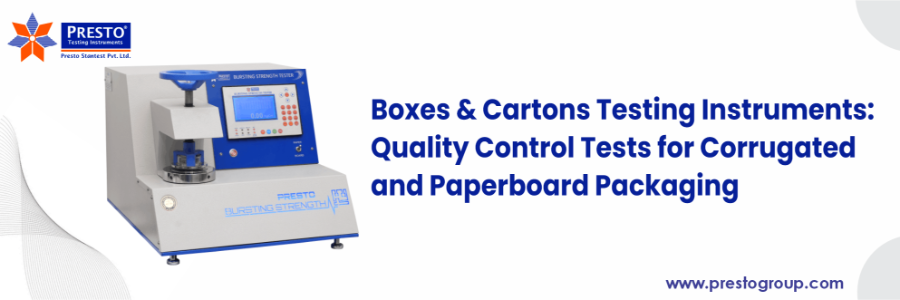
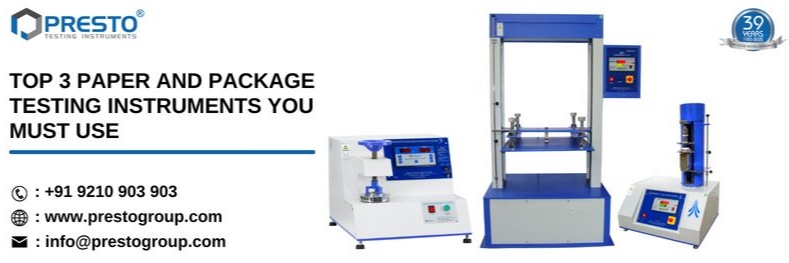
Bursting Strength Tester for Pharmaceutical Packaging Quality Testing
Bursting strength testers measure the amount of pressure that a material can withstand before it tears open, and are important for packaging materials like pharma boxes, cartons, and corrugated packaging for bulk shipment of medicines.
Boxes are stacked on transport and pushed into other loads. It could explode if weak, releasing the medicine to dust, moisture, or damage to some extent. When the tester presses a test piece, it will break at some exactly determined pressure, and the reading given by the device will state the strength of the material.
The procedure is usually adopted from known TAPPI and ISO procedures, which define the standards for paper and board properties. These findings help select the proper packaging grade for a pharma company by ensuring the box provides the proper protection at the lowest cost, as well as preventing any damage to the product as it enters the distribution center, due to pressure caused by stacking in the warehouse.
Torque Tester for Cap Closure Integrity and Seal Performance
Screw cap is present in almost all the pharma liquid bottles, syrup, and tablet bottles. The cap is too loose, and the medicine leaks or becomes contaminated. It might be too snug, resulting in a patient's inability to open it, which could be a problem for elderly patients. This is where a Torque Tester comes in as it allows to measure the exact torque required to open or close a cap.
Unmatched by any other instrument for child-resistant closures common in pharma packaging. The widely referenced ASTM D2063 standard for torque retention on continuous thread closures lays out how this should be measured and reported, keeping manufacturers consistent across batches and suppliers.
A decent torque tester will produce a digital torque reading and may have a peak-hold function, which will automatically record the maximum torque applied. This eliminates guesswork and ensures caps aren't too loose or too tight, as well as a line-to-line consistency.
Peel Strength Tester for Blister Pack and Flexible Packaging Evaluation
One type of packaging that tablets or capsules can be packaged in is blister packs. They use a thin, peeling, and easy-on-the-patient seal, and remain intact enough to prevent water and air infiltration until peeled open. A Peel Strength Tester is used to precisely determine the amount of force required to separate that seal.
This equilibrium isn't so easily attained. An inadequate seal can lead to tablets being exposed to moisture and prematurely expiring. Usually, firm seals irritate patients or shatter the tablet during opening.
The peel strength testing is usually performed following the ASTM F88 method, which is used to determine the strength of sealing between flexible barrier packages. This also helps to meet ISO 11607—the global standard for packaging with sterile medical devices and numerous pharma products—the right balance between seal strength, easy opening, and protection of the shelf life.
Box Compression Tester for Pharmaceutical Packaging Strength Assessment
Medicines are normally packed into smaller boxes once they have been packed; these are corrugated and stacked in larger boxes for transport, layered on top of others, sometimes for weeks in a warehouse or truck. A Box Compression Tester test will determine if a box is able to withstand that pressure without crushing.
It applies a constant force that is compressive to a box sample, and measures the precise point at which it starts to bend. The strength of the cardboard and its construction directly influence the capacity to carry.
Boxes that are under-designed can result in a damaged product, and boxes that are too strong are wasteful of materials and money. It is through the box compression data, common standards such as ASTM D642 specifications, and ISTA testing methods that pharma companies discover and verify that the balance meets shipping requirements.
Vacuum Leak Tester for Container Closure Integrity Testing
CCIT, shortened for Container Closure Integrity Testing, is one of the most important testing procedures in the pharmaceutical packaging process. It validates a sealed vessel, such as a vial, bottle, or pouch, to exclude contaminants and to maintain the product sealed throughout its shelf life. One of the most trusted instruments for this use is the Vacuum Leak Tester.
This test is done by sealing a sample in a vacuum system. Air is being pulled out, and the system will monitor if there is any change in pressure. Even if it is minuscule, a leak causes the gas to flow into the chamber, and the equipment is immediately able to detect this on-site and at that very instant.
This technique is also compliant with standards such as ASTM D4991 for leak testing rigid containers, and nondestructive leak testing by pressure differential testing, ASTM F2338. This deterministic testing also has advantages over other tests, such as dye testing and visual inspection, as per regulatory guidance in USP 1207, which confirms sterile barrier integrity and identifies leaks missed by visual inspection.
Melt Flow Index Tester for Pharmaceutical Plastic Material Analysis
Plastic resins are used to manufacture a wide range of components for the pharmaceutical packaging industry, including bottle caps, blister trays, containers, etc. The manufacturers should know the behavior of the plastic when molten before forming it into shape, and a Melt Flow Index Tester measures it.
This instrument measures the amount of melted plastic that flows through a small opening in a given period of time, typically 10 minutes, measured in grams per ten minutes. This one value conveys lots of information to the plastic manufacturer on the molecular weight of the resin and how it will mold.\
The test is normally conducted according to widely recognised plastic flow tests standards, ASTM D1238 and ISO 1133. A significant deviation from the specified data for melt flow index is generally an indication of a melt flow problem, which may impact the strength and consistency of the molded packaging components.
Key Factors to Consider When Selecting Pharmaceutical Laboratory Equipment
When it comes to selecting pharmaceutical lab equipment, it's not all about finding the latest gadget on the market. It means locating instruments that will meet your testing requirements, budget, and compliance regulations.
Factors to consider are that the instrument should meet the required ASTM, ISO, or USP standards, be automated for reduced human error and increased testing speed in high-volume laboratories, be accurate and traceable to ensure audit risk is reduced, be easily installed, trained, and maintained, and be robust enough to handle the daily and repetitive use of the test measurements.
A reputed manufacturer of those instruments for lab testing in India, such as Presto, provides instruments that take all such factors into consideration, to help labs remain compliant while keeping their operations efficient.
Future Trends in Testing Instruments for Modern Pharmaceutical Labs
The pharma lab testing space is progressing towards smarter and smarter connected instruments. Some newer models feature touch screens, data logging capabilities, and data transfer to lab software, eliminating time-consuming paperwork and providing an easy-to-track electronic log file for reviewing during audits.
In addition, there has been a greater trend to test non-destructively, in a deterministic manner, particularly in relation to container closure integrity testing, and regulators are increasingly going with this approach, such as using vacuum decay tests rather than the older manual tests due to their uniformity.
For lab equipment, the move away from single-unit testing standards to multiple testing standards on a single machine is a growing trend, as global supply chain get more complicated, which will make it easier for labs to cope with exports to countries requiring different testing standards.
Need Reliable Pharmaceutical Testing Instruments?
Ensure accurate quality control, regulatory compliance, and packaging integrity with advanced testing solutions from Presto. Our experts can help you choose the right instrument for your pharmaceutical laboratory needs. Call us at +91 9210 903 903 or email [email protected] to get expert guidance and a customized solution today.
 Partner with Presto to enhance testing accuracy, ensure product safety, and maintain the highest pharmaceutical quality standards.
Recent Articles
- Climatic Chamber: Working Principle, Uses, Diagram, Price & Top Manufacturers in India
- Izod vs Charpy Impact Test: Difference, Method & Standards
- Colorimeter vs Spectrophotometer: Accuracy, Working Principle, and Industrial Uses
- Quality Assurance and Quality Control: Two Pillars of Product Excellence
- Hardness Test: Types, Testing Methods, Procedures, and ASTM Standards
Need more information
Connect with us for your business enquiries. Generally, we respond within one or two working days.