

- /
- Article / Salt Spray Testing Machine and Environmental Test Chambers: Testing Methods, Standards, and Applications
Salt Spray Testing Machine and Environmental Test Chambers: Testing Methods, Standards, and Applications
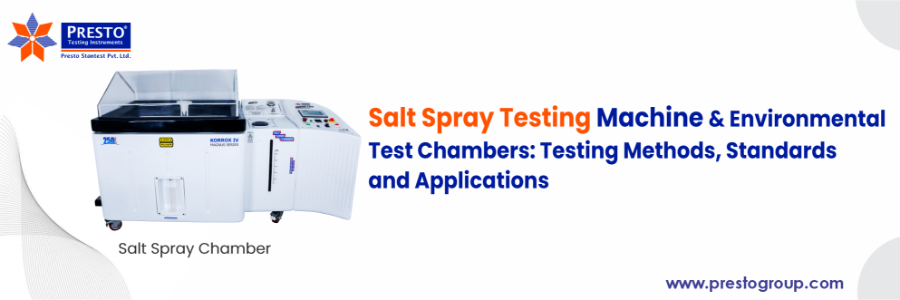
Products come out looking perfect off the line. However, once they are released from the facility, the effects of moisture and salt in the air, vibration, heat, and cold affect their durability. To keep up with these factors, manufacturing units rely on tools like the salt spray testing machine & the environmental test chamber.
The section below discusses in detail the core aspects of the salt spray testing machine and how they function. Here, the readers will also learn about common testing standards and techniques, and their application in an industrial setting.
What is a Salt Spray Testing Machine?
The salt spray testing machine consists of a closed box with a salt solution mist, also referred to as a salt fog. The salt solution is a combination of sodium chloride and purified water. The painted metal samples are then placed in the box, and the salt solution is left to settle on the samples.
Functioning of a Salt Spray Tester
The internal design may vary, but the basic test flow is simple. A neutral salt spray test typically involves the steps below:
Prepare the samples
- Oil, dust, and fingerprints should be cleaned off the parts.
- Cover areas that must not be exposed.
- For coated panels, record coating type and thickness.
Preparing the salt solution
- Dissolve 1 g of the substance, sodium chloride, in deionized or distilled water.
- Maintain pH to near neutral for neutral salt spray or more acidic for special variants.
Set up the chamber
- Heat the chamber air to the desired temperature - usually about 35 degrees Celsius for neutral salt spray.
- Adjust air pressure and nozzle settings so the mist falls at the specified collection rate on reference dishes.
Place samples inside
- Hang or support them so droplets run off at an angle of about 15 to 30 degrees from the vertical.
Run the test for set hours.
- It can take as little as 24 hours, up to 1000 hours, or longer, depending on the customer specifications.
Inspect and rate results.
- Intervals or at the end, check for rust, blistering/peeling, white corrosion products/base metal attack.
- Compare with agreed acceptance criteria, like maximum rust percentage after some hours
Main Salt Spray Methods and Variants
International standards define several flavors of salt spray test for different purposes
- Neutral Salt Spray (NSS)
Salt solution is near neutral pH. This is the most common method for steels, zinc coatings, galvanized parts, and many paints. - Acetic Acid Salt Spray (AASS)
Acetic acid is added to lower the pH, making the environment more aggressive. This is often used for decorative copper, nickel plus chromium or nickel plus chromium coatings on consumer goods and trim parts. - Copper Accelerated Acetic Acid Salt Spray (CASS)
Copper chloride is added along with acetic acid, creating an even more severe environment. This method is extensively used for decorative metal plating systems that demand exceptionally high corrosion resistance.
Important Standards for Salt Spray Testing
Several major standards bodies define how salt spray tests must be performed. The most widely referenced are
- ASTM B117: ASTM B117 clearly defines the application of the salt spray test apparatus, including solution composition, pH regulation, air pressure, temperature, and test observation around the globe.
- ISO 9227: International standard defining the apparatus, reagents, and methods to be used in NSS, AASS, and CASS tests on metallic materials with or without protective coatings. It also describes how to evaluate the corrosiveness of the test environment of the cabinet.
- JIS Z 2371: A Japanese standard with a similar purpose, widely adopted by manufacturers serving the Japanese market.
Typical Applications Of Salt Spray Testing
Salt spray chambers are used wherever components are likely to be exposed to salty or acidic environments in service, or in storage and transport. The industries include:
- Marine and Offshore: Coating testing, materials for ships, offshore platforms, harbor equipment, and coastal plants.
- Automotive: Body panels, hardware, brakes, exhausts, underbody paint, and trim - ensure that rust does not form too soon.
- Construction and Building Hardware: Testing of door and window fittings, cladding elements, fasteners, railings, and other external hardware with respect to weather and pollution.
- Electrical/Electronics: To determine if connectors, terminals, enclosures, and printed components can operate in salty and industrial environments without electro-failure.
Salt Spray Testing Machine Vs Environmental Test Chamber
| Aspect | Salt spray testing machine | Environmental test chamber |
| Main purpose | Accelerated corrosion testing in a salty atmosphere | Simulation of temperature, humidity, and other climatic conditions |
| Typical environment | Constant salt fog at a fixed temperature | Cold, dry heat, damp heat, thermal cycling, sometimes salt mist |
| Key international standards | ASTM B117, ISO 9227, JIS Z 2371, IEC 60068 2 11 | IEC 60068 series such as 60068 2 1, 2 2, 2 30, 2 5, and others |
| Main test variable | Salt concentration, pH, fog rate, chamber temperature | Temperature range, humidity range, rate of change, cycle profile |
| Typical industries | Automotive, marine, construction hardware, coatings, and plating | Electronics, automotive electronics, industrial control, appliances |
| Test mode | Usually, continuous exposure to salt fog | Constant conditions or programmable cycles over time |
| Results focus | Rust, blistering, coating breakdown, visible corrosion products | Functional performance, cracking, swelling, insulation, and drift |
| Correlation to the real field | Good for ranking coatings, limited for exact life prediction | Better for simulating real climate profiles when correctly specified |
| Equipment complexity | Generally simpler, single environment | Often more complex with multi-step programming and wider controls |
| Typical role in projects | Quality control and comparison of coatings and surface treatments | Design validation, reliability testing, and full product qualification |
Final Words
Salt Spray Testing Machines are now being extensively used across industries for improving the quality and consistency of different batches of products. On the other hand, aid in the simulation of external temperature variations. These tests prove to be critical in developing products that comply with modern industry standards and provide seamless quality control.
Contact Presto Group Today!
Hidden corrosion can quickly turn into expensive repairs. Pick from our selection of salt spray testing equipment for guaranteed reliability and performance.
Call us: +91 9210903903
Email: info@prestogroup.com
Visit: www.prestogroup.com
Recent Articles
- Colorimeter vs Spectrophotometer: Accuracy, Working Principle, and Industrial Uses
- Quality Assurance and Quality Control: Two Pillars of Product Excellence
- Hardness Test: Types, Testing Methods, Procedures, and ASTM Standards
- Moisture Analyzers: Definition, Working, Calibration & Industrial Uses
- Top Analytical Testing Instruments in the Pharmaceutical Industry
Need more information
Connect with us for your business enquiries. Generally, we respond within one or two working days.