
- /
- Blog / How Corrosion, Vibration and Stress Testing Solve Automotive Quality Problems
How Corrosion, Vibration and Stress Testing Solve Automotive Quality Problems
The automotive industry learns one lesson again and again — if a component can fail, eventually it will. The only question is whether that failure happens inside a testing laboratory or out on the road where it becomes expensive, dangerous, and difficult to control.
A connector that corrodes too early can shut down an electrical system. A vibrating dashboard may seem like a small issue at first, but it often points toward larger assembly weaknesses. A cracked bracket or brittle plastic part can eventually turn into a major warranty claim.
This is why modern manufacturers depend heavily on reliable Automotive Testing Instruments before releasing any vehicle component into production.
And honestly, this is where many companies either save money long-term or create problems for themselves later.
Proper testing is not just about meeting standards on paper. It is about understanding how materials and components behave after years of real world exposure to vibration, moisture, stress, temperature changes and repeated loading conditions.
The most effective quality control systems usually rely on three major areas:
- Corrosion testing
- Vibration testing
- Mechanical stress testing
Together, these testing methods help manufacturers identify weak points before the product reaches customers.
Why Automotive Components Fail Under Real Driving Conditions
Vehicles operate in extremely aggressive environments.
Road vibrations never stop completely. Humidity enters small gaps. Salt from coastal air and winter roads slowly attacks metal surfaces. Repeated loading creates fatigue over time. Heat cycles expand and contract materials constantly.
Most failures happen because multiple stresses work together.
For example, a metal part may easily pass load testing in dry conditions. But after corrosion exposure, the same component becomes weaker and more vulnerable to vibration fatigue.
That is exactly why manufacturers now use advanced Corrosion Vibration Stress Testing methods to simulate real operating environments as closely as possible.
The objective is simple: detect failure early while the product is still inside the lab.
Corrosion Testing Helps Prevent Long Term Material Damage
Corrosion remains one of the most common causes of automotive durability problems.
The damage usually develops slowly, which makes it more dangerous. A component may appear perfectly fine during assembly but start deteriorating after months of exposure to moisture and salt.
This is especially common in:-
- Coastal regions
- Snow-prone areas using road salt
- High-humidity environments
- Industrial pollution zones
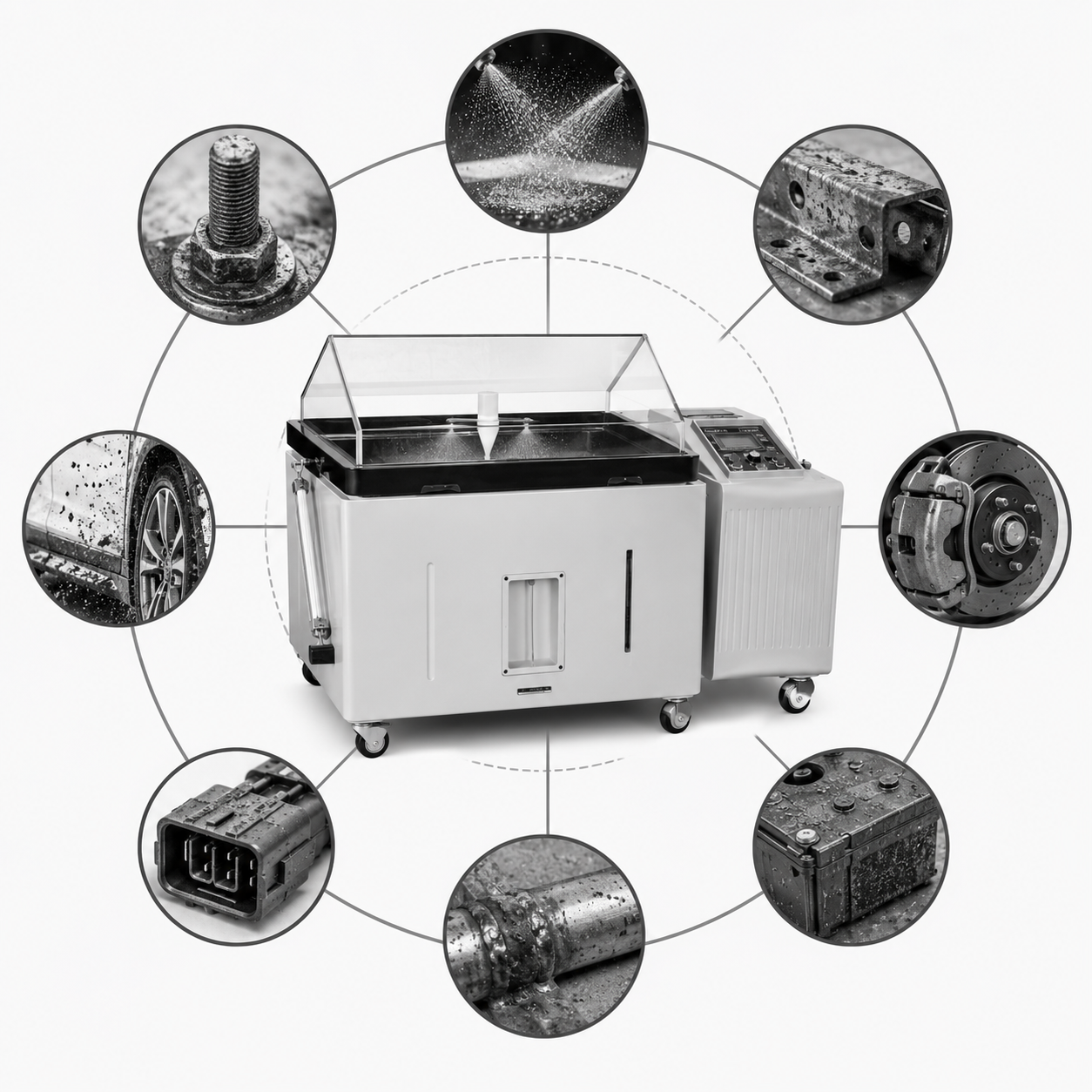
To evaluate resistance against these conditions, manufacturers use a Salt Spray Chamber.
How a Salt Spray Chamber Works
A Salt Spray Chamber creates a controlled corrosive environment by continuously spraying a fine salt mist over test samples.
Inside the chamber, components are exposed to:-
- Salt-laden humidity
- Controlled temperatures
- Moisture-rich conditions
- Accelerated corrosion cycles
This helps engineers evaluate:-
- Surface coating durability
- Rust resistance
- Plating quality
- Paint adhesion performance
- Corrosion protection effectiveness
The process may sound straightforward, but accuracy matters a lot here.
Small deviations can ruin the results.
Improper salt concentration, poor nozzle maintenance, or inconsistent chamber cleaning can completely affect corrosion patterns and produce unreliable data.
This is where many labs make mistakes.
Automotive Components Commonly Tested
A Salt Spray Chamber is widely used for testing:-
- Fasteners and bolts
- Chassis coatings
- Brake components
- Fuel system parts
- Battery enclosures
- Electrical connectors
- Welded assemblies
Manufacturers pay special attention to welded and coated regions because corrosion often begins around edges, joints, and surface imperfections.
Why Vibration Testing Is Critical in Automotive Manufacturing
Every moving vehicle produces vibration.
Engines generate continuous motion. Roads create repeated impacts. Uneven terrain, potholes, and speed breakers add additional stress to assemblies.
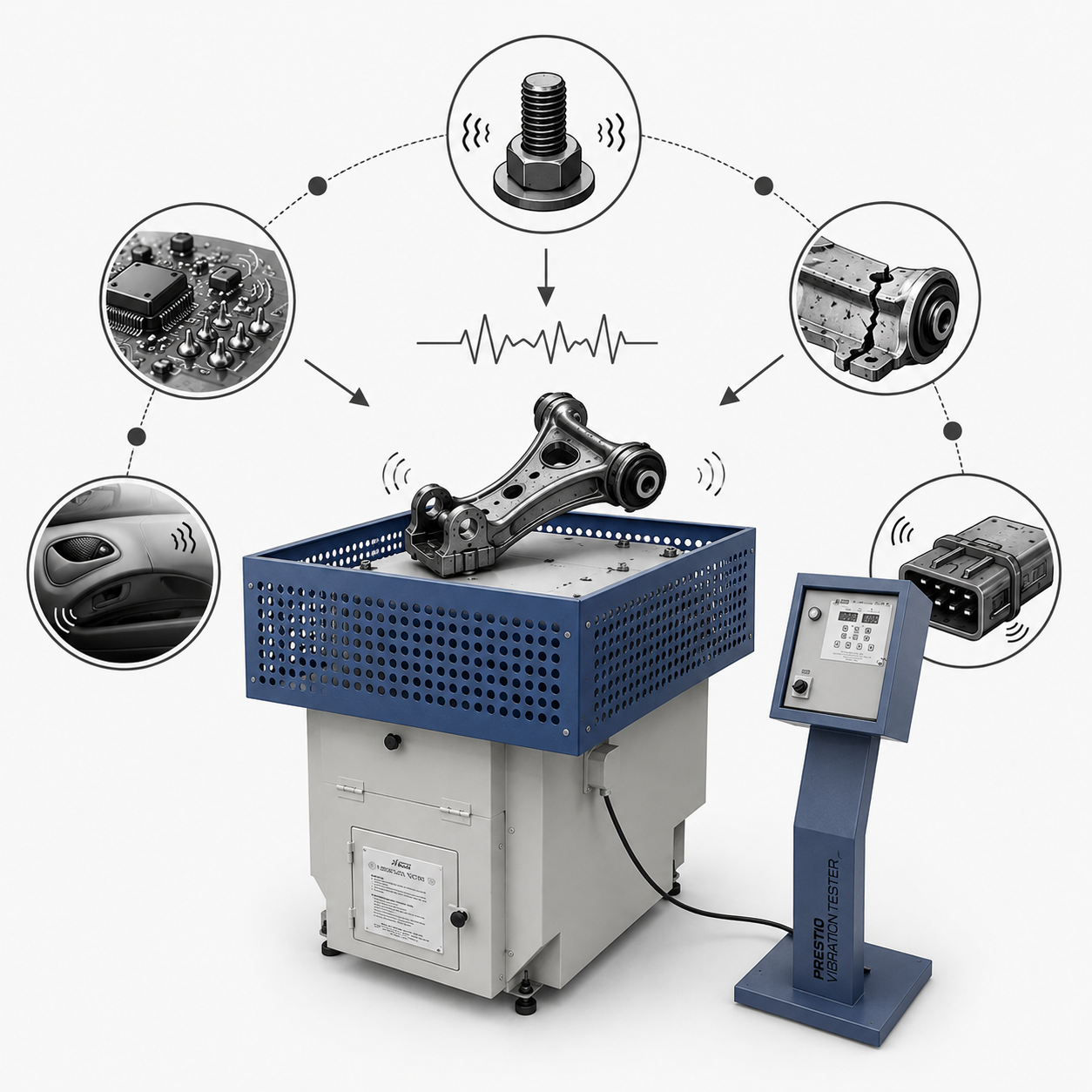
Over time, vibration can lead to:-
- Loose fasteners
- Cracked solder joints
- Structural fatigue
- Connector failures
- Interior rattling noises
Some of these problems appear only after long operational cycles, which is why laboratory simulation becomes essential.
A Vibration Table allows engineers to recreate these conditions in a controlled environment.
What a Vibration Table Actually Does
A Vibration Table simulates real mechanical movement patterns by generating controlled vibrations at different frequencies and amplitudes.
Depending on the application, the equipment can reproduce:-
- Vertical vibration
- Horizontal vibration
- Random vibration
- Sinusoidal motion
- Transportation shock conditions
This helps manufacturers understand how components behave under long-term operational stress.
For example, an assembly may pass dimensional inspection perfectly but begin producing noise or looseness after repeated vibration cycles.
Without vibration testing, those issues often remain hidden until the product reaches the customer.
Common Problems During Vibration Testing
One of the biggest issues is unrealistic fixture design.
If the component mounting inside the test setup does not replicate actual vehicle conditions, the vibration response changes completely.
Another common mistake is applying unnecessarily high vibration intensity.
More aggressive testing does not always mean better testing.
The purpose is to simulate realistic conditions — not destroy the sample artificially.
Don’t rush this part.
Accurate vibration testing depends heavily on proper setup, calibration, and realistic operating conditions.
Tensile Strength Testing Verifies Structural Reliability
Mechanical strength is still one of the most important quality factors in automotive manufacturing.
Even small material inconsistencies can eventually create structural problems under repeated loading conditions.
That is why manufacturers rely on a Tensile Strength Tester to verify material performance.
What a Tensile Strength Tester Measures
A Tensile Strength Tester applies controlled pulling force to a sample until deformation or fracture occurs.
During testing, engineers measure:-
- Yield strength
- Ultimate tensile strength
- Elongation percentage
- Breaking point
- Material deformation behavior
The equipment is commonly used for testing:-
- Metal samples
- Plastic materials
- Rubber products
- Weld joints
- Composite structures
This helps manufacturers confirm whether supplied materials actually meet design specifications.
And honestly, material certificates alone are not enough anymore.
Batch variations happen regularly in production environments. Even slight differences in processing conditions can affect long-term durability.
Why Tensile Testing Matters More in Modern Vehicles
Modern vehicles increasingly use lightweight materials to improve fuel efficiency and EV range.
But reducing weight also reduces error margins.
Manufacturers now depend heavily on tensile testing for validating:
- Lightweight alloys
- High-strength polymers
- Adhesive bonding systems
- Structural reinforcements
- EV battery housings
Without proper tensile validation, parts may survive initial inspection but fail under continuous service conditions.
Impact Testing Reveals Hidden Material Weakness
Some materials behave well under slow loading conditions but fail suddenly under impact.
This creates serious concerns in automotive applications where components experience sudden shock during collisions, rough roads, or accidental impacts.
That is why Impact Testers (Izod/Charpy) are still widely used across automotive laboratories.
Understanding Izod and Charpy Impact Testing
Both Izod and Charpy methods measure the amount of energy a material absorbs before fracture.
The difference mainly lies in sample positioning and impact direction.
These tests help evaluate:
- Material toughness
- Brittle fracture behavior
- Shock resistance
- Temperature sensitivity
- Sudden load performance
Manufacturers commonly perform impact testing on:
- Interior plastic parts
- Automotive polymers
- Metal alloys
- Composite materials
- Safety-related components
Cold-temperature testing is especially important because some materials become brittle in low-temperature environments.
A component that performs well at room temperature may crack unexpectedly during winter conditions.
Small cracks during testing often reveal larger reliability risks later.
Why Combined Corrosion, Vibration and Stress Testing Matters
Real-world automotive failures rarely happen because of a single factor.
Corrosion weakens material surfaces. Vibration increases fatigue. Mechanical loading eventually causes fracture.
That complete sequence happens continuously in actual vehicle operation.
This is why many manufacturers now use integrated Corrosion Vibration Stress Testing programs that combine multiple validation stages.
A typical testing sequence may include:
- Corrosion exposure inside a Salt Spray Chamber
- Vibration simulation using a Vibration Table
- Tensile strength verification after environmental exposure
- Impact resistance testing under controlled conditions
This approach provides much more realistic durability data compared to isolated testing methods.
And practically speaking, it reduces field failures and warranty costs significantly.
The Growing Importance of Automotive Testing Instruments in EV Manufacturing
Electric vehicles have increased the need for more advanced testing procedures.
Battery systems introduce additional vibration concerns. Lightweight structures create new mechanical challenges. Moisture protection around electronics becomes even more critical.
Because of this, modern Automotive Testing Instruments are increasingly used for:
- Battery pack durability testing
- Connector corrosion analysis
- Structural fatigue evaluation
- Thermal cycling studies
- Electrical enclosure validation
EV manufacturers especially focus on vibration related connector failures because electrical interruptions inside high voltage systems can become serious safety issues and more.
Selecting the Right Testing Strategy
Not every automotive component requires the same testing conditions.
Over-testing wastes resources. Under-testing creates reliability risks.
Experienced engineers usually select testing methods based on:
- Actual operating environment
- Material type
- Safety importance
- Service life expectations
- Vehicle application
- Regulatory standards
For example, decorative interior trim obviously requires different validation compared to structural suspension components.
Yet many suppliers still apply generalized testing procedures across unrelated products.
That usually creates inaccurate reliability predictions.
Why Test Interpretation Is Just as Important as the Test
Running the equipment is only part of the process.
The real value comes from interpreting failure behavior correctly.
A crack after vibration testing may indicate poor mounting design. Corrosion concentrated near edges can point toward coating thickness inconsistency. Brittle fracture during impact testing may reveal material processing problems.
Good engineers study these patterns carefully instead of simply labeling results as pass or fail.
That attention to detail improves product reliability far more effectively.
Practical Closing Thoughts
Automotive durability problems usually begin with small weaknesses — microscopic cracks, gradual corrosion, loose connections, or material fatigue that develops slowly over time.
Then thousands of driving cycles make those weaknesses worse.
That is why tools like the Vibration Table, Salt Spray Chamber, Tensile Strength Tester and Impact Testers (Izod/Charpy) have become essential for modern automotive quality control.
Reliable Corrosion Vibration Stress Testing helps manufacturers identify problems early, improve long term durability, and reduce expensive failures after product launch.

Many automotive testing laboratories now prefer trusted manufacturers of Automotive Testing Instruments such as Presto Group for consistent material testing, durability validation, and quality assurance across automotive applications.
Recent Blogs
- What is MFI (Melt Flow Index)? Full Form, Formula, Benefits, Limitations, and Industrial Testing Applications
- Injection Molding: Process Steps, Machine Operation, Diagrams & Testing Instruments
- Peel Strength and Heat Seal Strength Testing for Flexible Packaging
- Industrial and Laboratory pH Meters: Working, Diagram, Uses and Selection Guide
- Industrial Leak Testing: Methods, Technologies, Benefits, and Industry Applications