

- /
- Blog / GSM Measurement Techniques for Paper, Textile, and Packaging Industries
GSM Measurement Techniques for Paper, Textile, and Packaging Industries
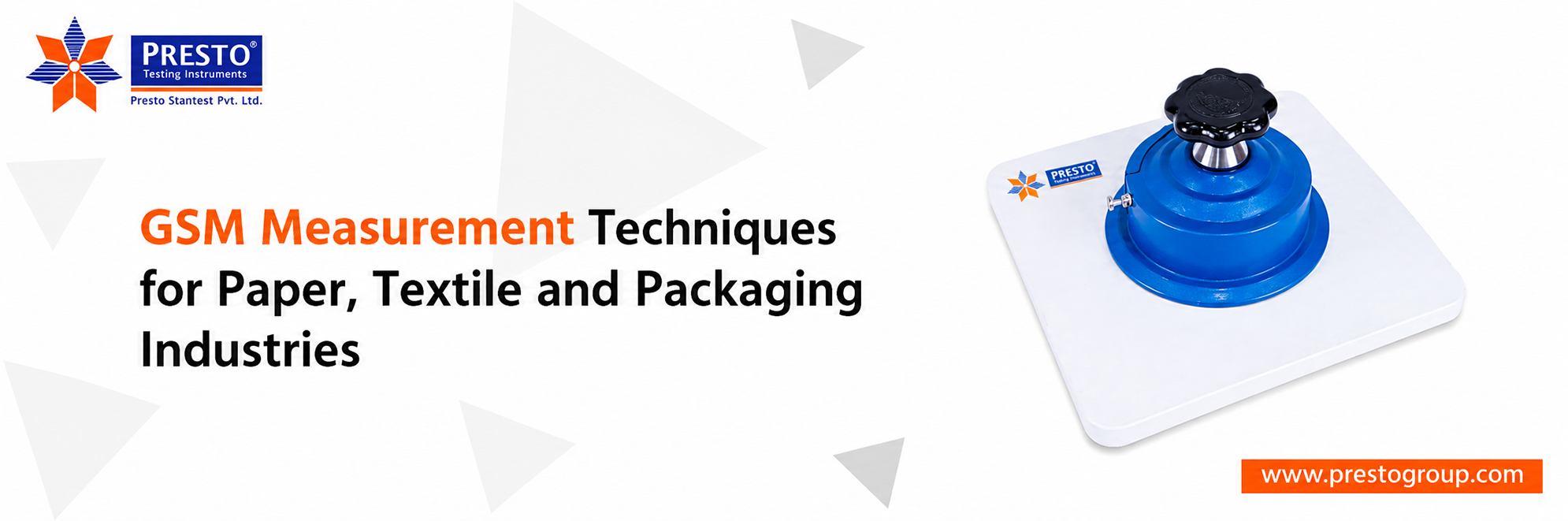
Material quality is one of the most important factors in manufacturing industries. From paper, fabric, corrugated boxes, through to labels and flexible packaging materials, manufacturers require a consistent and dependable way of measuring consistency and performance. This is where GSM Measurement comes in handy.
GSM Full Form stands for Grams per Square Meter. A common unit throughout the world for measuring the mass of a substance per unit area. Grammage measurement is very significant for assessing paper and board quality in accordance with the International Organization for Standardization (ISO 536).
By grasping the concept of GSM, manufacturers can create products that meet the required quality standards, minimize material waste, and ensure uniformity between manufacturing runs. In this article, we will be talking about how GSM can be measured, the GSM formula, the examples of GSM testers, and why GSM is important in the paper, textile, printing, and packaging industries.
What is GSM? GSM Full Form and Its Importance in Material Testing
The GSM Full Form is Grams per Square Meter.
Therefore, it's the unit mass per unit cross-sectional area. GSM measurement is the most common measurement for:
- Paper
- Paperboard
- Corrugated sheets
- Textile fabrics
- Nonwoven materials
- Plastic films
- Flexible packaging materials
The concept of GSM measurement is widely recognized in testing standards published by the Technical Association of the Pulp and Paper Industry (TAPPI) and ISO.
Why is GSM Important?
GSM helps manufacturers:
- Ensure consistency of products.
- Ensure raw material specifications are correct.
- Reduce production variations
- Improve customer satisfaction
- Make sure the Industry Standard requirements are met.
- Control production costs
For instance, a paper sheet with a higher GSM has a greater strength and durability in comparison to the sheets that possess a lower GSM. Likewise, GSM of a fabric is one important factor in deciding the weight of fabric and its applicability for different uses.
Key Benefits of GSM Measurement
- Better quality control
- Improved material consistency
- Reduced rejection rates
- Accurate product classification
- Enhanced manufacturing efficiency
For this reason, GSM testing is a standard quality control process in numerous industries.
How is GSM Measurement Performed? Methods and Calculation Techniques
The precise GSM measurement is so important in assessing material quality. Different techniques are employed in the manufacturing process based on the type of materials and the manufacturing needs.
Manual GSM Measurement Method
The traditional method involves:
- Trimming a sample of a known area- 100 sq. cm..
- Accurately weighing the sample.
- Using GSM Formula.
- Computing the final value of GSM.
It is a simple but time-consuming method in the case of a large production environment.
Instrument-Based GSM Measurement
In general, the steps of the process are as follows:
- The cutting of samples with a GSM cutter.
- Precision weighing
- Automatic GSM calculation
- Digital display of results
Numerous laboratories apply procedures that are similar to the ISO 536 Paper and Board Determination of Grammage Standard to generate consistent and repeatable results.
Steps Involved in GSM Testing
- Prepare the sample
- Cut to a standard-size piece of paper.
- Determine the mass of the sample.
- Calculate GSM value
- Measure and sum up performance
The process allows manufacturers to see variation in the material before it's produced by a consumer.
GSM Formula for Accurate Material Weight Determination
The GSM Formula is one of the simplest and most important calculations in material testing.
GSM Formula
GSM = Weight of Sample (grams) × 10,000 ÷ Sample Area (cm²)
This formula is used to calculate the weight of material per sqm.
Example of GSM Calculation
Suppose:
- Sample Weight = 2 grams
- Sample Area = 100 cm²
Then:
- GSM = (2 × 10,000) ÷ 100
- GSM = 200 g/m²
This is equivalent to a weight of 200 grams per square meter.
Why is the GSM Formula Important?
The GSM Formula helps manufacturers:
- Verify material specifications
- Compare production batches
- Maintain quality consistency
- Meet customer requirements
For assessing the quality of tests, whether conducted on paper, textiles, or packaging materials, the correct understanding of the GSM formula is crucial.
GSM Tester and Digital GSM Tester: Working Principle and Applications
A GSM Tester is an instrument for testing paper, fabric, corrugated board, films, and packings, which is used to measure their GSM value. It can assist manufacturers in ensuring consistency and quality of products.
How Does a GSM Tester Work?
The testing process has four parts:
- Cutting a sample of a specific size
- Weighing on a precision balance
- Applying the GSM Formula:
- Demonstrating the GSM value
A Digital GSM Tester is being used in modern testing laboratories due to its quicker and more accurate results.
Advantages of Digital GSM Tester:
- High testing accuracy
- Faster measurements
- Easy operation
- Reduced human error
- Improved quality control
- Reliable test records
Applications of GSM Tester
The wide use of the GSM Tester is for:
- Paper testing
- Textile testing
- Corrugated box testing
- Flexible packaging testing
- Nonwoven fabric testing
- Printing material evaluation
A Digital GSM Tester can greatly enhance the testing efficiency and precision for manufacturers performing frequent GSM measurements.
Paper Thickness and GSM: Key Factors in Material Evaluation
It is a common mistake to think that the terms "Paper Thickness GSM" and “Thickness” mean the same thing. They are, however, measuring different properties of a material.
GSM Measures Weight
GSM is a measure of the thickness or weight of material per square meter.
Thickness Measures Material Depth
Thickness is the figure which represents the actual depth of material which is generally expressed in microns or millimetre thickness.
According to guidance published by the Technical Association of the Pulp and Paper Industry (TAPPI), materials with similar GSM values may still have different thicknesses because density and manufacturing methods can vary.
Typical Paper GSM Ranges
| Paper Type | Typical GSM |
| Copier Paper | 70–100 GSM |
| Magazine Paper | 90–130 GSM |
| Brochure Paper | 130–200 GSM |
| Business Card Paper | 250–400 GSM |
| Packaging Board | 250–600 GSM |
Understanding both GSM and thickness helps manufacturers select the right material for specific applications.
GSM in Paper, Textile, and Printing Industries
GSM in Paper Industry
GSM in the paper industry is used to judge the qualities of paper, paper strength, consistency, and printing performance. All manufacturers carry out GSM Measurement at regular intervals to make sure that products comply with the industry and customer requests.
GSM in Textile Industry
In Textile Industry, GSM is used to find out the weight, durability or the applicability of the textile. The rating "GSM" (grams per square meter) is an important help factor in classifying fabrics for apparel and industrial textile applications, as stated by the Textile Institute. Consistent fabric quality is ensured by Regular GSM Measurement.
GSM in Printing Industry
GSM in printing industry has an impact on print stiffness, quality, and appearance. GSM values are used in the printer software to decide the right type of paper to use in printing books, brochures, catalogs, magazines, etc. For high-class print surfaces, qualities with higher GSM might be better.
GSM in Packaging and Flexible Packaging Industry Applications
GSM in Packaging
GSM, or grams per square meter, is one of the key factors affecting the strength and performance of packaging materials.
GSM Measurement is used to assess the following characteristics of the manufacturers:
- Carton boards
- Labels
- Corrugated sheets
- Folding cartons
- Packaging papers
A proper GSM not only keeps the material loss to a minimum, but also benefits the product protection.
GSM in Packaging Industry
For GSM in Packaging Industry, the quality control staff keeps a check on GSM values periodically, which includes ensuring:
- Consistent packaging performance
- Better load-bearing capacity
- Improved product protection
- Reduced transportation damage
GSM in Flexible Packaging Industry
The GSM in flexible packaging industry also measures, which is very important.
Flexible packaging materials such as:
- Laminates
- Plastic films
- Foils
- Pouches
- Multilayer packaging structures
Need accurate GSM Measurement to maintain a consistent barrier as well as durability.
Small GSM differences can have an impact on package strength, sealing capacity, and, in general, product protection.
Choosing the Right GSM Testing Machine for Quality Control
Choosing the right GSM Testing Machine can be vital to accurate and reliable tests.
Features to Consider
A good GSM Testing Machine should provide:
- High-precision measurements
- Easy operation
- Durable construction
- Quick testing process
- Repeatable results
- Reaching industry compliance
Why Accurate GSM Testing Matters
Accurate GSM testing will assist manufacturers:
- Reduce product rejection
- Improve quality consistency
- Optimize material usage
- Enhance customer satisfaction
- Meet industry requirements
Advanced GSM Testing Instruments for paper, textile, printing, packaging, and flexible packaging industries are available with Presto Stantest.
Get Accurate GSM Testing Solutions from Presto Stantest
Looking to ensure accurate GSM measurement and superior material quality? Connect with Presto Stantest for advanced GSM testing solutions tailored to paper, textile, printing, and packaging industries. Call +91 9210 903 903 or email info@prestogroup.com to speak with our experts today.

Invest in precise GSM testing to enhance product quality, reduce material waste, and achieve consistent manufacturing performance.
Recent Blogs
- What is MFI (Melt Flow Index)? Full Form, Formula, Benefits, Limitations, and Industrial Testing Applications
- Injection Molding: Process Steps, Machine Operation, Diagrams & Testing Instruments
- Peel Strength and Heat Seal Strength Testing for Flexible Packaging
- Industrial and Laboratory pH Meters: Working, Diagram, Uses and Selection Guide
- Industrial Leak Testing: Methods, Technologies, Benefits, and Industry Applications
Related Blogs
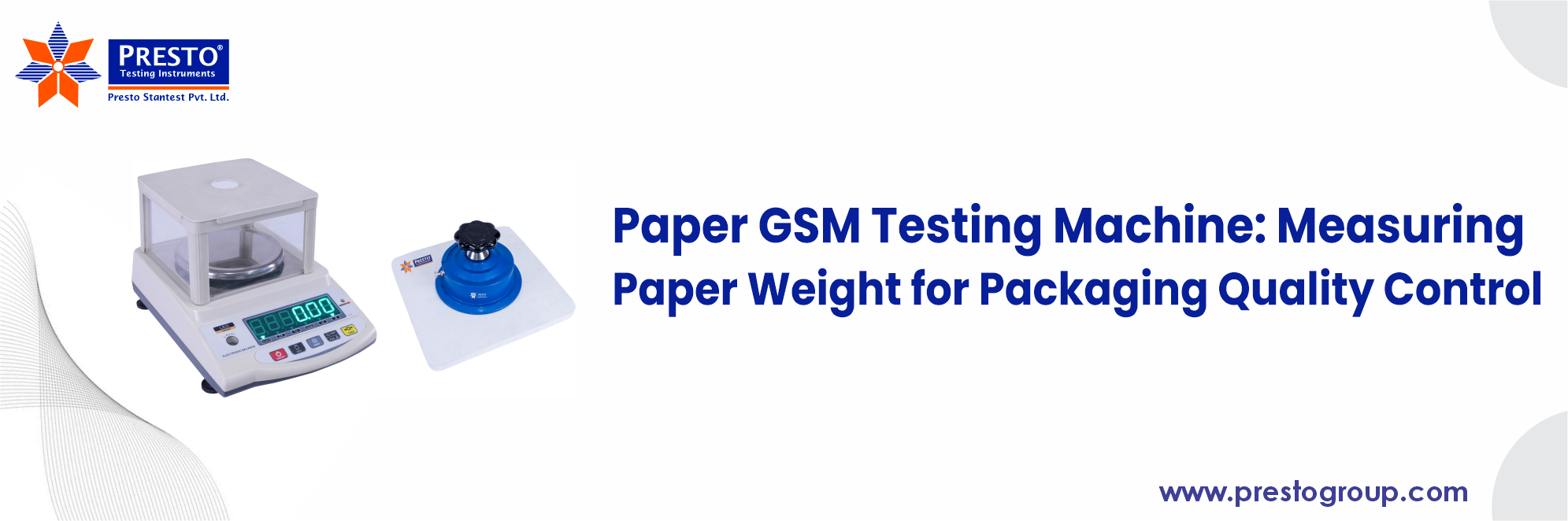
Paper GSM Testing Machine Measuring Paper Weight for Packaging Quality Control
GSM Calculator Guide: How to Measure Fabric, Paper & Plastic Weight
The 5 Biggest GSM Round Cutter Mistakes You Can Easily Avoid
