
- /
- Blog / SST vs CCT Corrosion Analysis: Accuracy, Standards and Performance
SST vs CCT Corrosion Analysis: Accuracy, Standards and Performance
Corrosion reduces the life span of products, increases maintenance costs, and reduces customer satisfaction. Here, we have continued our discussion regarding accelerated corrosion testing. In the earlier blogs, we have discussed the importance of accelerated testing in the Automotive and Aerospace sectors, and we have talked about the names of the most commonly used testing methods.
Automotive, aerospace, marine, and construction industries use accelerated corrosion testing to understand in detail how different metals and coatings behave under extreme environments. Here we are going to discuss what the different testing methods are, their strengths, limitations, how standards define the testing, and what the new challenges and solutions are in accelerated corrosion testing.
In this blog, we are going to discuss the Difference Between SST and CCT, which of the two testing methods is better for high-quality products, and what are the main applications of both testing methods, use of their equipment and technologies and also the standard tests used by different industry and government agencies.
SST vs CCT Testing: Key Differences in Corrosion Analysis and Performance
SST vs CCT testing are test methods used to examine how well the products can resist corrosion.
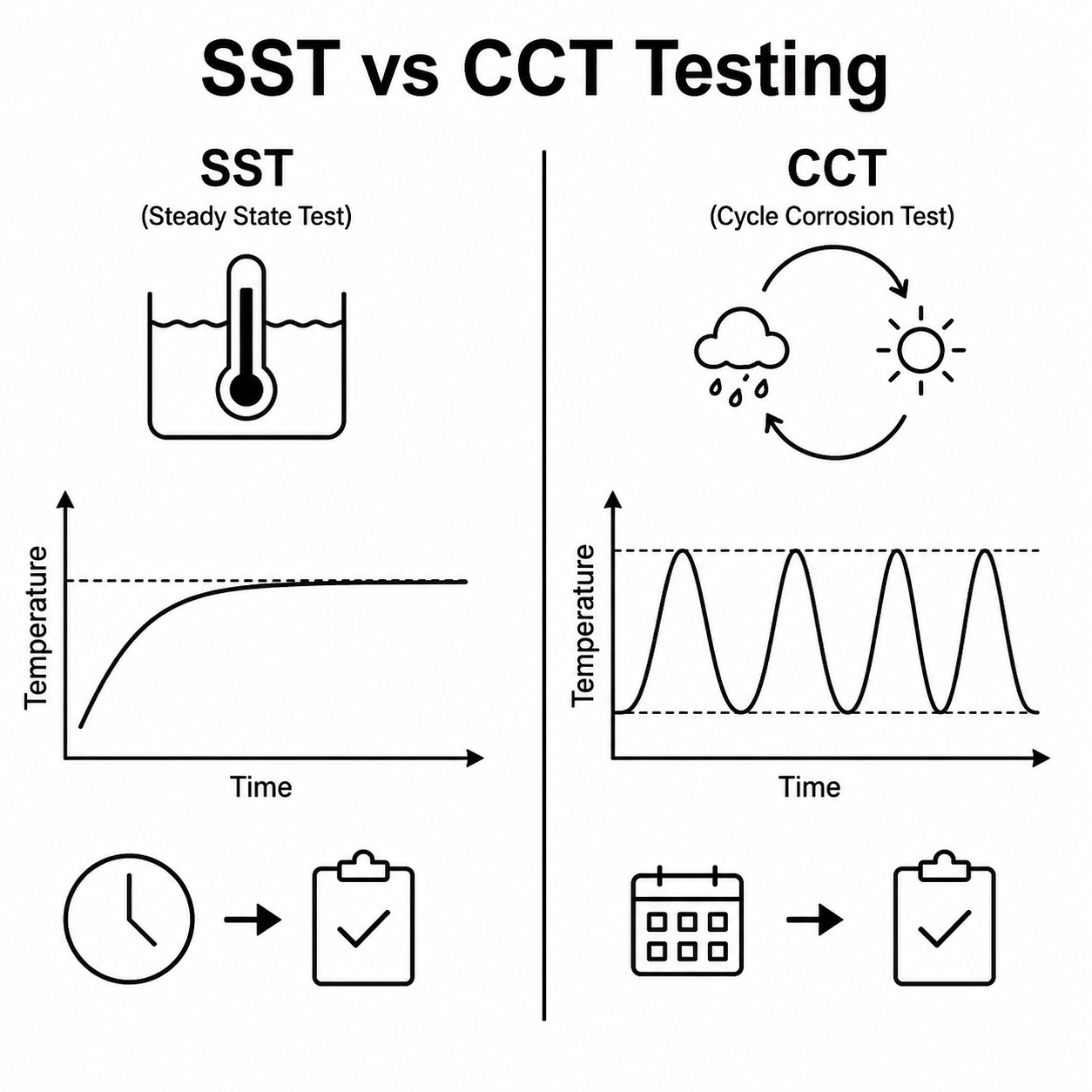
SST (Salt spray test) Subject a test specimen to a continuous salt fog environment in a controlled environment.
However, CCT (Cyclic Corrosion Test) simulates changing environmental variables such as a wet period, a drying period, temperature changes, humidity, and salt spray. These variables imitate the true conditions products endure while in the field.
| Parameter | SST | CCT |
| Exposure Type | Continuous salt fog | Cyclic environmental conditions |
| Test Complexity | Simple | Advanced |
| Real-World Correlation | Moderate | High |
| Typical Use | Quality control | Product validation |
Manufacturers who focus solely on basic corrosion screening might utilize SST. However, for industries that are looking for durable and realistic results, CCT is often seen as more meaningful.
SST Test Full Form and CCT Test Full Form: Meaning and Importance
SST Test Full Form is Salt Spray Test. It is also known as the Salt Fog Test, as the test chamber creates a powdery mist of salt solution that settles over the test specimen.
CCT Test Full Form is Cyclic Corrosion Test. Unlike the SST, this test method simulates varying conditions using a number of different environmental stages.
Why are these tests important? These tests can help:
- Assess coating performance
- Improve product reliability
- Decrease warranty claims
- Meet customer specifications
- Enhance the quality assurance and management programs
No matter if a company manufactures auto parts or construction hardware, knowing what SST and CCT are can help ensure product quality is achieved.
What is a Salt Spray Test (SST)? Purpose, Process and Applications
The Salt Spray Test, or salt fog test, is one of the oldest and most widely used accelerated corrosion test methods. It is used to determine the corrosion resistance of metallic materials and the performance of protective coatings by subjecting them to a salt-laden environment.
The ASTM B117 standard states that the Salt Spray Test is a method of qualitatively evaluating the corrosion resistance of coated and metallic specimens in a controlled corrosive environment.
In a typical test, the following procedure is followed:
- Preparation of the test samples.
- Placement of samples into a Salt Spray Test Chamber.
- Production of continuous salt fog by way of a sodium chloride solution.
- Control of chamber temperature conditions.
- Periodic inspection of samples for signs of corrosion.
Typical uses of the Salt Spray Test include:
- Automotive parts
- Fasteners and hardware
- Electrical enclosures
- Powder-coated products
- Metal finishes
- Building materials
Due to its simplicity and reproducibility, the Salt Fog Test is still used by industries.
What is a Cyclic Corrosion Test (CCT)? Working Principle and Industrial Uses
A Cyclic Corrosion Test (CCT) was introduced to address the continuous limitations of salt fog testing. It, however, does not use a salt fog. Instead, it subjects a product to progressively changing conditions that more closely replicate outdoor service conditions.
Cyclic Corrosion Tests have shown a better correlation with exposure practice compared with the conventional salt spray testing, Statistical Correlation between ASTM B117 Salt Spray Test Results and Field Corrosion Behavior.
Stages of a Cyclic Corrosion Test Chamber
- Salt spray exposure
- High-humidity exposure
- Dry exposure
- Temperature conditioning
- Condensation exposure Conditions
Cyclic Corrosion Test is often conducted in:
- Automotive industry
- Aerospace industry
- Marine industry
- Construction industry
- Metal finishing industry
CCT will give manufacturers a better understanding of long-term product performance to evaluate their behaviour in prolonged outdoor exposure.
Difference Between SST and CCT: Accuracy, Reliability, and Real-World Correlation
| Parameter | SST (Salt Spray Test) | CCT (Cyclic Corrosion Test) |
| Test Environment | Continuous salt fog exposure | Cycles of salt spray, humidity, drying, and temperature changes |
| Accuracy | Good for coating comparison | Better reflects actual service conditions |
| Reliability | Suitable for routine quality checks | More reliable for predicting long-term performance |
| Real-World Correlation | Moderate | High |
| Applications | Fasteners, coatings, plated parts | Automotive, aerospace, marine industries |
| Equipment Used | Salt Spray Test Chamber | Cyclic Corrosion Test Chamber |
| Cost | Lower | Higher |
| Best For | Routine corrosion screening | Advanced durability and product validation |
Salt Spray Test Standards and Cyclic Corrosion Test Standards You Should Know
Some standards and decrees have been adopted to facilitate reliable and repeatable testing.
Some common Salt Spray Test Standards include:
- ASTM B117 – One of the most common salt spray test standards
- ISO 9227 – Neutral salt spray, acetic acid salt spray, copper accelerated salt spray
- JIS Z 2371 - This test standard is commonly used in Asia
The common Cyclic Corrosion Test Alerts are:
- SAE J2334 – The standard test for automotive corrosion
- ASTM G85 – A series of salt spray tests modified for cyclic testing
- ISO 16701 – The road vehicles exposure test to corrosion standards
Adhering to the proper Salt Spray Test Standards and Cyclic Corrosion Test Standards will help manufacturers increase product consistency and meet customers’ needs.
Salt Spray Test Chamber vs Cyclic Corrosion Test Chamber: Features and Benefits
Equipment plays a crucial role in corrosion testing performance.
A Salt Spray Test Chamber is a specialised machine crafted to provide a stable salt fog environment. Common characteristics include:
- Corrosion-resistant chamber construction
- Temperature control system
- Salt solution reservoirs
- Uniform fog
- Sample holding rack
Using a Salt Spray Test Chamber can benefit conductivity by:
- Easy to operate
- Reduced testing cost
- Repeatable and reliable
- Suitable for routine testing
A Cyclic Corrosion Test Chamber may also provide these advantages:
- Programmable testing cycles
- Humidity control
- Drying
- Temperature variation control
- Automated test sequencing
These intrinsic advantages make Cyclic Corrosion Test Chambers a better choice for industries that need realistic environmental simulation.
How to Choose the Right SST and CCT Test Equipment for Corrosion Testing
With a proper strategy, you can pick the best SST and CCT Test Equipment.
Here are some points to be aware of before you make a decision:
Testing Standards: Corrosion Test equipment should be in compliance with the Salt Spray Test Standards and Cyclic Corrosion Test Standards applicable to your industry.
Chamber Capacity: Select a chamber that fits the size of your specimen and the volume of your testing needs.
Automation Features: Highly accurate controls enhance the test capability and reduce operator involvement.
Calibration and Service Support: Regular calibration is required to achieve reliable test data. By working with an experienced equipment provider for your corrosive testing needs, you will have reliable technology and long-term technical support.
Ease of Use: Improved interfaces decrease training time and use.
Presto Stantest supplies state-of-the-art corrosion testing solutions that help laboratories and manufacturers achieve accurate and reliable testing performance. From Corrosion Testing Equipment to Salt Spray Test Chambers, Presto helps organisations provide greater assurance for product reliability and improved quality control.
Get Accurate SST & CCT Corrosion Testing Solutions with Presto Stantest
Whether you need a Salt Spray Test Chamber for routine quality checks or a Cyclic Corrosion Test Chamber for advanced durability validation, Presto Stantest delivers reliable, standards-compliant corrosion testing equipment to meet your industry requirements.

Call us at +91 9210 903 903 or email info@prestogroup.com to find the ideal corrosion testing solution for your application.
Recent Blogs
- What is MFI (Melt Flow Index)? Full Form, Formula, Benefits, Limitations, and Industrial Testing Applications
- Injection Molding: Process Steps, Machine Operation, Diagrams & Testing Instruments
- Peel Strength and Heat Seal Strength Testing for Flexible Packaging
- Industrial and Laboratory pH Meters: Working, Diagram, Uses and Selection Guide
- Industrial Leak Testing: Methods, Technologies, Benefits, and Industry Applications

Related Blogs
Common Mistakes in ASTM B117 Salt Spray Testing and How to Avoid Them
Cyclic Salt Spray Testing Machine: Diagram, Test Cycles, and Industrial Usage
How to Perform Salt Spray Testing as per ASTM B117 and ISO 9227 Standards