

- /
- Blog / What is HDT? Importance, Standards and Testing Procedures in Manufacturing
What is HDT? Importance, Standards and Testing Procedures in Manufacturing
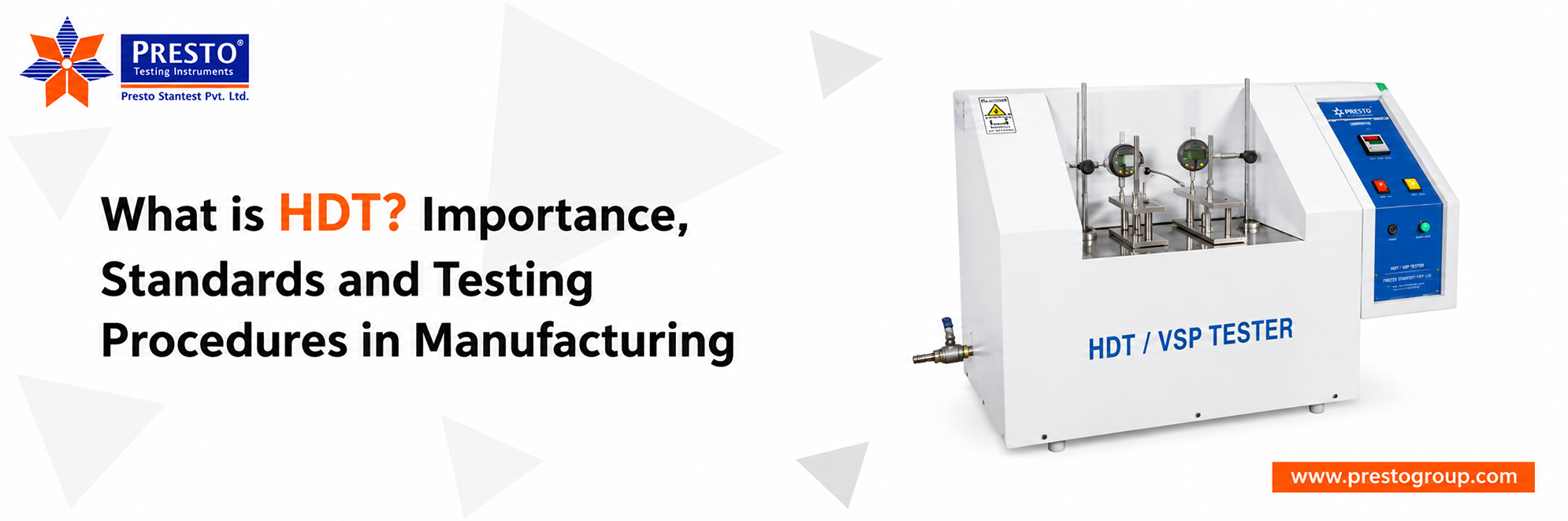
Plastic products used in automotive, packaging, electronics, and industrial applications are often exposed to heat during their service life. If these materials lose their shape or strength under elevated temperatures, product failure can occur. This is where Heat Deflection Temperature (HDT) testing becomes important.
HDT Full Form is Heat Deflection Temperature. It is one of the most commonly used tests to determine how a plastic material behaves when subjected to both heat and a specified load. By understanding HDT Values, manufacturers can choose the right materials, improve product durability, and maintain quality standards.
In this blog, we will explain the meaning of Heat Deflection Temperature (HDT), how it is measured, the importance of a Heat Deformation Tester, and the standards followed during testing.
What is HDT? HDT Full Form and Its Importance in Material Testing
Heat deflection temperature is what the acronym HDT stands for. It is the temperature at which a plastic begins to deform under a specific load.
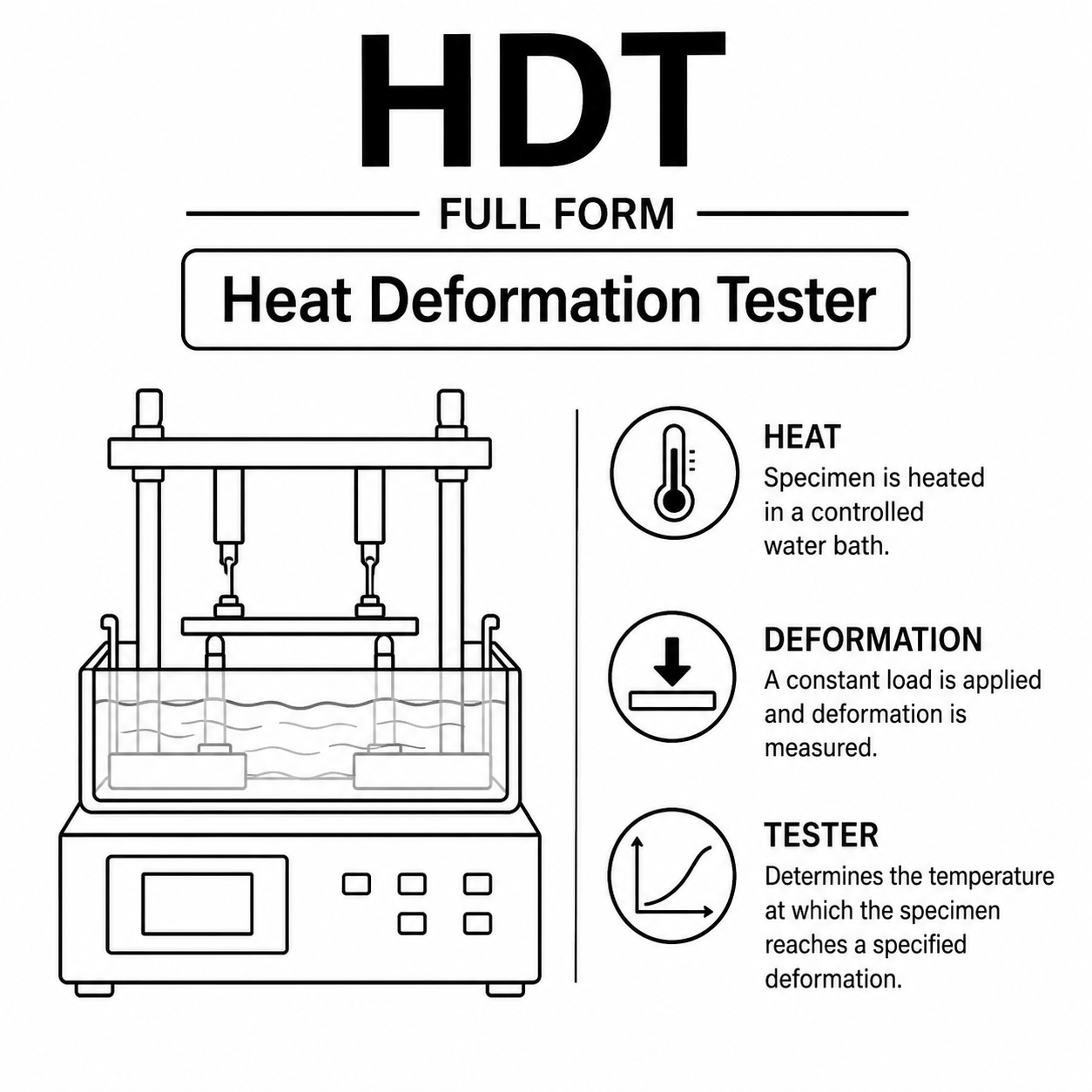
In simple terms, HDT helps manufacturers understand whether a material can maintain its shape and strength when exposed to heat.
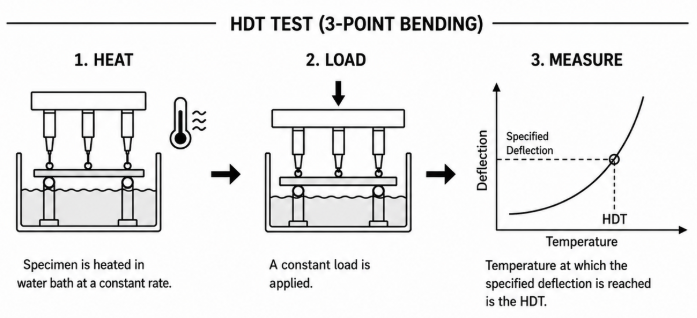
According to ASTM D648, HDT is the temperature at which a standard plastic specimen deflects by a certain amount under flexural load. This is a common method for testing the short-term heat resistance of plastics.
HDT testing matters to manufacturers using HDT for
- Choosing the best material for the final use
- Assessing the heat performance of plastics
- Reliability of the product
- Avoiding product failures in elevated temperatures
- Industrial quality
Heat Deflection Temperature (HDT): Meaning, Applications, and Industrial Relevance
Heat deflection temperature is not the melting temperature. Rather, it is the temperature at which the material starts to lose its shape-differentiation under load.
This characteristic is particularly important for a product used in a warm environment.
Applications of Heat Deflection Temperature (HDT)
This temperature is tested by the HDT in the following industry sectors:
- Automobile parts
- Electrical and electronic components
- Plastic packaging
- Home appliances
- Medical appliances
- Consumer products
- Research and development laboratories for polymers
For example, plastic parts running under a car’s coupé should not lose their shape at higher temperatures. Likewise, plastic casings for electrical components should not deform while running continuously.
Why HDT Values Matter for Product Performance and Material Selection
HDT information is an indication of a material’s ability to withstand heat. A larger or higher HDT score indicates that a material can handle a higher temperature before the point of deformation.
But choosing only for strength or visual characteristics may not suffice. Thermal performance should not be ignored.
Why HDT is Useful
Constructors use HDT scores to:
- Compare various grades of polymer
- Identify suitable materials for specific applications
- Enhance product life
- Aid research and development
- Satisfy client demands
As an example, Performance or reinforced engineering plastics will typically have a higher HDT score than standard components and are thus fit for critical applications.
Formula for Heat Deflection Temperature and How HDT is Calculated
Many people research the Heat Deflection Temperature Formula, thinking it’s computed through a simple equation.
Though Heat Deflection Temperature is computed from lab tests and not simply a calculation of its own.
The test was based on a calculation of flexural stress under three-point loading conditions.
During equipment setup, the bending stress used is:
σ = 3PL / 2bd²
Where:
σ = Flexural stress
P = Applied load
L = Support span
b = Width of the sample
d = Thickness of the sample
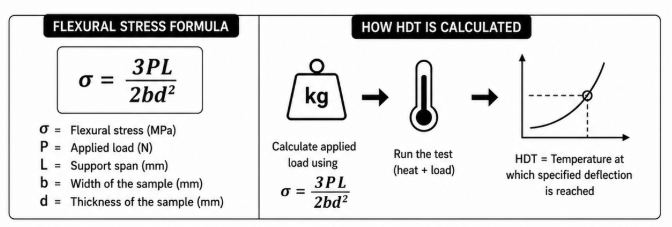
The Formula for Heat Deflection Temperature is used for calculating the appropriate loading conditions for the test specimen.
The method includes test conditions such as the test specimen dimensions, heating rates and loading for internationally comparable results, which are specified in ISO 75.
Heat Deformation Tester: Working Principle and Testing Procedure
A Heat Deformation Tester is a device for obtaining heat deflection temperature (HDT) and Vicat Softening Temperature.
According to the data published by PRESTO, its HDT/VSP Tester device offers...with the best possible ability to assure the polymer's capacity to bear the loads at elevated temperatures. and precise deformation measurement.
Basic Test Method
The test method usually comprises the following steps:
- Specimen preparation as per standard dimensions.
- Sample positioning.
- Applying the required stress.
- Heating of the medium at a specified rate.
- Sensing of the deformation.
- Obtaining the final HDT value.
A reliable Heat Deformation Tester is key for obtaining repeatable results essential for product control and quality development.
HDT/VSP Tester: Features, Applications, and Benefits in Manufacturing
HDT/VSP Tester is used for determining Heat Deflection Temperature (HDT) and Vicat Softening Point (VSP) of plastics to enable manufacturers to determine the material they are using.
Key Features:
- Accurate temperature control
- Accurate deformation measurement
- Easy to operate
- Test Standards compliance
Applications: Plastics manufacturing, packaging, automotive, electrical and quality control laboratories.
Benefits: Better material choice, fewer product defects, better product quality, and efficient manufacturing.
As per the specifications of the PRESTO HDT/VSP Tester, this device is designed to provide consistent test results for polymer testing applications.
Heat Deflection Temperature Standards and Compliance Requirements
Adhering to recognised Heat Deflection Temperature Standards is vital in ensuring repeatable, reliable and comparable test specifications across various testing applications in biological labs.
Providing a standardised test also enables manufacturers to demonstrate compliance with industry and customer specifications.
Heat Deflection Temperature Standards commonly used
The most commonly used Heat Deflection Temperature Standards are:
- ASTM D648 - Standard Test Method for Temperature of Deflection of Plastics Under Flexural Load
- ISO 75 - Plastics: Evaluation of Temperature of Deflection Under Load
- ASTM D1525 - Fully Standard Test Method for Vicat Softening Temperature of Plastics
- ISO 306 - Determination of Vicat Softening Temperature
The ASTM D648 standard includes specifications detailing specimen dimensions, loading conditions, and heating rates for HDT testing.
Manufacturers can achieve repeatable test results for each HDT test by using the parameters suggested by ASTM International.
How HDT Testing Helps Improve Product Quality and Manufacturing Efficiency
Testing is a critical element of any quality management system. Heat Deflection Temperature (HDT) testing provides manufacturers with actionable data about the performance of materials under the combined effects of heat and load.
They can use that data to improve product quality and manufacturing efficiency.
Ways HDT Testing Improves Product Quality
Heat Deflection Temperature (HDT) testing helps manufacturers:
- Identify inappropriate materials before production begins
- Validate supplier material claims
- Lower field failures and customer complaints
- Confirm products perform under application-service conditions
- Encourage continuous improvement
Once manufacturers have knowledge of their HDT Values, they can make confident material selection decisions with application needs in mind.
Why Choose Presto Stantest For HDT Testing Solutions?
Choosing the right testing equipment can be as critical to success as choosing the right material. For many manufacturers, Presto Stantest is a name they trust to provide reliable, accurate, easy-to-operate testing equipment.
Benefits of Presto Stantest HDT/VSP Tester
- Developed for repeatable and reliable testing
- Capability to test against established testing standards
- Applicable to R&D and quality control
- Laboratory operator-friendly
- Built with tough construction for long service life
- Supported by technical and customer assistance
Presto’s advanced testing solutions enable manufacturers to improve their quality assurance practices and make better choices on material selection.
Manufacturers seeking to enhance their quality assurance should consider using PRESTO advanced testing solutions to support independent, repeatable and reliable material testing.
Enhance Your Material Testing Accuracy with PRESTO
Ensure reliable Heat Deflection Temperature (HDT) testing and make informed material selection decisions with Presto advanced HDT/VSP Tester. Contact our experts today to find the right testing solution for your quality control and R&D requirements. For more information about HDT testing solutions, call us at +91 9210 903 903 or email us at info@prestogroup.com today.
Recent Blogs
- What is MFI (Melt Flow Index)? Full Form, Formula, Benefits, Limitations, and Industrial Testing Applications
- Injection Molding: Process Steps, Machine Operation, Diagrams & Testing Instruments
- Peel Strength and Heat Seal Strength Testing for Flexible Packaging
- Industrial and Laboratory pH Meters: Working, Diagram, Uses and Selection Guide
- Industrial Leak Testing: Methods, Technologies, Benefits, and Industry Applications

Related Blogs

Dry Heat Sterilization: How It Works, Key Advantages, and Formula

Hot Air Oven: Precision Heating for Reliable Results

Conduct Heat Deformation Tests Accurately with the Hot Air Oven