
- /
- Article / Ash Content Determination in Food, Polymer, and Textile Industries Using Muffle Furnace
Ash Content Determination in Food, Polymer, and Textile Industries Using Muffle Furnace
In industries where product quality matters a lot, ash content testing is not just another lab procedure. It actually helps manufacturers understand how pure, stable, and consistent their material is. From food products and plastic compounds to technical textiles, ash determination gives important information about inorganic residue left after complete burning of the sample.
This testing becomes even more important when industries are working under strict quality standards and export regulations. A small variation in ash percentage can affect product performance, shelf life, safety or even customer trust.
That’s why laboratories today rely on advanced thermal testing equipment like a muffle furnace machine. It provides controlled heating at high temperatures and helps labs get accurate ash content values without contamination. Companies like Presto Group are offering modern furnace systems that are widely used across QA and R&D laboratories for reliable testing performance.
Why Ash Content Testing Matters Across Industries
Different industries use ash testing for different reasons, but the main purpose is almost same — checking the amount of inorganic residue left in the material.
In Food Industry
Food manufacturers use ash testing to measure mineral content and product purity. It also helps detect contamination or adulteration in raw materials.
For example:-
- High ash value in flour may show contamination from outer grain layers
- Spices with excess ash may contain dirt or unwanted fillers
- Dairy products are tested for mineral consistency
- Processed foods are checked for quality stability
Food brands cannot ignore this testing because even small quality issues can affect compliance and labeling standards.
In Polymer Industry
In plastics and polymers, ash determination is very useful for understanding filler content and reinforcement percentage.
Manufacturers test:-
- Glass-filled polymers
- Rubber compounds
- Calcium carbonate loading
- Flame retardant additives
- Composite materials
Many automotive and electrical plastic parts depend on correct filler percentage. If ash values go wrong, product strength and durability can also get affected.
In Textile Industry
Textile laboratories also use ash testing for fiber analysis and chemical finish evaluation.
It helps identify:-
- Mineral treatments on fabrics
- Fiber blend composition
- Residual inorganic chemicals
- Flame-retardant coating presence
- Fabric contamination
Especially in technical textiles, ash testing becomes important because these fabrics are used in industrial and safety applications.
Advanced Understanding of Muffle Furnace Technology
A normal heating oven and a muffle furnace machine are not same. A muffle furnace is specially designed for high-temperature applications where accurate thermal processing is needed.
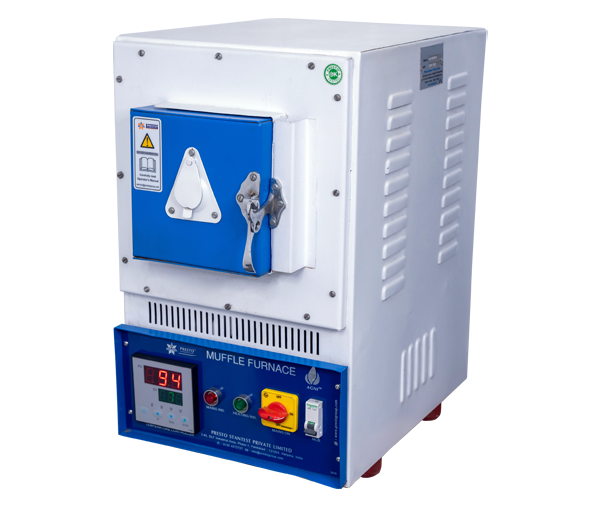
Inside the furnace, the sample does not come in direct contact with flames or combustion gases. Instead, heating elements around the chamber create controlled heat uniformly from all sides. This improves testing accuracy and avoids contamination.
The chamber insulation is also important because it maintains stable internal temperature while reducing heat loss outside.
Modern laboratories now prefer digital furnaces because they offer better temperature stability, programmable controls, and safer operation.
Muffle Furnace Working Principle
The muffle furnace working principle is based on indirect high-temperature heating in a closed insulated chamber. The sample is placed inside a ceramic crucible and heated gradually at a selected temperature until all organic matter burns away completely.

During the process, several stages happen:-
- First, moisture starts evaporating
- Then volatile compounds break down
- Organic material gets oxidized
- Finally, inorganic residue remains as ash
This remaining ash is then measured to calculate ash percentage.
Modern furnace systems use PID controllers for maintaining precise heating conditions. This is very important because uneven heating can directly affect the final ash result.
Key Parameters That Influence Ash Content Accuracy
Ash content testing may look simple from outside, but actually many factors influence the final result. Even a small mistake in temperature or heating duration can create wrong values.
Below are some important parameters laboratories monitor carefully:-
| Parameter | Impact on Test Results |
| Heating Rate | Prevents sudden sample burning |
| Final Temperature | Ensures complete oxidation |
| Holding Time | Helps stabilize ash residue |
| Air Circulation | Improves combustion efficiency |
| Crucible Quality | Avoids chemical interaction |
| Chamber Uniformity | Gives repeatable results |
Choosing the right muffle furnace temperature is one of the most critical parts of ash determination. Lower temperature may leave carbon residue while excessive temperature may damage certain minerals.
Muffle Furnace Uses in Food Laboratories
Food laboratories have many different testing requirements and ash analysis is one of the most common among them.
Some common uses of muffle furnace in laboratory testing are:-
- Total ash testing in flour and grains
- Mineral analysis in dairy products
- Ash determination in edible oils
- Purity testing of spices
- Sugar quality evaluation
- Processed food residue analysis
Spice manufacturers especially depend on ash testing because contamination in spices is a common issue in the market.
In many cases, acid-insoluble ash testing is also done to check dirt, sand, or external impurities present in the sample.
Polymer Industry Applications of Muffle Furnace
The polymer industry uses ash determination mainly for formulation control and filler percentage evaluation.
Advanced polymer testing applications include:-
- Glass fiber content testing
- Carbon black residue analysis
- Filler percentage measurement
- Reinforced plastic evaluation
- Rubber compound testing
For polymer manufacturers, ash testing is not only about quality checking. It also helps during product development and process optimization.
Nowadays many labs prefer programmable furnaces because different polymers decompose differently. Controlled heating ramps improve accuracy and reduce testing variation.
Textile Industry and Thermal Residue Analysis
Textile industries use thermal residue analysis for understanding fiber composition and inorganic treatment levels.
Some important applications are:-
- Fiber identification
- Fabric finish analysis
- Flame-retardant treatment evaluation
- Mineral residue detection
- Industrial textile testing
Ash testing becomes more useful in technical and industrial fabrics where performance standards are strict.
For example, fire-resistant fabrics often contain inorganic compounds that can be identified through ash residue testing.
Importance of Uniform Heating in Ash Analysis
One major reason why laboratories invest in good furnace systems is temperature uniformity.
If heat distribution inside the chamber is uneven, then some parts of the sample may burn completely while others remain partially oxidized. This creates inconsistent results.
Poor heating can lead to:
- Carbon residue formation
- Incomplete combustion
- Unstable ash values
- Repeatability problems
That’s why modern systems from Presto Group are designed with high-quality insulation and controlled heating technology for better thermal uniformity.
Most advanced furnaces now include:
- Digital PID controllers
- Ceramic fiber insulation
- Over-temperature protection
- Energy-efficient heating elements
- Adjustable ventilation systems
These features improve both accuracy and operational safety.
Understanding Muffle Furnace Diagram and Internal Components
A standard muffle furnace diagram generally shows different important components inside the system.
Main parts include:
- Outer metal body
- Ceramic insulated chamber
- Heating coils or elements
- Thermocouple sensor
- Temperature controller
- Air ventilation system
- Crucible support tray
The chamber material is specially made for handling repeated high-temperature cycles without damage.
In advanced models, users can also set programmable heating profiles for automatic testing operations.
Selecting the Right Muffle Furnace Machine for Industrial Laboratories
Choosing the correct furnace depends on the testing application and laboratory workload.
Important Selection Criteria
Temperature Range
Different materials need different heating conditions.
- Food samples usually need 500–600°C
- Polymer testing may require 600–800°C
- Ceramic applications can go above 1000°C
Chamber Capacity
Labs with high sample load generally prefer larger chambers for better productivity.
Temperature Accuracy
Accurate ash determination depends heavily on stable temperature control.
Heating Speed
Fast heating saves time, but controlled ramping is still important for sensitive samples.
Safety Features
Modern furnaces should have:
- Thermal cut-off system
- Insulated outer body
- Digital temperature display
- Door safety mechanism
Muffle Furnace Uses Beyond Ash Determination
There are many industrial muffle furnace uses apart from ash testing.
Some additional applications are:
- Heat treatment of metals
- Loss on ignition testing
- Ceramic sintering
- Material annealing
- Glass testing
- Thermal decomposition studies
- Pharmaceutical residue analysis
Because of this versatility, muffle furnaces are commonly used in universities, industrial QA labs, research centers, and manufacturing industries.
Energy Efficiency and Modern Furnace Design
Older furnace systems consumed a lot of electricity and also generated excessive external heat.
But modern furnace technology has improved significantly.
Today’s systems use:
- Ceramic fiber insulation
- Smart PID controllers
- Low thermal mass chambers
- Faster heat recovery systems
These improvements reduce energy consumption and improve temperature stability at the same time.
Manufacturers like Presto Group are now focusing more on energy-efficient and long-lasting furnace designs suitable for continuous industrial usage.
Muffle Furnace Price in India
The muffle furnace price in india depends on several factors like:
- Maximum temperature range
- Chamber size
- Automation features
- Temperature controller type
- Build quality
- Brand support
Basic laboratory models are comparatively affordable, while advanced programmable systems cost more because of better precision and automation features.
But while selecting a furnace, laboratories should not focus only on pricing. Long-term accuracy, durability, service support, and temperature consistency are equally important.
A good furnace investment usually improves testing reliability for years.
Future Trends in Ash Content Testing
Laboratory testing systems are becoming smarter and more automated.
Modern ash testing setups now include:
- IoT-based monitoring
- Data logging systems
- Remote operation features
- Automated temperature profiling
- Smart safety controls
These technologies reduce manual work and improve repeatability in industrial laboratories.
As industries continue demanding better product consistency and tighter quality control, advanced furnace systems will become even more important in future testing laboratories.
Role of Muffle Furnace in Reliable Ash Content Analysis
Ash content testing is not just about heating a sample and checking what remains after burning. In actual laboratory work, it helps industries understand product purity, material consistency, contamination level, and filler content. This is why food, polymer, and textile industries regularly use this test during quality checking.
For accurate results, proper heating control matters a lot. If temperature is not stable or heating is uneven, the final ash value can easily get affected. That’s why understanding the muffle furnace working principle becomes important for laboratories handling regular testing work.
Whether it is checking food quality, evaluating polymer compounds, or analyzing textile materials, a good muffle furnace machine helps labs get more consistent and dependable results without much testing variation.
For reliable thermal testing solutions and laboratory equipment, you can connect with Presto Group.
Upgrade Your Laboratory Testing Accuracy
Looking for a reliable muffle furnace machine for precise ash content testing? Presto Group offers advanced furnaces with uniform heating, accurate temperature control, and dependable performance for food, polymer, and textile industries.

Phone: +91 9210 903 903
Mail: [email protected]
Get trusted thermal testing solutions designed for modern industrial laboratories.
FAQs
1) What is the ideal muffle furnace temperature for ash content testing?
The required temperature depends on the sample type. Food products are usually tested around 500–600°C, while polymers and composite materials may require higher temperatures up to 800°C.
2) What are the common uses of muffle furnace in laboratory applications?
Muffle furnaces are widely used for ash content testing, loss on ignition analysis, heat treatment, ceramic processing, material decomposition studies, and pharmaceutical testing.
3) Why is uniform heating important in a muffle furnace machine?
Uniform heating ensures complete combustion of organic material and prevents inconsistent ash results caused by uneven oxidation inside the chamber.
4) How does the muffle furnace working principle help in accurate testing?
The furnace uses indirect heating inside an insulated chamber, which avoids contamination from direct flames and provides controlled oxidation for precise residue analysis.
Recent Articles
- Climatic Chamber: Working Principle, Uses, Diagram, Price & Top Manufacturers in India
- Izod vs Charpy Impact Test: Difference, Method & Standards
- Colorimeter vs Spectrophotometer: Accuracy, Working Principle, and Industrial Uses
- Quality Assurance and Quality Control: Two Pillars of Product Excellence
- Hardness Test: Types, Testing Methods, Procedures, and ASTM Standards

Need more information
Connect with us for your business enquiries. Generally, we respond within one or two working days.