
- /
- Blog / What is Ash Value? Full Form, Formula and Significance in Testing
What is Ash Value? Full Form, Formula and Significance in Testing
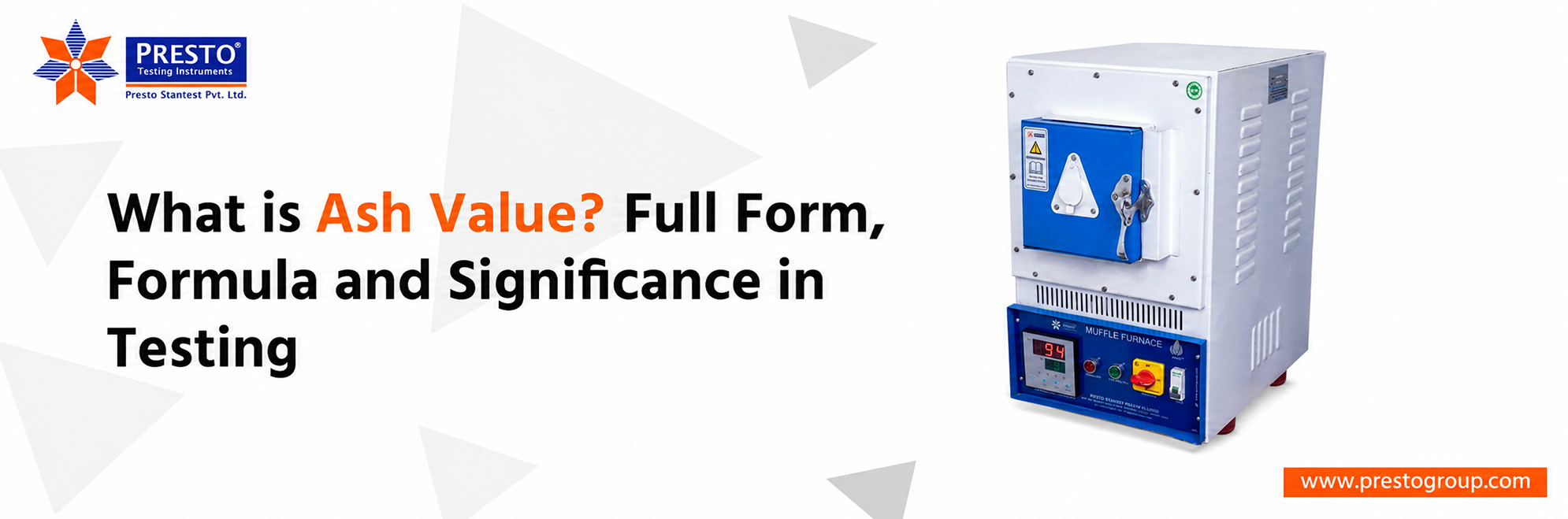
In the purity, safety and quality assessment of your product, even the minute residual material left after burning is important. This residual material is called Ash Value or content, and it reveals the inorganic material found in a sample to labs that perform testing.
In simple terms, Ash Value refers to the amount of mineralized or unburnable material remaining after heating a sample to high temperature. Ash Content Analysis is a crucial quality test for food, pharmaceuticals, polymers, rubber, chemicals and packaging businesses. An accurate Ash Test can be carried out and testing control enhanced if the appropriate Muffle Furnace is used.
What is Ash Value? Definition, Importance, and Industrial Applications
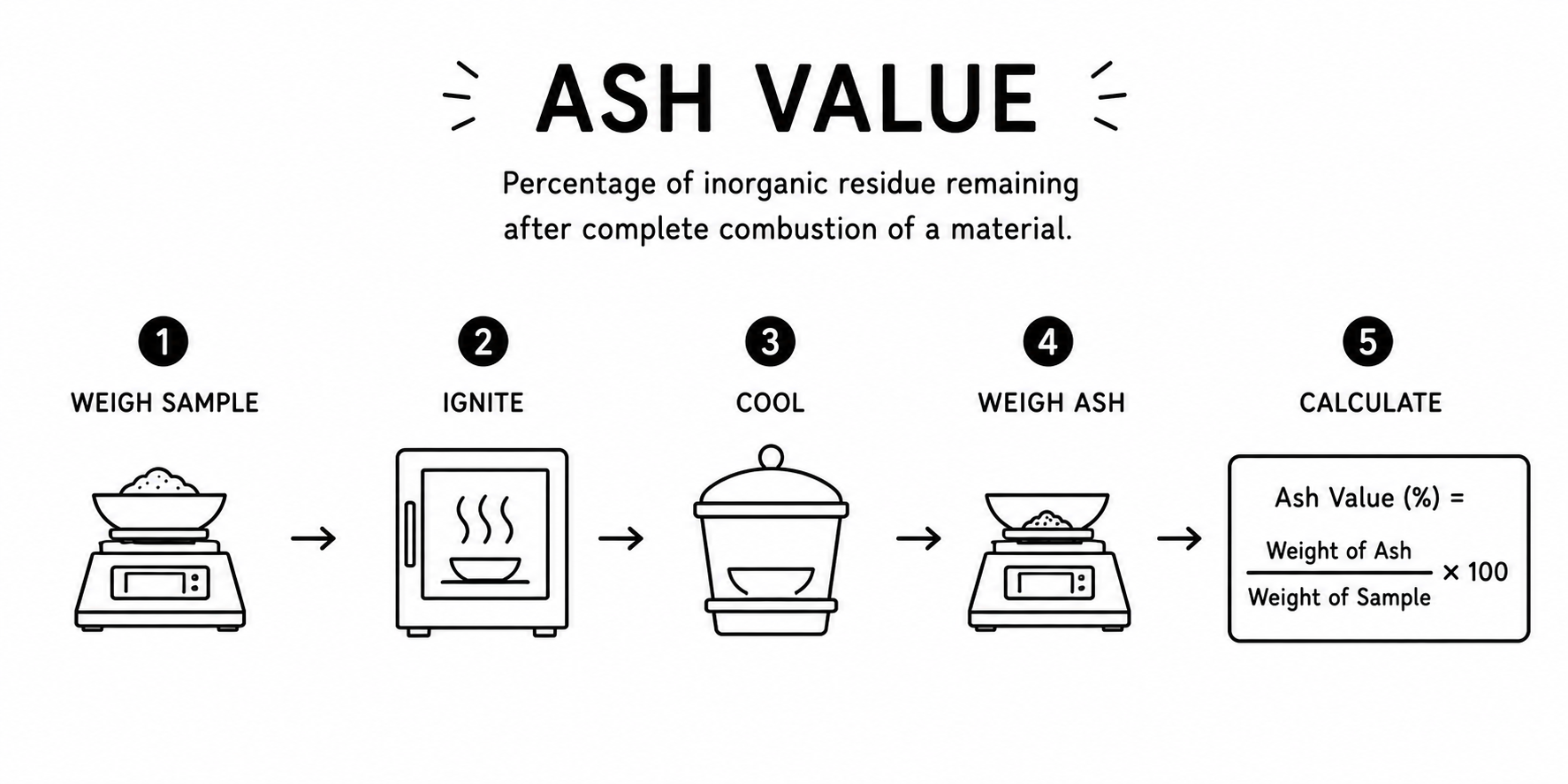
Ash Value is the proportion of inorganic residue remaining after a material is fully incinerated in controlled heat. Most of the organic component burns out, leaving spent minerals, salts, metals, fillers and other non-combustible substances as ash.
The Significance of Ash Value is high because it helps identify:
- Purity of raw materials
- Mineral content in food samples
- Filler content in polymers and rubber
- Contamination in chemicals
- Quality of pharmaceutical ingredients
- Consistency of production batches
In industries, Ash Value is used to test whether a product complies with the required quality. If the amount of ash content is too high or low, it may indicate poor quality raw material, contamination or wrong formulation.
Ash Full Form and Why Ash Content Analysis Matters in Quality Testing
Many people are searching for the Ash Full Form, but ash is generally not considered an abbreviation. In analysis, the term “ash” refers to the residue left after heating a sample at high temperature to burn off volatile components.
Ash Content Analysis is important because it provides valuable insight into the sample's non-organic material. This helps the business prevent quality-related problems before the product reaches the customer.
For example:
- In food testing, ash shows mineral content.
- In rubber testing, ash shows fillers and additives.
- In pharma testing, ash helps check purity.
- In plastics, ash shows inorganic residue or filler levels.
The Significance of Ash Value is not specific to any industry. It helps in the safety of the product, legal compliance, and consistency in standard batch-to-batch production
Ash Test: Purpose, Procedure, and Testing Standards
An Ash Test is conducted to determine ash after heating a sample in a Muffle Furnace. The Ash Test is used to remove organic matter from a sample and measure inorganic content.
Basic Ash Test Procedure
- Take a clean and dry crucible.
- Weigh the empty crucible.
- Add a known amount of sample.
- Place the sample in a Muffle Furnace.
- Heat it at the required temperature.
- Cool the crucible in a desiccator.
- Weigh the ash residue.
- Use the Ash Value Formula to calculate the result.
The temperature and duration may vary depending on the sample and standard used. Many laboratories use controlled heating, as sudden application of high heat may lead to loss of the sample or wrong results.
Ash Value Formula and Ash Calculation Formula for Accurate Results
Ash Value Formula is very simple and easy. It aids in calculating the ash percentage by determining the weight difference between the before- and after-heating weights.
Ash Value Formula
Ash Value (%) = Weight of Ash / Weight of Sample × 100
This is also called the Ash Calculation Formula.
Example of Ash Calculation Formula
If the sample weight is 5 grams and the ash residue is 0.25 grams:
Ash Value (%) = 0.25 / 5 × 100 = 5%
This means the sample has 5% ash content.
For accurate assessment, the weighing balance, crucible, and sample preparation must be proper, and the temperature of the Muffle Furnace must be controlled.
Significance of Ash Value in Food, Pharmaceutical, and Material Testing
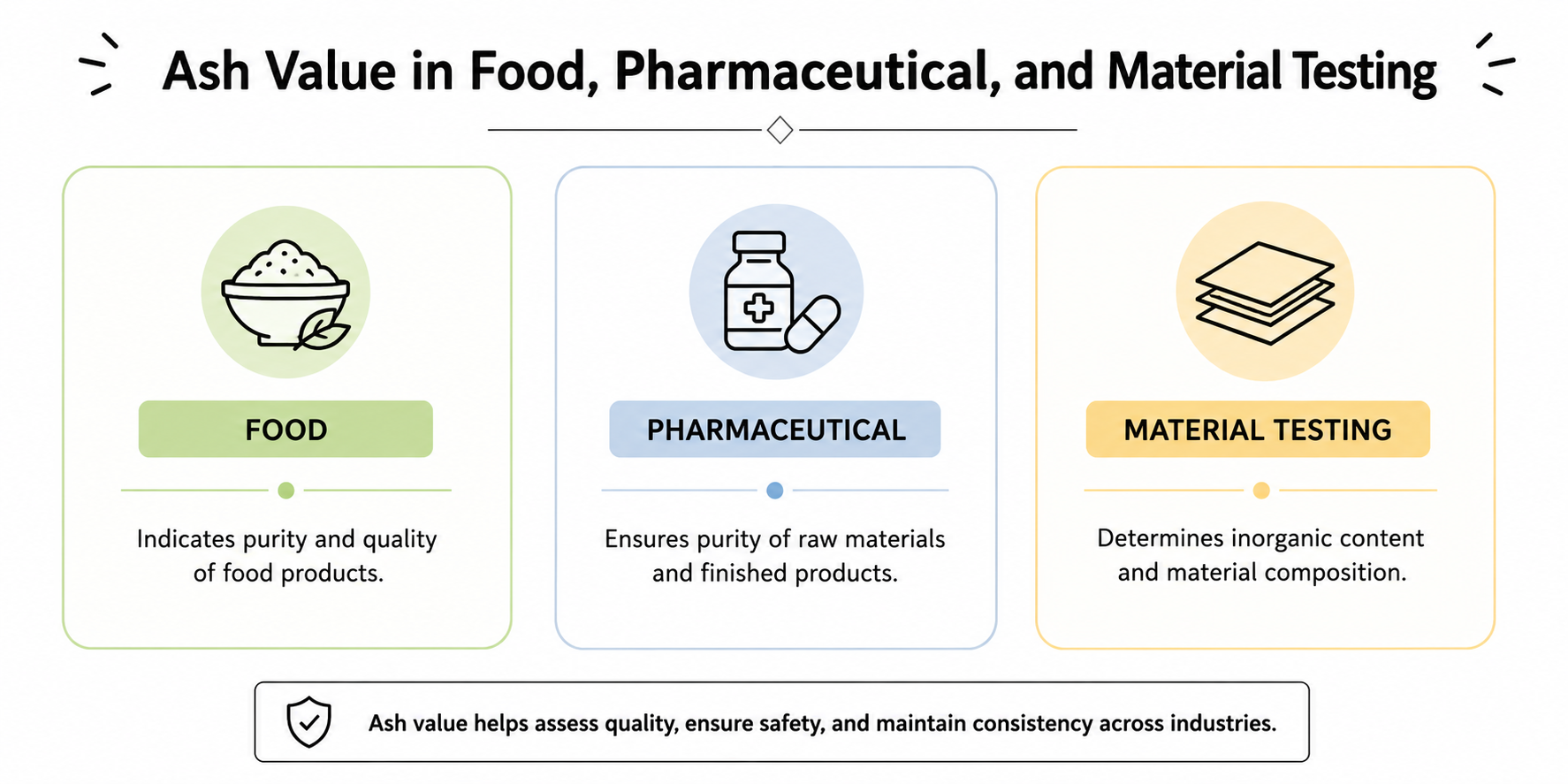
The importance of Ash Value may vary from one industry to another. But the core objective remains the same: to assess the purity and quality of products.
In Food Testing
Ash Value helps in detecting unwanted inorganic matter in Pharma. It is also applicable in raw material quality control and herbal product quality evaluation.
In Pharmaceutical Testing
In pharma, Ash Value helps detect unwanted inorganic matter. It also supports raw material quality checks and herbal product testing.
In Material Testing
Ash Content Analysis is needed in rubber, plastics, polymers, and chemicals to identify fillers, additives, and inert residues. This analysis is critical for the product's strength, performance, and consistency.
Proper Ash Test helps manufacturers reduce rejections, improve quality control, and maintain product trust. Ash Value Formula
How a Muffle Furnace is Used for Ash Content Analysis
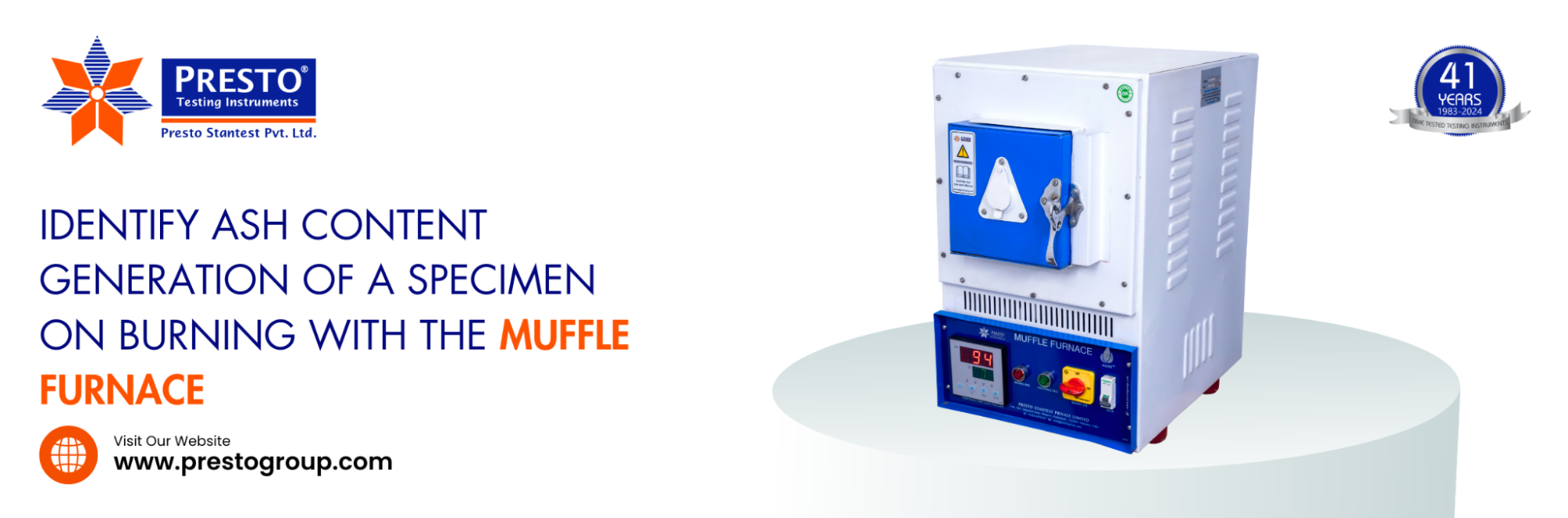
A Muffle Furnace is one of the most essential instruments used for Ash Content Analysis. It heats the sample at a high and controlled temperature without direct flame contact.
The sample is placed in the furnace's heating chamber. The furnace burns away organic matter, leaving only ash. Using the Muffle Furnace is ideal for testing food, polymers, rubber, chemicals, textiles, and pharma samples.
PRESTO is a global manufacturer of laboratory testing instruments optimized for quality and control needs across industries. In laboratories that require steady heating, controlled testing, and reliable performance, a well-made Muffle Furnace can support better ash testing accuracy.
Uses of Muffle Furnace in Laboratory Testing and Research
Beyond testing Ash Content, there are many uses of Muffle Furnace in laboratory work. The laboratory, research, quality control, and industrial testing all rely on the Muffle Furnace’s wide range of testing capabilities.
Common Uses of a muffle furnace in the laboratory include:-
- Ash Content Analysis
- Heat treatment of samples
- Loss on ignition testing
- Material residue testing
- Ceramic testing
- Metal and mineral testing
- Polymer and rubber testing
- Sample preparation for further analysis
Uniform heating, high-temperature control, and clean testing are all advantages of the Muffle Furnace that make it the laboratory’s choice. These qualities enhance the laboratory’s repeatability and reduce testing errors.
Ash Management Techniques to Improve Testing Accuracy and Compliance
Ash management techniques are useful for ensuring accurate and repeatable testing results. Inadequate analysis, incorrect temperature, and dirty crucibles can affect the Ash Value test result.
Useful Ash Management Techniques
- Use clean and dry crucibles.
- Weigh samples carefully.
- Avoid overloading the crucible.
- Follow the right heating temperature.
- Cool samples in a desiccator.
- Calibrate the Muffle Furnace regularly.
- Record every test detail.
- Follow approved testing standards.
- Train lab staff properly.
Good Ash Management Techniques are also useful for meeting our compliance needs. They reduce errors and improve decision-making in our quality testing.
Final Analysis
Ash Value is a simple but powerful quality test. It shows the inorganic residue left after heating and provides the industry with information on purity, mineral content, fillers, and contamination levels. When used with the right Ash Test, Ash Value Formula, and a well-controlled Muffle Furnace, the laboratory can conduct Ash Content Analysis with precision.
If you are in search of reliable testing, Presto offers advanced testing instruments optimized for quality, accuracy, and longevity. Discover Presto Groups testing solutions to upgrade your lab’s testing process and quality control.
Get Accurate Ash Value Testing Solutions for Your Lab
Ensure precise Ash Content Analysis with advanced laboratory instruments designed for reliability and consistency. Improve quality control, reduce errors, and achieve compliance across industries like food, pharma, polymers, and chemicals with trusted testing equipment.
Call us at +91 9210 903 903 or email info@prestogroup.com
 Accurate Results | Trusted by Industry Leaders | Fast Delivery
Contact us today for expert guidance and the best testing solutions for your laboratory needs.
Recent Blogs
- Injection Molding: Process Steps, Machine Operation, Diagrams & Testing Instruments
- Peel Strength and Heat Seal Strength Testing for Flexible Packaging
- Industrial and Laboratory pH Meters: Working, Diagram, Uses and Selection Guide
- Industrial Leak Testing: Methods, Technologies, Benefits, and Industry Applications
- PET Preform Quality Test Using Preform Measurement Instruments — Step-by-Step Guide
Related Blogs

Mastering Ash Content Analysis: Technicals Insight into the Muffle Furnace

Behind the Scenes: The Role of Muffle Furnaces in Quality Control
Identify Ash Content Generation of a Specimen on Burning with the Muffle Furnace