
- /
- Article / Bureau of Indian Standards (BIS): Role, Functions, and Industrial Applications
Bureau of Indian Standards (BIS): Role, Functions, and Industrial Applications

When manufacturers talk about product quality in India, the conversation usually leads back to the Bureau of Indian Standards. Whether it’s packaging materials, electrical products, industrial equipment, or consumer goods, BIS standards quietly influence how products are tested, approved and accepted in the market.
A lot of businesses think BIS is only about certification. That’s not really true. The real value of BIS quality standards shows up during production — where consistency, safety, and process control actually matter.
And honestly, this is where many companies struggle.
A product may look perfectly fine visually but still fail during transportation, storage, or customer use. In packaging industries especially, small variations in material strength or sealing quality can create expensive problems later.
That’s why standardized testing and proper quality assurance systems are taken seriously across industries now.
Why the Bureau of Indian Standards (BIS) Matters for Modern Industries
The Bureau of Indian Standards is the national standards authority of India operating under the Ministry of Consumer Affairs.
Its primary role is to create and maintain Indian Standards for products, materials, testing procedures, and industrial systems.
Most people recognize BIS because of the ISI mark. But the organization’s responsibilities go far beyond product labeling.
BIS helps industries maintain:
- Product safety
- Manufacturing consistency
- Standardized testing methods
- Material quality benchmarks
- Process reliability
- Regulatory compliance
Without standardization, every manufacturer would follow different quality practices. That usually creates inconsistency in the market and increases product failure risks.
Why BIS Quality Standards Matter in Industries
In manufacturing, quality problems usually don’t start as big failures. Most of the time, they begin with small changes that people hardly notice in the beginning. Maybe the packaging material becomes slightly thinner, seal quality drops a little, or product strength starts varying between batches.
Production still continues normally for some time. Then slowly, rejection rates increase. Customer complaints start showing up. Sometimes products even get damaged during transportation.
This is where BIS quality standards actually help industries in a practical way. They support better process control, improve product consistency, and help manufacturers maintain reliable quality during regular production. Good standards cannot remove every problem completely, but they do help reduce unnecessary variation — and honestly, that’s something most industries deal with every single day.
Major Functions of BIS
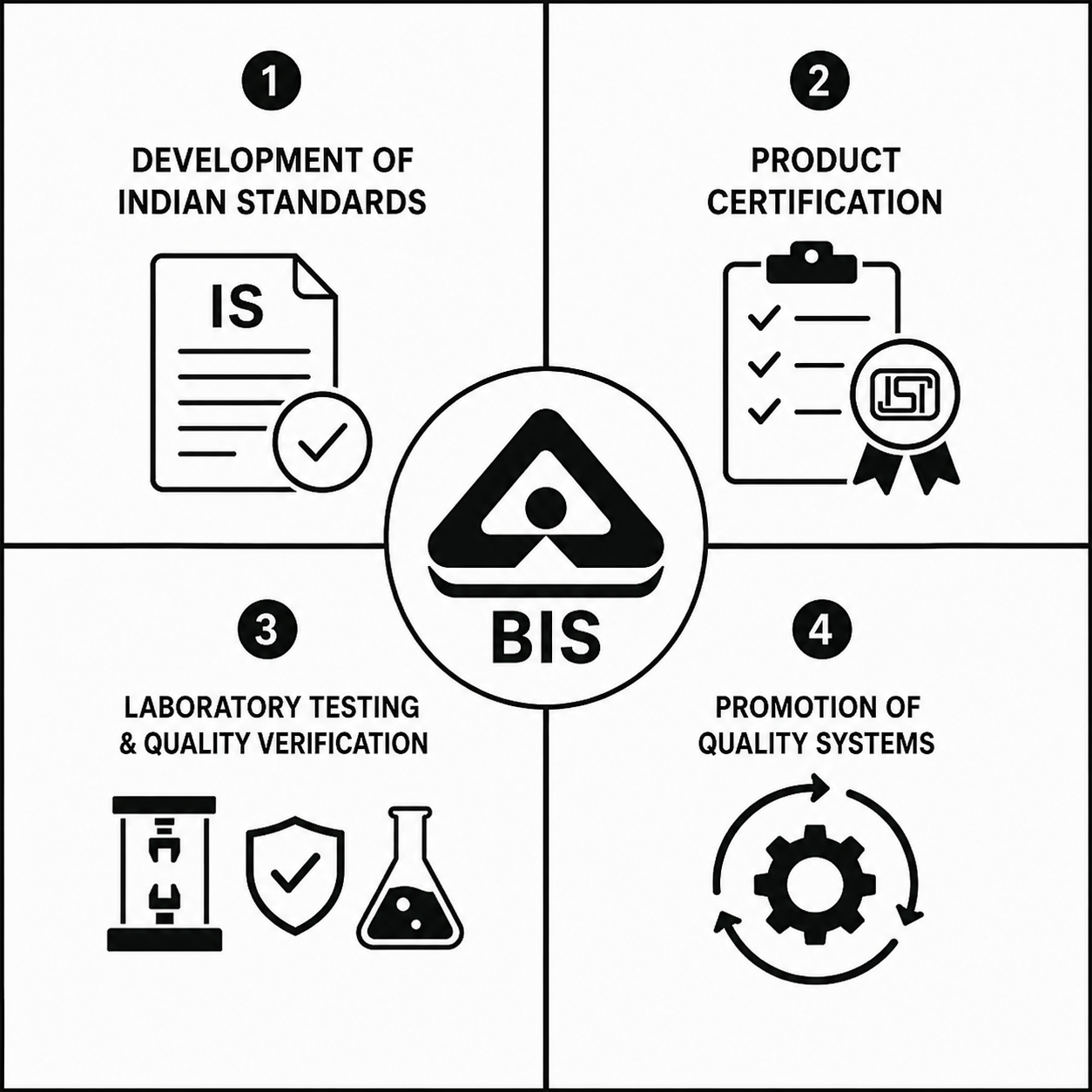
1. Development of Indian Standards: One of the main functions of BIS is developing Indian Standards for different industries.
These standards define technical requirements related to:
- Product dimensions
- Material specifications
- Testing methods
- Safety parameters
- Performance limits
- Sampling procedures
For manufacturers, these standards create a clear framework for production and quality evaluation.
In packaging industries, for example, material appearance alone is never enough to judge quality. Actual testing becomes necessary.
2. Product Certification: BIS also manages certification systems for regulated products.
Products falling under mandatory certification categories must undergo:
- Product testing
- Factory inspections
- Process verification
- Documentation review
After approval, manufacturers can use the ISI certification mark.
But many companies focus only on obtaining certification and ignore regular monitoring afterward. That’s usually where inconsistency begins.
Certification is one part. Maintaining quality daily is the harder part.
3. Laboratory Testing and Quality Verification: Testing plays a major role in BIS compliance.
Manufacturers use standardized testing methods to verify whether products meet required specifications.
Depending on the industry, testing may involve:
- Tensile strength analysis
- Compression testing
- Seal integrity evaluation
- Burst strength testing
- Environmental conditioning
- Barrier property testing
Small deviations can ruin the results here. Especially when testing instruments are not calibrated properly.
Sometimes the issue isn’t even the material itself. The testing process becomes unreliable.
4. Promotion of Quality Assurance Systems: BIS also supports industries in developing proper quality assurance systems.
Strong quality systems help manufacturers monitor:
- Production consistency
- Material variation
- Inspection records
- Process control
- Corrective actions
Factories with disciplined quality systems usually face fewer audit complications and lower rejection rates.
BIS Standards in Packaging Industry
The packaging sector depends heavily on standardization because packaging directly protects the product during storage and transportation.
That’s why BIS standards in packaging industry applications are widely used in sectors such as:
- Food packaging
- Pharmaceutical packaging
- Flexible packaging
- Corrugated box manufacturing
- Plastic packaging
- Industrial packaging materials
Packaging failures may not always appear immediately. Sometimes damage happens during shipping or long-term storage.
And by then, the losses become much larger.
BIS Quality Standards for Packaging Materials
Packaging materials must perform consistently under real operating conditions, not only inside laboratories.
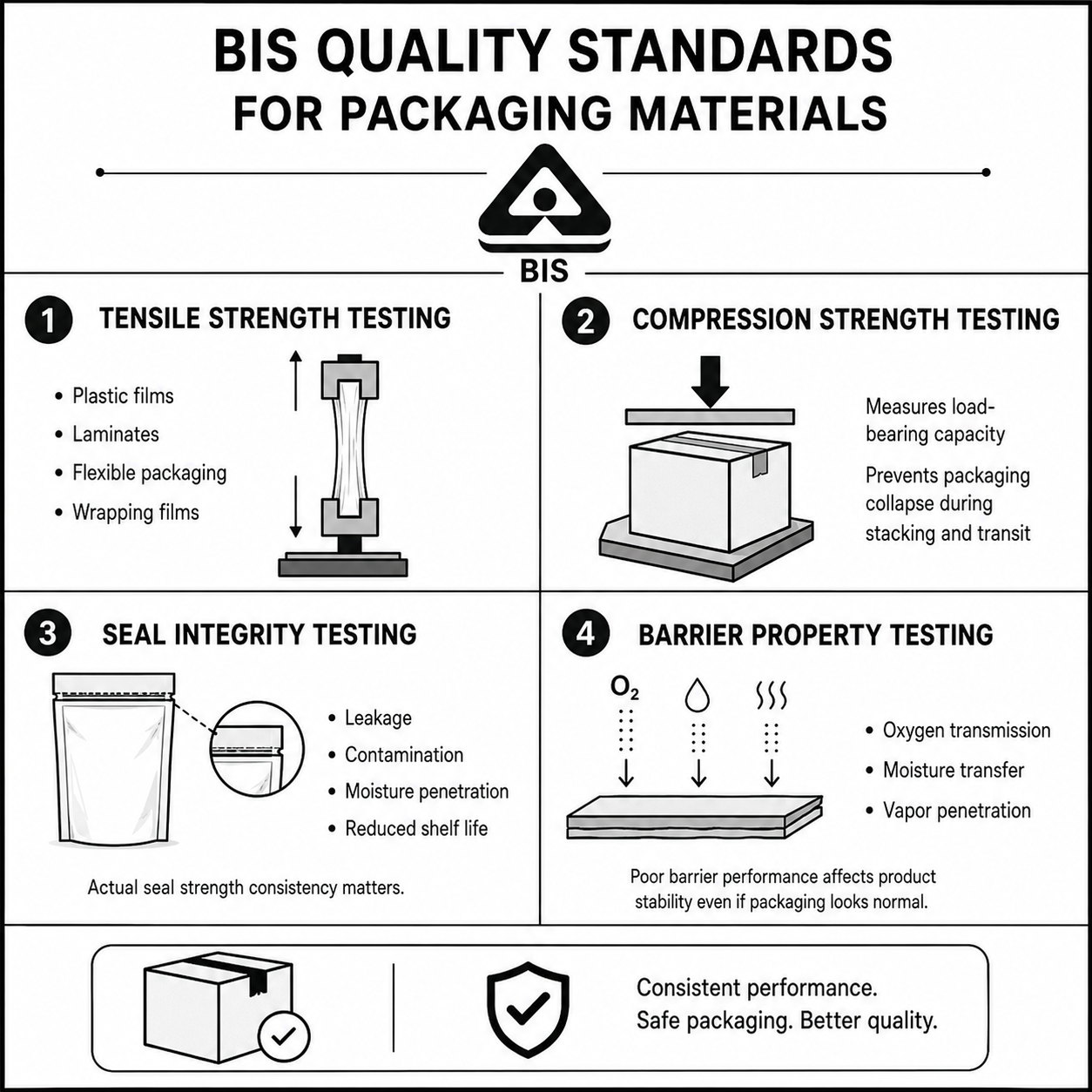
That’s why BIS quality standards for packaging materials focus heavily on performance testing.
Tensile Strength Testing
This test measures how much pulling force a material can withstand before breaking.
It is commonly used for:
- Plastic films
- Laminates
- Flexible packaging materials
- Wrapping films
Weak tensile strength often causes tearing during handling or automated packaging operations.
Compression Strength Testing
Corrugated boxes and containers are tested for load-bearing capacity.
Poor compression strength can lead to packaging collapse during stacking and warehousing.
This becomes a serious issue during long-distance logistics operations.
Seal Integrity Testing
Seal quality is critical in food and pharmaceutical packaging.
Improper sealing may cause:
- Leakage
- Contamination
- Moisture penetration
- Reduced shelf life
This is where many labs make mistakes. Visual sealing inspection alone is not enough. Actual seal strength consistency matters far more.
Barrier Property Testing
Barrier testing evaluates resistance against:
- Oxygen transmission
- Moisture transfer
- Vapor penetration
For sensitive products, poor barrier performance affects product stability very quickly.
Even when the packaging looks perfectly normal from outside.
Industrial Applications of BIS Standards
Packaging Industry:- In the packaging industry, BIS standards help manufacturers maintain proper material quality during storage and transportation. A packaging material may look fine from outside but still fail when pressure increases during handling. That’s why companies regularly test seal strength, compression resistance, and material durability before products move into the market.
Electrical Industry:- In electrical products, BIS standards mainly focus on safety and reliable performance. Issues like overheating, weak insulation or wiring faults often become risky later if proper testing is ignored. Because of this, manufacturers usually keep checking product quality throughout production instead of depending only on final inspection.
Automotive Industry:- The automotive industry follows BIS standards to maintain consistency in component quality and material performance. Even small variations in parts can slowly affect vehicle reliability over time. This is why manufacturers pay close attention to testing procedures and process control during regular production activities.
Construction Industry:- Construction materials like cement, steel, and pipes are tested according to BIS specifications to maintain strength and structural reliability. Problems in construction quality usually don’t appear immediately. They develop gradually, which makes proper testing and quality monitoring very important for long-term infrastructure safety.
How Manufacturers Maintain BIS Compliance
Good manufacturers usually treat BIS compliance as a regular production practice, not just a one-time certification process. Once production starts increasing, maintaining consistency becomes much more important than simply getting approval.
Step 1: Identifying Applicable Standards: Manufacturers first identify which Indian Standard applies to their product category. This sounds simple, but selecting the wrong standard can delay certification, testing approvals, and even production timelines. Many companies underestimate this part in the beginning.
Step 2: Product Testing: Products are tested according to BIS-defined methods before approval and during routine production. Depending on the material or application, testing may include tensile testing, compression testing, seal strength evaluation, burst testing, or environmental testing. Small variation in testing procedures can affect the final results more than people expect.
Step 3: Documentation and Inspection: Manufacturers also need to maintain proper records during production and inspection activities. This includes calibration certificates, test reports, inspection logs, and production records. During audits, incomplete documentation often creates unnecessary trouble. Sometimes the product quality is fine, but paperwork is missing.
Step 4: Continuous Quality Monitoring: Some companies reduce testing frequency after receiving certification approval. Usually not a good idea. Quality variation increases slowly when monitoring becomes inconsistent, especially in large-scale manufacturing where machines run continuously and material batches keep changing regularly.
BIS and Product Safety Regulations India Follows
Product safety regulations India continues to strengthen across industrial sectors.
Manufacturers are increasingly expected to maintain:
- Standardized testing procedures
- Traceable quality records
- Reliable inspection systems
- Consistent production quality
For exporters too, BIS compliance improves business credibility and buyer confidence.
Importance of Testing Equipment in BIS Compliance
Reliable testing equipment is essential for maintaining compliance with BIS quality standards.
Without accurate instruments, even well-designed quality systems become unreliable.
Industries commonly use testing equipment for:
- Tensile strength analysis
- Compression testing
- Seal integrity testing
- Burst strength evaluation
- Coefficient of friction testing
- Environmental simulation
The objective is not only certification approval.
The real goal is reducing failures before products reach customers.
Companies like Presto Group support industries with laboratory testing instruments used for packaging and material quality evaluation. Manufacturers involved in packaging compliance and BIS testing requirements often depend on reliable testing systems to maintain production consistency.
For technical assistance or product inquiries:
Phone: +91 9210 903 903
Email: [email protected]
BIS Standards and Their Role in Reducing Manufacturing Failures
BIS standards remain one of the strongest foundations of industrial quality control in India.
Especially in packaging industries, where material performance directly affects product safety and transportation reliability, standardized testing becomes extremely important.
Most manufacturing failures don’t happen because machines stop working completely. Usually, they happen because small inconsistencies are ignored for too long.
Weak seals. Improper testing. Missed calibration. Poor process monitoring.
That’s exactly why proper standards and disciplined quality assurance systems still matter so much in modern manufacturing.
Recent Articles
- Climatic Chamber: Working Principle, Uses, Diagram, Price & Top Manufacturers in India
- Izod vs Charpy Impact Test: Difference, Method & Standards
- Colorimeter vs Spectrophotometer: Accuracy, Working Principle, and Industrial Uses
- Quality Assurance and Quality Control: Two Pillars of Product Excellence
- Hardness Test: Types, Testing Methods, Procedures, and ASTM Standards

Need more information
Connect with us for your business enquiries. Generally, we respond within one or two working days.