

- /
- Article / ASTM vs ASME Standards: Key Differences and Their Impact on Product Quality
ASTM vs ASME Standards: Key Differences and Their Impact on Product Quality
In manufacturing and industrial engineering, standards are not just technical references used for documentation. They actually affect product reliability, workplace safety, material consistency, and even regulatory compliance in daily industrial work. Among the most commonly recognized standards worldwide are ASTM and ASME. People often use these terms together, but in real industrial operations both serve very different purposes.
The difference between ASTM and ASME standards is important for manufacturers, quality assurance teams, engineers, procurement professionals and testing laboratories. If their roles are misunderstood, it can lead to wrong material selection, failed inspections, production delays, or compliance related problems later on.
This article covers ASTM and ASME full forms, their key differences, industrial use and their impact on product quality.
ASTM Full Form and Its Role in Industry
The ASTM Full Form is American Society for Testing and Materials, now officially known as ASTM International.
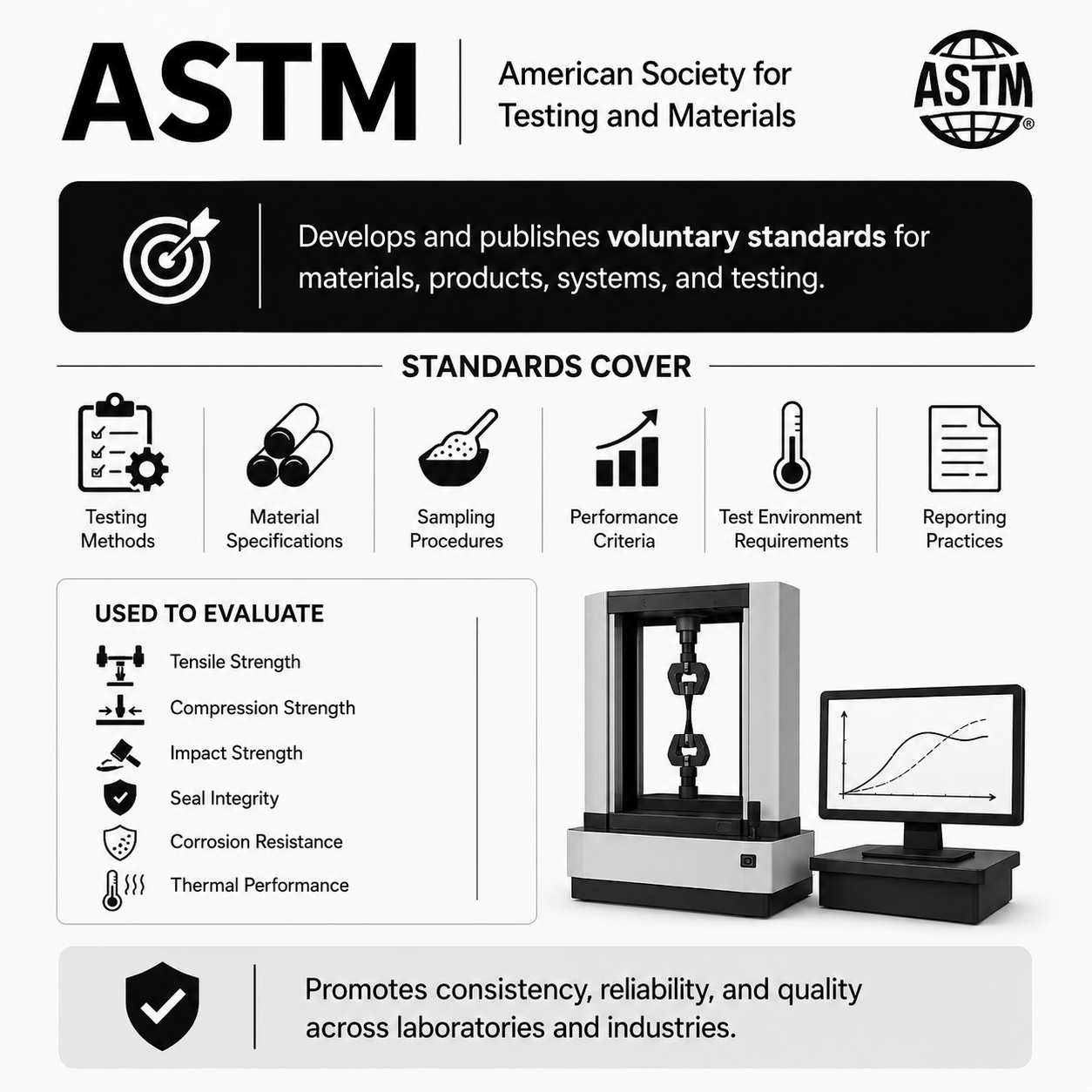
ASTM develops and publishes technical standards for materials, and products, systems and testing procedures. These standards are widely used across industries to ensure consistency in material testing and product evaluation.
An ASTM Standard typically defines:-
- Testing methods
- Material specifications
- Sampling procedures
- Performance criteria
- Test environment requirements
- Reporting practices
For example, ASTM standards are commonly used to determine:-
- Tensile strength of materials
- Compression resistance
- Impact strength
- Seal integrity in packaging
- Corrosion resistance
- Thermal performance
The primary objective of ASTM standards is to ensure that testing methods remain consistent and repeatable across laboratories and manufacturing facilities.
ASME Full Form and Its Industrial Importance
The ASME Full Form is American Society of Mechanical Engineers.
ASME develops engineering codes and standards related to the design, fabrication, installation, inspection, and operation of mechanical systems and equipment.
ASME standards are especially important in industries where safety and pressure handling are critical. These standards are widely followed in:-
- Oil and gas
- Petrochemical plants
- Power generation
- Chemical processing
- HVAC systems
- Pressure vessel manufacturing
- Industrial piping systems
One of the most recognized ASME publications is the ASME Boiler and Pressure Vessel Code (BPVC), which establishes safety requirements for pressure containing equipment.
Unlike ASTM, which primarily focuses on material testing standards, ASME concentrates on engineering safety, operational reliability, and structural integrity.
ASTM vs ASME - Understanding the Key Difference
The discussion around ASTM vs ASME often creates confusion because both standards are used together in many industries. However, their purposes are different.
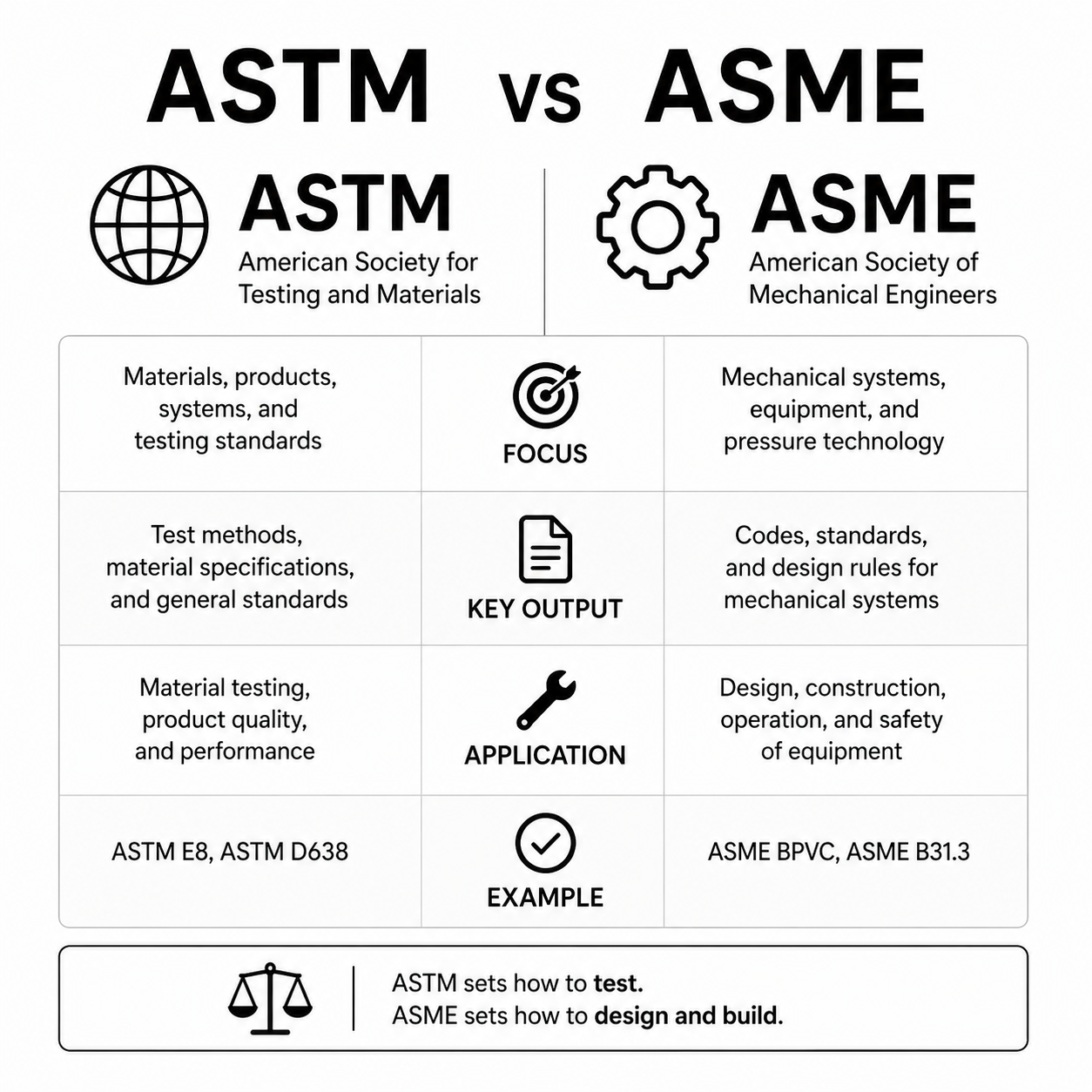
| ASTM Standards | ASME Standards |
| Focus on material testing and specifications | Focus on engineering design and safety |
| Define testing procedures | Define construction and operational codes |
| Used extensively in laboratories and quality testing | Used in mechanical engineering and industrial equipment |
| Evaluate material performance | Ensure safe system operation |
| Common in quality control processes | Common in pressure systems and fabrication |
In practical industrial applications, ASTM and ASME frequently complement each other.
For instance:-
- ASTM standards may specify how a steel material should be tested.
- ASME standards may determine whether that steel is suitable for a pressure vessel operating under specific conditions.
This relationship makes both standards equally important in industrial manufacturing and quality assurance systems.
Why ASTM Standards Matter in Material Testing
Accurate testing is the foundation of reliable manufacturing. Without standardized testing methods, product quality can vary significantly between production batches and testing laboratories.
ASTM standards help manufacturers maintain:-
- Consistent testing procedures
- Reliable test results
- Product uniformity
- Better supplier qualification
- Improved customer confidence
In industries dealing with packaging materials, plastics, metals, rubber, textiles, and construction products, ASTM standards are used daily to validate product quality.
Some common categories of ASTM Standard applications include:
Mechanical Testing
- Tensile testing
- Compression testing
- Flexural testing
- Impact resistance testing
Packaging Material Testing
- Burst strength testing
- Seal strength testing
- Drop testing
- Peel adhesion testing
Chemical Analysis
- Corrosion testing
- Chemical composition analysis
- Contamination checks
Environmental Testing
- Temperature resistance
- Humidity exposure
- UV aging performance
These testing standards are particularly important in industries where product failure can lead to customer complaints, safety concerns, or regulatory issues.
Why ASME Standards Are Essential for Engineering Safety
ASME standards play a major role in ensuring the safe operation of industrial systems.
Mechanical equipment operating under pressure or extreme temperatures requires careful engineering control. Even minor design errors can create serious operational risks.
ASME codes help manufacturers manage:-
- Pressure calculations
- Structural integrity
- Material selection
- Welding procedures
- Inspection methods
- Safety certification
ASME compliance is widely required for:-
- Boilers
- Heat exchangers
- Pressure vessels
- Pipelines
- Industrial reactors
- Mechanical process systems
In industries such as oil & gas or power generation, ASME compliance is often mandatory because equipment failure can result in severe financial and safety consequences.
ASTM ASME Industry Use Across Different Sectors
The practical use of ASTM and ASME standards varies depending on the industry.
Packaging Industry
ASTM standards are heavily used for:-
- Seal strength testing
- Compression testing
- Film testing
- Burst testing
ASME involvement is usually limited unless the facility includes mechanical process systems.
Oil and Gas Industry
- ASTM standards verify raw material quality.
- ASME standards regulate piping systems and pressure equipment.
Construction Industry
- ASTM standards evaluate concrete, steel, and construction materials.
- ASME standards apply to HVAC systems and mechanical infrastructure.
Pharmaceutical Industry
- ASTM standards support packaging validation and material testing.
- ASME standards apply to process piping and sterile systems.
Automotive Manufacturing
- ASTM standards ensure raw material consistency.
- ASME standards support mechanical engineering processes.
Understanding ASTM ASME industry use helps organizations maintain both product quality and operational safety.
Applications of ASTM and ASME Standards in Quality Assurance
ASTM and ASME standards are not just used for compliance paperwork or audit documents. In actual manufacturing work, they play a big role in maintaining product quality, smoother production processes, and better consistency during operations. Most industries rely on these standards almost daily, even if customers never really notice it directly.
- Supplier Qualification:- Manufacturers often use ASTM testing standards to check incoming raw materials and make sure suppliers are maintaining proper quality standards consistently.
- Product Validation:- These testing methods help companies confirm whether a product is performing properly before it goes into the market. This becomes more important in industries where small quality issues can later create bigger problems.
- Process Standardization:- ASME standards help companies follow controlled engineering and fabrication procedures. Specially in mechanical systems and pressure related equipment, proper process control matters a lot.
- Regulatory Compliance:- During audits, inspections and certifications, many industries are expected to follow internationally accepted standards. Without proper compliance, approvals can easily get delayed.
- Export Quality Requirements:- Global buyers also ask for ASTM or ASME compliance reports before approving suppliers or placing larger orders in many cases.
A strong quality assurance system usually depends on how properly these standards are followed during manufacturing, testing, and day to day production activities.
Industrial Standards Comparison: ASTM and ASME Together
When discussing industrial standards comparison, ASTM and ASME should not be viewed as competing systems.
Instead:
- ASTM focuses on testing accuracy and material performance.
- ASME focuses on equipment safety and engineering design.
Many industrial products require both.
For example:
- A pressure vessel may require ASTM-tested steel materials.
- The vessel itself must be designed and fabricated according to ASME codes.
This integration ensures:-
- Reliable materials
- Safe operation
- Better durability
- Lower failure rates
- Improved product quality
The Impact of Standards on Product Quality
The relationship between standards and product quality is direct and measurable.
Properly implemented standards help organizations achieve:-
- Consistent manufacturing quality
- Reduced product rejection rates
- Improved safety performance
- Better customer satisfaction
- Stronger regulatory compliance
On the other hand, poor standard implementation can result in:-
- Inconsistent testing results
- Material failures
- Equipment breakdowns
- Product recalls
- Audit failures
This is why quality assurance in manufacturing depends heavily on recognized standards and controlled testing systems.
Choosing the Right Standard for Your Industry
Selecting the correct standard depends on several factors, including:-
- Product type
- Industry requirements
- Customer specifications
- Regulatory obligations
- Operational risks
Organizations involved in material testing should be prioritize ASTM standards, while industries dealing with pressure systems and mechanical equipment should focus strongly on ASME compliance.
In many cases both standards are necessary to achieve complete product and operational reliability.
Final Thoughts
Understanding ASTM vs ASME is really about understanding where each standard fits inside industrial work. ASTM standards help manufacturers test materials properly and maintain consistency in product evaluation. ASME standards are more connected with engineering safety, mechanical reliability, and how equipment performs under real operating conditions.
Both standards support important areas like:-
- product consistency,
- safer industrial operations,
- stronger quality assurance systems,
- controlled manufacturing processes,
- and regulatory compliance.
In many industries, you cannot rely on only one. Material quality without proper engineering control can still create failures. On the other hand, even well-designed equipment becomes risky if the material testing is poor. That balance matters.
For companies involved in packaging, material testing, industrial manufacturing, or engineering systems, following the right standards helps avoid long-term quality issues and unnecessary operational risks. And honestly, fixing quality problems after production always costs more than controlling them from the beginning.
Businesses looking to improve testing accuracy and product quality often work with experienced testing solution providers like Presto Group, especially when reliable material testing and quality control become part of daily operations instead of just audit preparation.
Recent Articles
- Climatic Chamber: Working Principle, Uses, Diagram, Price & Top Manufacturers in India
- Izod vs Charpy Impact Test: Difference, Method & Standards
- Colorimeter vs Spectrophotometer: Accuracy, Working Principle, and Industrial Uses
- Quality Assurance and Quality Control: Two Pillars of Product Excellence
- Hardness Test: Types, Testing Methods, Procedures, and ASTM Standards
Need more information
Connect with us for your business enquiries. Generally, we respond within one or two working days.

.png)